rovik. reads: ambani & sons
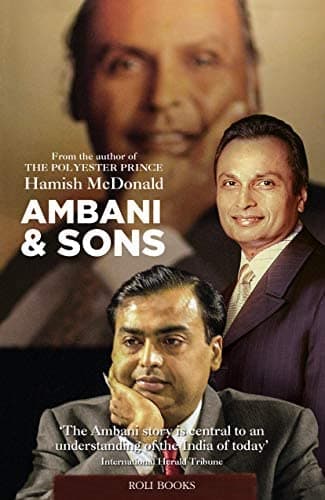
Mukesh Ambani is the richest man in Asia and if you have not heard of him or Reliance Industries, you may be sleeping on one of the biggest industrial giants in the world. Someone passed me this book a while ago and since I was clearing my backlog, I decided to explore this hard-hitting biography of both Dhirubhai Ambani, founder of the conglomerate, as well as his sons. Interwoven with political intrigue, business lessons and family drama, Hamish McDonald paints a revealing picture of the Reliance group of companies.

I am willing to salaam anyone. One thing you won’t find in me and that is ego.
Dhirubai Ambani
Dhirubhai reminds me of a classic cowboy businessman. Coming up in the days of the License Raj, he was incentivised to find ways to navigate the system while creating value for himself and those around him. His success is objectively impressive, owing to his relationship-driven business style and his acumen for financial engineering. He was willing to collaborate with and incentivise anyone who could advance his goals. Dhirubhai managed to show India what was possible if you were ready to work the system.
Anil later recalled that Dhirubhai’s personal physician, a Dr Pandey, had predicted the morning of that Saturday that his patient would choose such a day to die. “Sir planning mein chaltey hain na?” Pandey said. “Sir jayenge to Saturday raat ko hi jayenge” (Sir plans before he does anything? If Sir goes, then he will go on Saturday night.) If he goes on a Saturday night, it will be after a day’s work. The funeral will be on Sunday. As that’s a holiday, there will be no office, people can attend, there will be no traffic for the funeral site. It will be over by evening and on Monday worning, everyone can get back to work.” Dhirubhai indeed died later that day, shortly before midnight.
Hamish McDonald
McDonald spends a large chunk of the book describing the Reliance business and a lot of it is very interesting (although some of it can get tedious). It is clear that McDonald is critical of the Reliance conglomerate, especially in its influence of public policy and its treatment of shareholders, and as with most big businesses, it is probably a good stance to take. Perhaps most unique to Reliance’s capital structure is the fact that it has an incredible base of shareholders that are made up of low to middle-income workers. The company is closely intertwined with the livelihoods of the everyday Indian. For me, I was most drawn to the stories of Dhirubhai as a businessman and how he consistently prioritised himself as an executive first, even in his family life. Even now, it is nearly impossible to distinguish the Ambanis from the Reliance business.
While India needs entrepreneurs like Mukesh Ambani, it also needs a much stronger state to apply rules against any abuse of market power. Businessmen will do what they can get away with, and the Relaince model shows a strong appreciation of the benefits of monopoly. A strong state would devote more resources to relevant and updated policies, better revenue collection and accountability and effective policing of rules, rather than persisting with so much effort in micro-managing affairs. It would strengthen its bureaucracy, not with greater powers but with better resources, education and disciipline so as to be truly the steel framework that Nehru envisaged, or the rule-keepers prescribed by Hayek.
Hamish McDonald
Lots have happened since Dhirubhai passed. Mukesh Ambani, the eldest son, continued introducing new capital-intensive verticals into the business, such as in telecommunications and biotech. Anil Ambani, the second son, manages a carved-out entity that allows both competition and distance for the brothers. Yet, as McDonald describes, it is not clear that Reliance’s reputation has been completely reformed especially as it continues getting profiled in the news. Regardless, it is clear that the Reliance story is far from being over and it is an important company to watch in Asia. How far will it expand beyond India, and how much of an influence will it have on the emerging economies in the rest of the region? These are questions I am curious about.
Here are my overall ratings:
Readability: 3/5
Intellectual Stimulation: 3/5
Perspective Shifting Capability: 4/5