rovik. reads: the billionaire raj
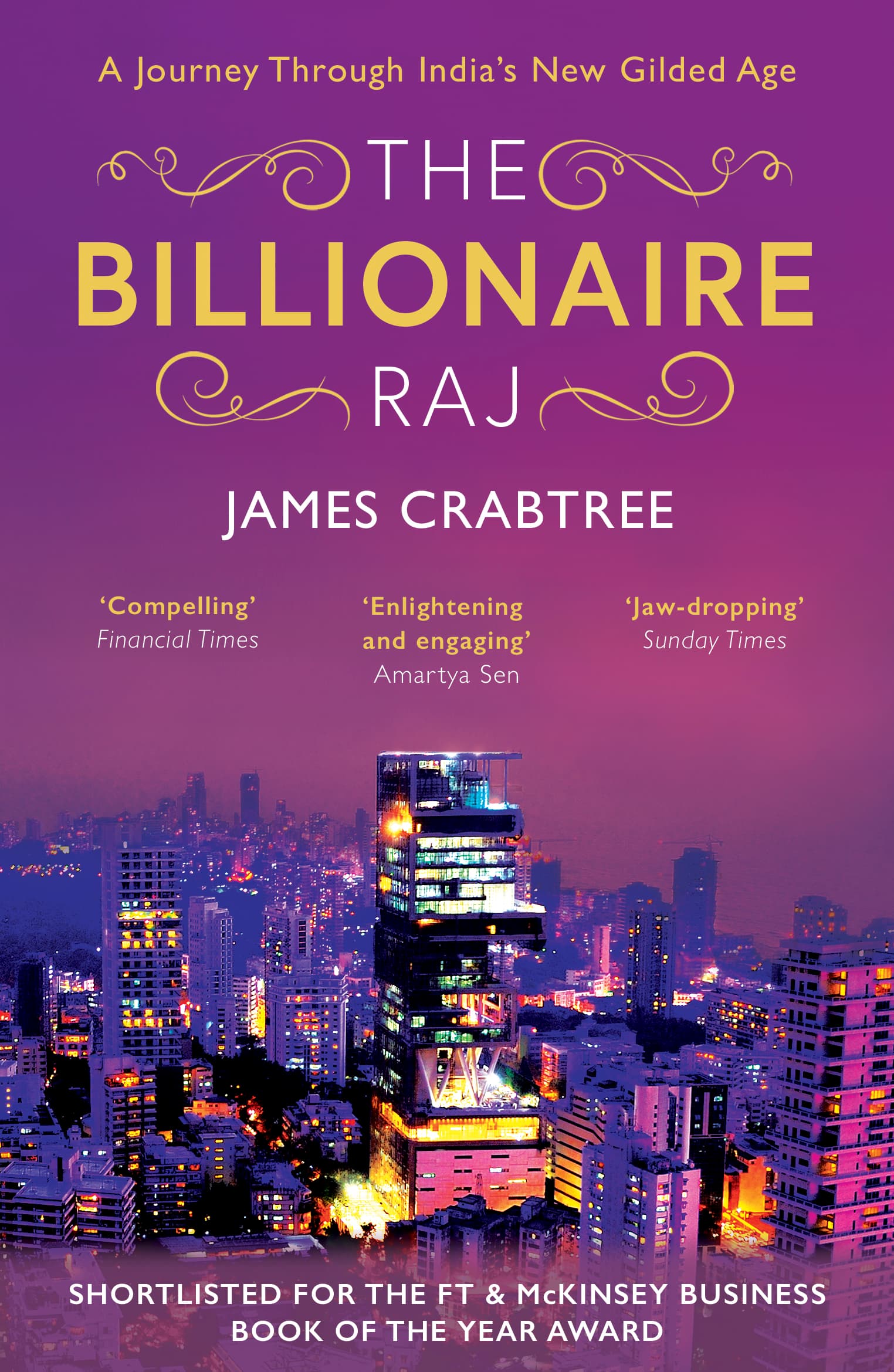
I’ve been increasingly fascinated with India as an economic and political model, together with other Asian countries such as China and Japan, but I had always felt overwhelmed by the sheer volume of personalities and events that have come to define the country and society. Having known James from a number of engagements at Straits Clan, I was keen to read his analysis on the India we know today and I was very pleasantly treated to an entertaining yet deep cutting look at India’s transitioning into and out of its “Gilded Age” where money, Modi and media have changed the face of the country.
Rather than fearing the world, India has embraced it. Yet for all their benefits, these decades of whirlwind growth have proved to be economically disruptive, socially bruising and environmentally destructive, leaving in their wake what novelist Rana Dasgupta has described as a sense of national “trauma”. Those benefits would have also undeniably been shared unevenly with, with the greatest portion of India’s new prosperity flowing to its top one per cent, or more specifically the top fraction of that one per cent. … For the best part of the half century after 1947, there followed the License Raj with its perverse edicts and myriad restrictions. Now in the quarter century after liberalization and set against the backdrop of a world in flux, a new system has grown up in their place: the Billionaire Raj.
James Crabtree
I recall learning about the BRIC economies when I was around 14, and even then I was told that India was the favorite of the group because of its combination of democracy and sizeable industry. What was left unsaid was that India was removing some of its self-imposed shackles of the License Raj, a time where permits were needed for everything and your ability to grease the wheels was a strong indicator of your ability to get ahead in the system. Liberalization in the last couple of decades have been a major cause for the rise of the wealth in the country, but even then the manner in which liberalization occurred and in which some features of the License Raj remained, caused an extreme skew in how wealth was accrued. The story of India’s rise therefore is not complete if we do not acknowledge the innate inequalities entrenched in the process.
Corruption plagues developing countries, not because their people are immoral but because it is often useful. At its best, graft can oil the wheels of progress, as political leaders gift economic rents to favored businesses, which is what happened in the ‘developmental states’ of east Asia. The proceeds of corruption can also bind together otherwise unstable social groups, as Samuel Huntington described in Political Order in Changing Societies.
James Crabtree
One of my favorite insights was on the role and “usefulness” of corruption in developing economies like India. I personally have always resented how casual talk about corruption was in India, especially when I remember I have family there. But I also recall that in my class on business ethics in the LSE, I had read an intriguing philosophical piece arguing that corruption was arguably ethical, especially if it was understood that the role of certain offices was to benefit the office-holder as well. These are implicit and socially constructed, but nonetheless real. I couldn’t find the exact paper I had read but I found a close comparison here. James explores this perspective in the context of India, in showing how ironically it was in the Southern states of India where corruption was encouraged towards economic development that we saw the largest transformations within the economy. Of course, I am glad to be in a country that abhors corruption because the social contract here is biased towards separation of public offices and private individuals, but this helps me understand how India works.
Modi’s victory in 2014 had rebuffed the notion that India itself had grown ungovernable, as if its turbulent democracy had become such a drag on its economy that it could not follow China’s rapid process of development. For all of its economic vitality since 1991, India’s political system had grown noticeably weaker. The authority of both the Congress and BJP had ebbed, stolen away by more vital regional rivals, while wobbly coalition governments in New Delhi took on the air of a permanent constitutional feature. Modi’s victory, with its stunning an unexpected scale, reversed all this and brought new power coursing back into the national capital.
James Crabtree
Finally, perhaps the takeaway that mattered the most was James’ reflections on the significance of Modi to India. As much as he’s a polarizing character, he has also been attributed for one of the steepest drops in explicit corruption that came to define India’s “Gilded Age”. Modi, while morally suspect in a lot of ways, is politically masterful and arguably consistent on most issues. The economic lens will flatter Modi’s time in power but his reputation on racial and humans rights issues will definitely shock the unaware. What Modi means to India is still a work in progress, but the book argues that it could signal a progressive era where a counter-movement builds off the economic momentum to introduce stronger protections and freedoms for its citizens. Whether this actually happens is something to monitor, but it seems like James is cautiously optimistic.
All in all, I really enjoyed reading The Billionaire Raj. If you’re at all curious about how India has developed in the last couple of decades, this is the book to read.
Here are my ratings:
Readability: 5/5
Intellectual Stimulation: 4/5
Perspective Shifting Capability: 4/5