what you should know about auschwitz
I’ll be honest, a big reason why I’m writing this is to help me process my visit to Auschwitz yesterday. Despite all the preparation I did, watching documentaries, reading books and talking to friends who have been there, I was still completely overwhelmed by the experience, leaving with so many questions and thoughts. While I will provide some guidance on how to approach Auschwitz with a prepared mind and soul, I will also use this as an opportunity to discuss how travel is not and should not be seen as an always joyous experience.
Why you should go to Auschwitz
If you are still deciding whether you should go to Auschwitz, let me be the first to say that I can understand your hesitation. Whether it be because you are wondering if Krakow itself is worth it or if it will take away from your holiday, let me put the matter to rest by saying that Auschwitz will impact your life significantly. It could be due to differing reasons from person to person, but Auschwitz is probably the single horrific example of man’s industrial killing of its own species. We cannot have a conversation on humanity, on peace or even on war without accepting and understanding what happened at Auschwitz.
There are many points in my life where my perspective on the world shifted and Auschwitz is definitely one of them. Poland isn’t just Auschwitz, far from it, but it is worth the visit even if just for Auschwitz.
What to expect

You are allowed to visit Auschwitz mostly for free unless you sign yourself up for either an internally organized or external tour. I strongly recommend these tours (the internal ones) because the guide is often well educated on Auschwitz and has dedicated their life to the issues and themes surrounding it.
The tour starts at the Arbeit Macht Frei gate, a tragically ironic gate that translates to ‘Work makes (you) free’. It is the beginning of a journey that becomes painful not only because of the horrors inside, but the duplicity of it all.

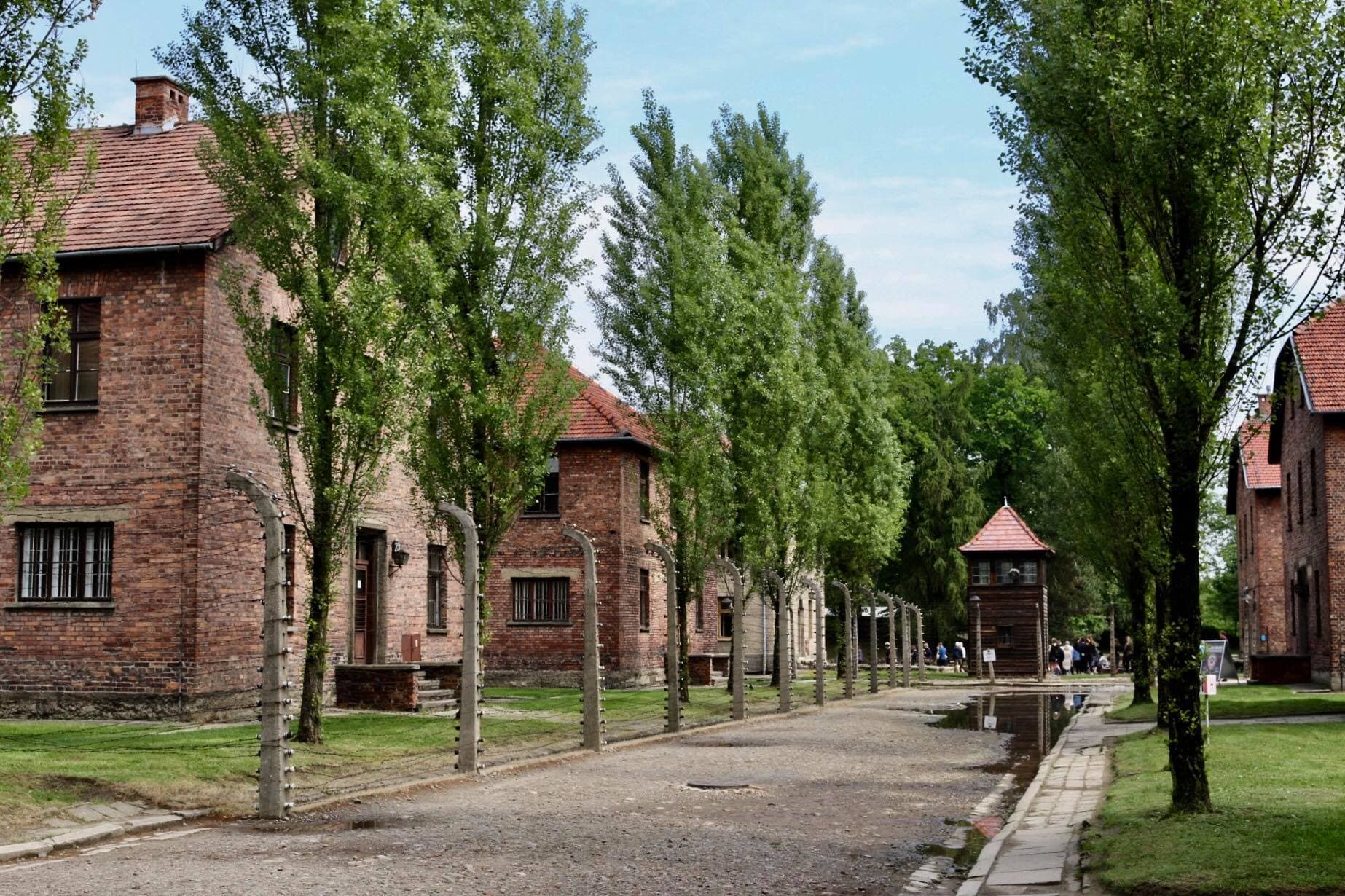
The Auschwitz complex is made up of actually three camps, the first of which is known directly as Auschwitz and is the main entry point. It used to be a Polish army barracks but was converted to concentration camps for the Nazis.

The museum was started a mere two years after the liberation by former occupants of the concentration camps. The desire to inform the world of the horrors was the immediate motivation behind the museum and that comes strongly across, both in the preservation of the camp as it was and in the message of the guides – ‘Grapple with this reality. Take it away and remember that this happened.’. You walk around the camp and you can see how constricting the whole complex is.

The experience starts simple enough with some background information on the deportation of Jews and Slavs by the Nazis, and documentation proving the events. It reminds me of the Holocaust deniers who ignorantly shoot down any notion that these concentration camps even existed. You look at all the proof and you can’t help but believe otherwise.


It doesn’t take long for the experience to start making your stomach curl. My guide long-sufferingly goes through the details and process of how the occupants were stripped and lied to before being killed, a majority of them on arrival. She then goes on to show us rooms filled with actual items found during the liberation, tons of shoes (including baby shoes) and belongings just thrown in a heap, without a care for the people they belonged to. There is a room with tapestry made out of the hair of the victims. It is at this point where I find myself needing fresh air, where empathy with the helplessness within these walls drive you into a sinking place.

There is also a prison where the prisoners were kept for rebelling against the guards. Mass shootings would happen regularly, and prisoners lived in horrendous conditions, the mere witnessing of drives you sick.

Some of the key elements the guard point you to is how even within the camp, amongst occupants and guards, there was a coordinated effort to create a veil of ignorance. Windows were blinded, occupants were partitioned and people were turned on each other simply to decrease the chances of people finding out what was happening. It is this fact that has made me miserable the past few days, that the people involved were so wicked they knew they were doing wrong (as opposed to being convicted they were right) and went ahead with it.

Of course, if you’ve done your research on the concentration camps, you would have also read about Dr Mengel, the Angel of Death, who operated on all sorts of prisoners, especially twins. This is another horrifying fact, that hospitals were not destinations of rescue in the camp but rather sites of horrible experimentation and torture. It reminds us again of the need of virtues and ethics, especially in professions such as medicine.


Possibly the most stomach-wrenching room was the crematorium, where the Nazis first experimented with using gas chambers to mass execute prisoners and then cremate them. This is the site of the industrial killing, the dearth of human sense, where it was rationalized that the taking of life could be mechanized.

From Auschwitz I, you can take the shuttle bus or the three-hour reflective walk to Birkenau (or Auschwitz II). This is the much larger complex meant for the Nazis to continue their operations at a larger scale. Prisoners were sent by rail here and disembarked for mass execution. These rails basically were the sign that their end was not that far away.

The camp is bleak and expansive, built for the very purpose of mass holding and execution. Able-bodied prisoners were used as slave labour in horrible living and working conditions, while the rest were killed. You will find many incomplete buildings, left behind because the Liberation was soon.
Reflecting on Auschwitz

I will admit that there’s a horrifying similarity with Auschwitz as it is and the decay aesthetic that is fetishized by millennials today. Overgrown grass and brick buildings normally remind me of times past that are associated with a more positive nostalgia. But here I am reminded that not all of the past was good. Not all of the past is celebratory. Not all of humanity has been good and not all of what we identify with can be progressive.
The acts committed within the camp frustrate me already, but it is knowing that these things happened and the world went on by for at least three years without intervening that sickened me. It is similar to what we hear about in Syria and North Korea today, with mass starvations and chemical attacks, and I wonder how I am supposed to respond today. I am implicated today just as anyone, my grandparents and great-grandparents included, were implicated in letting the Holocaust happen. I can’t let myself close my blinders.
It is also important as a traveler to recognize that as witnesses to the world, that we must learn from both grand beauty and grand tragedy. We cannot run away from the fact that travel involves us in the cultures of the lands we visit, and we must develop empathy and understanding with these themes.
I have always believed in the better side of humanity, but Auschwitz has seriously struck a blow, not because I don’t believe humans can’t do good, but because I must remember that we have committed a grave wrong. I’ve seen the cotton plantations in the southern states where slavery occurred, the Cambodian killing fields and a number of other scenes of absolute human horror and I struggle with the knowledge that we have erred so many times in such different parts of the world.
We must focus on the lessons, I understand. We must build ourselves up, from the rubble and the ruin. But it pains me that more than three million people had to die for us to have this lesson.
A Note on Taking Photos
As an amateur photographer, I debated a lot on this topic. I don’t take photos as much anymore simply for likes or shares, but more as a way to communicate my experience to the world. Auschwitz stood as an important experience to communicate, but I knew I had to strongly contextualize and communicate my intention. I wanted people who may never have the chance to visit Auschwitz for whatever reason to still go through the same journey I was going through. It is with that intention that I took photos, but I ensured that the camp and the stories in it took centre stage.
I personally think no one should take photos of Auschwitz with themselves in it because then you are centred instead of the camp and its stories. You distract from the message. The only exception I’ve ethically allowed for is if your relative was involved with the camp, in which case I can logically understand the personal relationship that is made with the camp.
Logistical Matters
Reaching the camp is best done from Krakow. You can take a train but I recommend the bus which leaves from the Krakow Bus Station nearly every half hour. Bus rides take 1.5 hours each way and cost less than 15 PLN. The bus stop back to Krakow is from the Auschwitz Car Park.
The camp has strict hours for visiting the camp without a guide so make sure you go to their website beforehand. If you want to get a guide, they have time slots online that you should book ahead for especially if you want an English tour.
There is a lot of walking involved at the camp and you are allowed to stay in as long as you want once you have your ticket. There are a number of cafes, bookshops, snack kiosks and one restaurant on the campus if you need them.
___
I’m personally still struggling with a lot of the complex themes that have been brought up by this visit. But I think that’s the point – recognizing that life and history are not simple and that we must daily fight evil such as this.
George Santayana’s quote can be found in the camp but its meaning sticks with me strongly now after the visit. It’s a good reminder of what all of this is about.
“Those who cannot remember the past are condemned to repeat it.”