the mystery of malta
After Marrakesh, I had visited my main hitlist of cities from London. Rather than sit quiet, however, I decided to pull out my list of underrated destinations to see if I can explore some of them before they get caught in the tourist cycle. Malta stood out as a unique destination, sitting in the Mediterranean, having both North African and Italian influences from its proximity to the regions as well as British and some French influences from its colonial history. How does a country that is so small deal with that much exposure? That was a question I was curious to answer, both as a Singaporean with similar histories and as a traveller with itchy feet.
Malta is made up of three main islands: the Malta main island, Comino and Gozo. Each of these islands, although small, are filled with numerous cities and have so much to offer. You can definitely explore the whole country easily though, and it simply takes some planning and orientation. Most people who come to the country do so on a cruise and so they only spend time in the capital city of Valletta.
Valletta


Valletta is the capital of Malta and a walled city on the eastern edge of the island. Built by the Knights Hospitalier of the Order of St John, the city was part of the building up of the country after having been a gift from the King of Spain to the Knights. You’ll come to realize how intertwined the Knights are with Malta as you explore the country. Entering the city is best done from the Valletta Bus Terminus, near the Triton Fountain.


Valletta is a very walkable city, but if you were to stop at any attraction, it would have to be at the St John Co-Cathedral. Initially built in the 1500s by the Knights Hospitalier, the exterior of the church is a Mannerist style building with not too much it. Pay the ticket price and enter though because you will be bombarded with high art and plenty of gold fixtures as you revel in the Baroque style of Mattia Pretti. The extremely ornate interior is the star of the museum and you can trace both the history of the Knights as well as the story of St John the Baptist, patron saint of the order, within the museum. There are a number of famous paintings as well as decorated tombstones and walls for you to spend time admiring. You can find the famous Beheading of St John the Baptist painting by Caravaggio in the oratory here as well.


Another iconic saint for Malta is Saint Paul, one of the biblical heavyweights. Apparently, he was shipwrecked here in Malta, which explains a number of other monuments in the country. At the St Paul Shipwreck Church, you can see murals depicting the story as well as a remnant of St Paul’s wristbone, encased in a golden sleeve.


The Parliament and President’s Palace of Malta is found in Valletta, and you can observe the guards conduct their ceremonies from the St George’s Square in the city. What’s more interesting in my opinion is the plentitude of open spaces to grab a snack and drink around the Palace, especially at the Grandmaster’s Palace courtyard as well as in front of the National Library.


One of the other key attractions in the city are the city gardens. The Lower and Upper Barrakka gardens are both extremely beautiful and provide great waterfront views from the city. Built to offer recreation for the Knights, the gardens now are normally filled with tourists who come for a walk or to read a book. In the upper gardens, you can even buy a beer and some pastries from the cafe as you enjoy the view towards the Three Cities. Make sure you plan your visit to catch the firing of the Saluting Battery from the Upper Gardens, a customary tradition now mainly done for tourism purposes.


Make sure you take the time to walk along the Valletta Coastline. On the northern front, you will see Sliema, a very residential city, but on the southern fronts, you will see the grand cityscapes of the Three Cities. These are all fortified cities and are known for being the oldest cities in Malta. The best view spots, in addition to the Gardens above, are the Siege Bell Memorial and the National War Museum.

Valletta as a city is meant to be walked around. I don’t think I’ve seen many other European countries with quite the charm as Maltese ones, and even if so, none with as unique a historical story as Malta. You can easily get lost in the populated side streets here, especially as they do go downhill outwards from the centre. Then again, that’s what you want.
Three Cities: Birgu

From Valletta, I highly recommend taking a ‘traditional boat’ ride to Birgu. Known also by its Italian name of Vittoriosa, this is one of the oldest cities in Malta, even being occupied by the Phoenicians. It used to have Valletta’s strategic importance of protecting the Grand Harbour, but now just is home to a number of churches and residential spaces. The boat ride costs only 3 Euros and is a short 5-10 minute ride across the Harbour. It is a bit bumpy and the boat isn’t that stable, so don’t get on if you easily get freaked out.


Within Birgu, there’s not an extreme lot to do. You can walk around the old neighbourhood streets where you will definitely feel the age of the city speak to you. Don’t get too lost though, street signs are pretty unhelpful here. If you want specific places to drop by, the St Lawrence Church and Fort St Angelo are notable historic sites.

Make sure to keep your eye out for some old-school storefronts and entrances. These are especially common in the Three Cities. Once you are across the harbour, you can try to explore Senglea and Cospicua, the other cities, but they don’t have as many things to see.
Marsaxlokk


Not too far away from Valletta is Marsaxlokk, a port city in Malta. This is a small city with not too much to do, but on Sundays, the city becomes a large market with fresh produce, lots of souvenir shops and extremely fresh seafood. You can find octopi and langoustines alongside local fish here. Make sure you get a photo of the iconic port, where Maltese-style coloured boats occupy the harbour.
Exploring the Malta Island

Unsurprisingly, a lot of Malta’s beauty is not just in its cities. You have to take the bus out to the western side of the island for some of the best attractions in Malta. The Blue Grotto is one of these, a naturally formed sea cave which can be explored by boat. The water has shades of emerald, a good reminder that Maltese waters are pristinely kept.


Not too far from the Grotto is one of Malta’s most important historical sites – the Hagar Qim and Mnjara Temples. These are reputed to be the world’s oldest free-standing stone structures and for an affordable price, not only can you get to visit these still active excavation sites, you can also learn about the history of these prehistoric structures. Experts can’t agree on which ancient civilization built these structures, only accepting that the people came from Neolithic times. It’s quite an astonishing exploration as you see how these temples, aged to 3200 BC, were built.
If you find this complex cool, make sure to make a booking for the Hypogeum, another one of Malta’s ancient historic sites. They only let in around 20 people every day for conservation reasons and tickets sell out a month in advance. We couldn’t make it for that reason, but don’t make the same mistake we did. Malta is home to some of the world’s oldest historic sites and it is crazy to see the active excavation work happening all over the island in that regard.
Mdina/Rabat

Mdina is Malta’s oldest city, aged to 8th Century BC, and is reputed to be built in the time of the Phoenicians. Entering the fortified city through the still intact Mdina Gate, makes you feel like you’re walking back in time to this prehistoric city. Mdina used to be Malta’s capital and main city, and is now simply known as the Silent City due to the restriction of motorized vehicles within the walls.


The city itself is made up of many small squares and lots of quiet streets to explore. It’s very well maintained and you can find some truly beautiful areas just for yourself. One of the more iconic sites within the city is the Mdina Cathedral, Malta’s oldest church with striking internal and external architectural styles. Make sure to grab a meal at one of the many restaurants within the city, filled with great terraces and even subterranean caves.


Outside of the fortified city is Rabat, a more populous and slightly more bustling city than Mdina. Rabat doesn’t have much to do compared to other Maltese cities but it is home to the Parish Church of St Paul, the other seat of the bishop in Malta. This church is where the Pope declared Malta to be religiously significant for hosting St Paul during his shipwreck and is also home to the Catacombs, an ancient Roman burial complex.
Gozo

Once you’ve seen the lot in the Maltese main island, make sure you plan the escape to Gozo, an island with a lot fewer people and locals who value a stronger balance between nature and civilization. Return ferries cost less than 5 Euros ad the views along the way are pretty.

The capital of Gozo is Victoria, a small city with many historic buildings and the most life in the island. There are a number of ways to walk around the city but all of them will bring you past a number of churches, squares and plazas that continue to interest you.


The star attraction in the city is the Citadel, also home to the Gozo Cathedral. Built by the Romans, the citadel towers above the city and is a winding complex of quiet streets and prominent terraces. The Cathedral was built later over the Roman Temple of Juno and continues to be a significantly beautiful part of the city. I had the fortune of visiting the citadel at night with our Couchsurfing Host (the citadel itself doesn’t close, but the cathedral does) so I tried my night photography, the results of which indicate I have a lot more room for improvement.


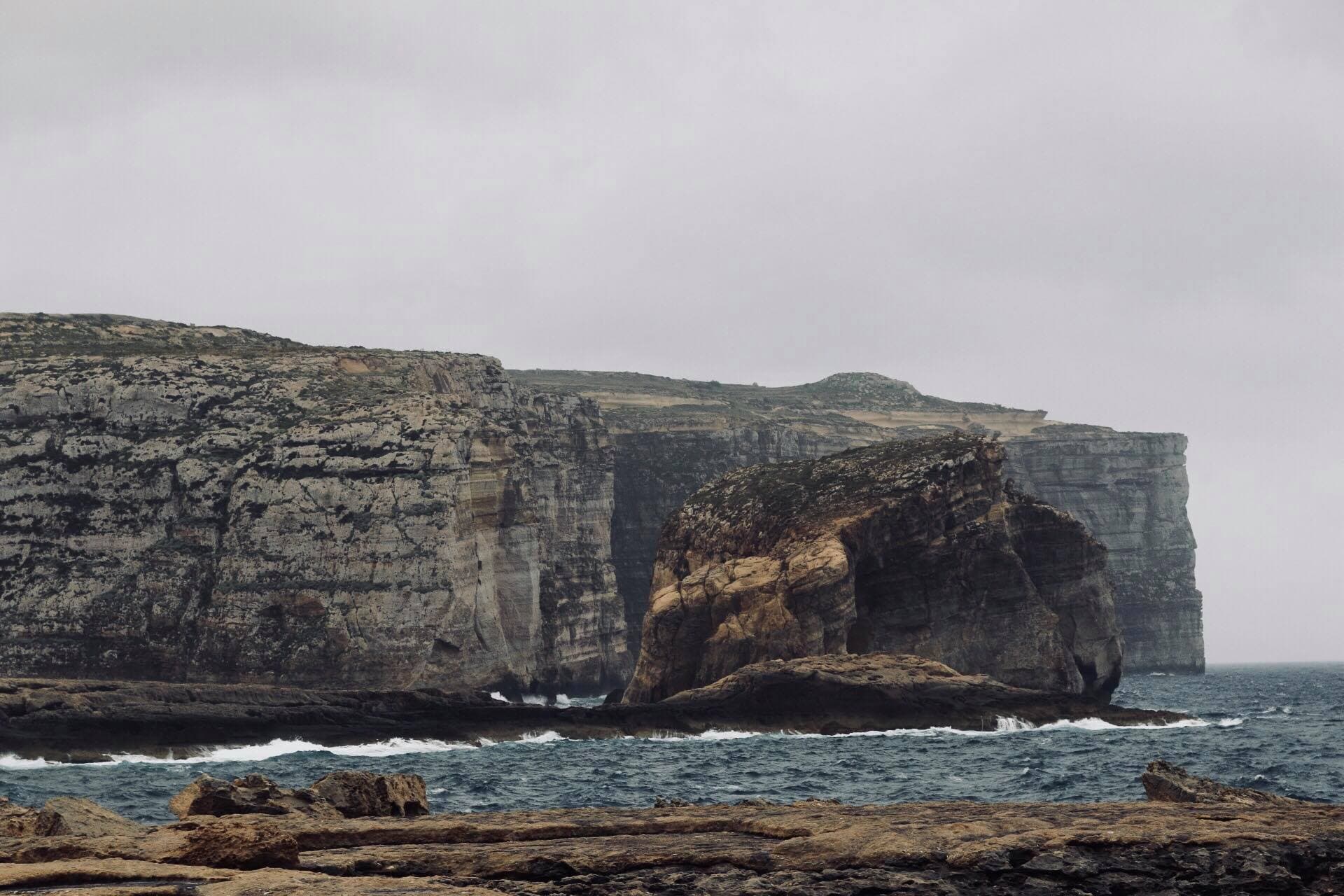
In the tourist pamphlets for Malta, you may have come across pictures of the iconic Azure Window, a rock formation that was popularized by Game of Thrones. Unfortunately, that rock formation crumbled into the sea due to the damage from tourist overexposure, but the Dwerja area is still naturally monumental. The rough seascape compels you to listen to the surroundings and you can really get overwhelmed by the ferocity of nature here. If you want to do more exploring, the Inland Sea is nearby for diving and boat trips.


While out of the way, the Ta’ Cenc Cliffs are another of the many examples of Gozo’s natural beauty. You’ll have to stop in a rural part of the island and walk out through short shrubbery to this breathtaking cliff area but it’ll be worth it. You also get a great view of the Sannat Church from near the cliff.


Finally, if you’ve been looking for beaches in Malta, you’ll be very pleasantly surprised. There are a number of accessible beaches on the Northern coast of Malta as well as parts of Comino and Gozo. I especially liked the Ramla Bay Beach in Gozo because of the path you can take from the elevation nearby through these hidden caves. It is rumoured that one of these caves is where Calypso detained Odysseus in the famous myth, but the Tal-Mixta Cave is a lot more accessible and a lot less touristy.
Worth Spotting


There is a lot to see in Malta but you can’t get enough of the iconic Maltese doors. Almost every door in Malta has unique ornamental door handles and sometimes interesting colours. If you ever find yourself in a boring part of the islands (quite impossible), the doors will keep you occupied. I found some pretty fun ones, including dragons and ancient faces.

I don’t normally pay that much attention to the flora in a country, but Malta’s Mediterranean climate allows its cacti to take front and centre around the island. This leads to a uniquely Maltese habit of Cacti graffiti around the islands, some of which are really fun.
You must now be asking- this seems like a lot of exploring, how should I be fuelling myself. Well, in that case, it’s time for the food section of the post.
Food

Malta’s national dish is the stewed rabbit. Normally stewed in a red wine sauce, the rabbit is cooked till the meat is juicy and falls off the bone. Served with roast vegetables, this dish comes off as a pretty standard European dish but the gamey rabbit definitely makes for an interesting meal. Most traditional restaurants will serve this on the menu but I had it Coogi’s Restaurant in ancient Mdina for some great views while I ate.

Another popular Maltese dish is ftira, but it comes in two forms. On the main island, it’s a ring-shaped sandwich that is known to be a great filling meal but on Gozo, it is a stuffed pizza that is sinfully good. I had mine at Maxokk Bakery, a small hole in the wall bakery in Gozo, where for 7 Euros, I had a ftira stuffed with local ricotta, Maltese sausage and egg that lasted me nearly three meals. It was amazing.


They say in Malta, you’ll try one pastizzi and you’ll never stop after. It was quite true. These are iconic pastries found around the island at bakeries, going for only 30 cents per pastizzi. Filled with mostly either local ricotta or peas and sometimes with chicken, these sinful packets are addictive because of their buttery exterior and delicious fillings. The best ones I had by far were at Crystal Palace in Rabat, alongside some local milk tea. Beware, two will fill you up easily.


If you are on an island, seafood must be on the menu. I was craving good Mediterranean style seafood and I got my fix at Porticello, a notorious (quite really, it has some ties with the Sicilian mob which I didn’t know till after) spot on the Valletta coast, that dishes out great Italian and Mediterranean style food at an affordable cost. For around 50 Euros per person, we got around 8 plates of appetizers and two salt-baked fish between five people. We were definitely stuffed by the end of it. You have your choice of fish, including local swordfish, bream and dolphin fish but we went with the tasty sea bass. I loved the octopus here as well.

For your sweet tooth, you can eat treats stuffed with figs and molasses at many of the markets in Malta. The Italian cannoli has also made its way here as a favourite dessert of the locals.

For something especially local, try to get some honey rings. They are actually filled with treacle but the bakers call them honey rings anyway. These aren’t extremely sweet but are shareable between two people and are quite delicious.

Finally, make sure to get your hands on some Maltese wines. Mostly younger than the other regions, Maltese wine is not exported widely so its easier to get wine in the country. They make their wines from some less common grapes so it’s worth tasting and it pairs surprisingly well with local cuisine as well.
___
Here are some general tips for Malta:
- Malta uses Euros and is pretty cash-oriented except for big restaurants. ATMs are also not that easy to find so make sure you stock up on Euros as you travel around.
- Safety is excellent in the country as there’s not much extreme poverty around.
- Malta is generally made up of either elderly locals or young expats, with a lot of the younger locals emigrated out. It’s quite an interesting juxtaposition while exploring the country but everyone was extremely friendly, with one elderly Maltese man even stopping to wish us a great day exploring his country.
- Malta is moderately affordable with food not costing over 20 Euros for a main dish at a nice restaurant and with most dishes being less than 8 Euros. Of course, it also depends on your proclivity to luxury because Malta can provide for that too.
- While Malta is a city worth driving through, public transport is both extremely reliable and very well connected throughout the country. We managed to see all of the sites, with some minor exceptions, through public transport. A 12-trip pass only cost us 15 Euros for buses around the country.
- English is well spoken around the country, with Maltese being the next largest spoken language.
- The one downside of Malta is that it’s low-budget travelling industry isn’t that well developed, as a lot of its visitors are pensioners who have timeshares in the country. There are no hostels around and Airbnbs are your best shot at getting affordable places. Message me for the specific places I stayed at.

I was very lucky to be able to explore this amazing country with old friend Eddie. Malta is a country that can be explored solo but it is not only easier, but also more fun with friends. I’m glad I got to see this severely underrated destination in my lifetime.