rovik. watches: bojack horseman
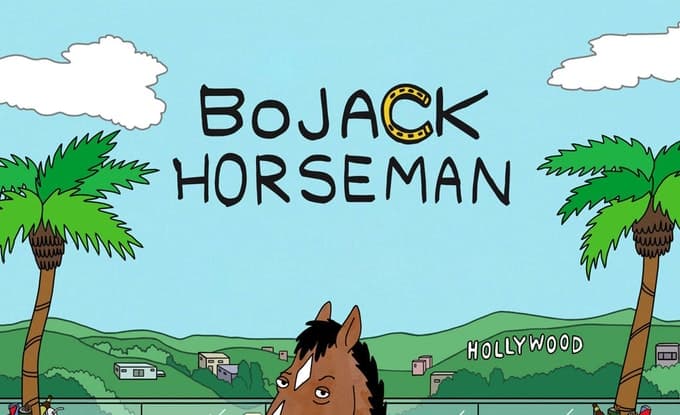
I’ve not written a TV review before, mainly because I can hardly anticipate when they’re truly over. Also if I was to review every TV show I’ve watched, this blog’s constitution may change quite drastically. Bojack Horseman has convinced me to make an exception, and perhaps to start a new thread, on the unique offerings of such quality programming, especially in today’s golden age of television. I have not seen a show that so honestly tackles topics of depression, purpose and contemporary existentialism all while wreaking havoc in true animation fashion across the anthropomorphic universe. Fair warning though, this show is unafraid to bring you through emotional slumps before providing you the necessary respite to confront your own biases towards the universe.
We are introduced to Bojack in Season 1 as a former sitcom star who has been out of work for a long while now, seeking relevance in his Hollywood community without wanting to put in the work again. The Netflix show is initially awkward, with humans and human-acting animals interacting, copulating and engaging in behavior that is foreign to even the viewer. It doesn’t take much before you lean into it, however, recognizing that the animal idiosyncracies only further highlight how un-normal humans are in contrast. What we assume are our simple behaviors are as unique as the tail-chasing frenzy of the dog or the glaring oversight of the resident pigeon. Everything is fair game for introspection… everything.
It’s not about being happy, that is the thing. I’m just trying to get through each day. I can’t keep asking myself ‘Am I happy? ‘ It just makes me more miserable. I don’t know If I believe in it, real lasting happiness, All those perky, well-adjusted people you see in movies and TV shows ? I don’t think they exist.
Four seasons of Bojack follow his attempts to develop the ability to be happy. As a former TV star, the answer initially seems to lie in reclaiming the platform of fame and popularity. Yet, projects like an autobiographical book written by ghostwriter Diane Ngyuen and the feature movie Secretariat only further prove Bojack’s deepest fear that happiness cannot come from the external.
Diane: Most people don’t even get to do The Brady Bunch version of the thing they want to do with their lives. You’re actually in a really good position now, because you can pretty much do anything you want. You’re responsible for your own happiness, you know?
BoJack: Good Lord, that’s depressing.
Diane: No, it’s not.
BoJack: I’m responsible for my own happiness? I can’t even be responsible for my own breakfast!
Yet, if happiness has to come from one’s own management of self, one must then deal with the gaping emptiness of their own existence, that every effort till this point has been in vain simply because there was no understanding of the why and how of life. Regardless of whether Bojack is ready to deal with that understanding, the show pushes through for our benefit and we are relieved from the depressive streaks with moments of pure wisdom, unbiased and lucid without the rancid stench of patronization. The reality is that we must try to be happy and do things that truly make us happy, not in the form of mall splurges or sexual exploits, but in the form of connecting with others and building honest and vulnerable relationships.
…you’re just gonna get older, and harder, and more alone. And you’re gonna do everything you can to fill that hole with friends, and your career, and meaningless sex, but the hole doesn’t get filled. And one day, you’re gonna look around and you’re gonna realise that everybody loves you, but nobody likes you. And that is the loneliest feeling in the world.
It gets easier. But you have to do it every day, that’s the hard part. But it does get easier.
One of my favorite parts of the show is the display of Bojack’s complex relationships with different characters in his life. From the asexual creative generator Todd to best friend Diane to empowered independent woman Princess Carolyn, Bojack’s struggles are frequently imbricated with those of others, creating opportunities for confrontation and accountability. These are elements of living that we require – people who understand that they can exacerbate our situations or play a role in bringing us back on a path towards happiness. People who can call out excessive wallowing or as the show puts it “fetishization of sadness”. These are grey areas, but the only people who are able to walk through those areas with us are real friends.
“You can’t keep doing shitty things then feel bad about yourself like that makes it okay. YOU NEED TO BE BETTER.”
When you look at everything with rose-colored glasses, then red flags just look like flags.
Bojack Horseman is not an easy show to watch, far from it. The comedy comes from the stark juxtaposition of reality as the world would like it and reality from Bojack’s perspective. There is a continuous jumping from the outside to the inside and back again, both in terms of Hollywood’s constant observation and commentary of Bojack’s life as well as the actual internal conversations we become privy to as a viewer. At the heart of it is perhaps the soul of everyone today – lost, seeking and utterly bombarded by the world and its forces. The command to be happy is demanded of us yet we are not in a position to make that journey till we learn to accept where we are. Fans of the existential diatribes of Rick and Morty will love this show, but I’d still recommend small doses.
Is it catharsis to watch such a show? I don’t think so, I do not feel better and frankly, I feel quite worse. But to see an anthropomorphic horse struggle the same struggles I am enduring provides respite and clarity, and in a lot of way’s Bojack’s small successes provide me confidence in continuing to talk about these issues. The animation is top stuff, with great artwork and quality voice casting. It really is a show in a league of its own.