rovik. screens: tiong bahru social club
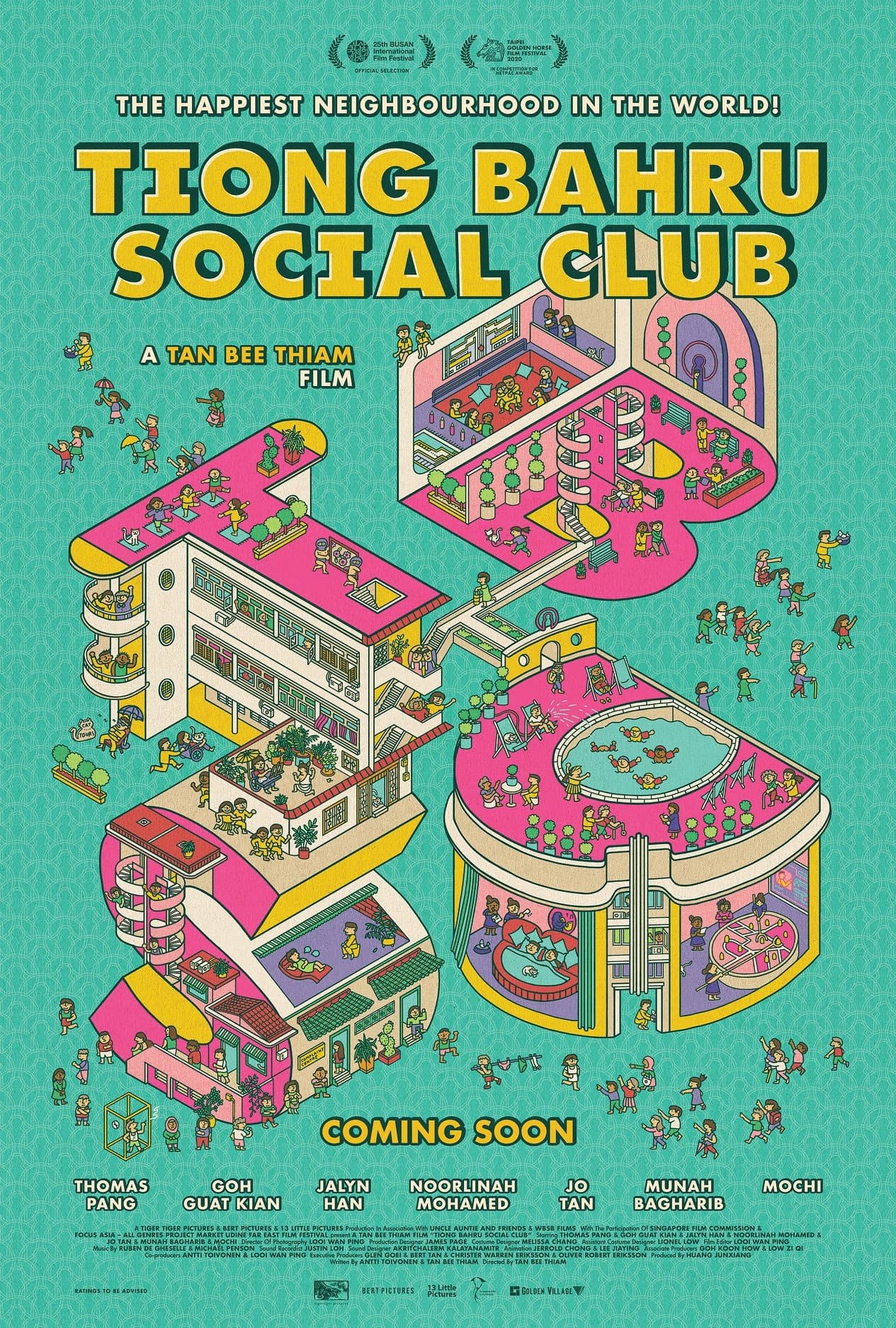
I knew quite immediately that I wanted to watch Tan Bee Thiam’s Tiong Bahru Social Club after watching its Wes Anderson-esque trailer. Resulting from the COVID restrictions, I had the whole cinema practically to myself as I enjoyed this surreally colorful picture. The main plot follows Ah Bee, who leaves his accountant job (where he is forced to accept claims “on a bell curve”) to become a Happiness Agent at the Tiong Bahru Social Club, a retirement village cum investment opportunity where retirees are paired with said agents and data dictates decisions.
The movie has a lot going for it and I found myself getting very triggered by a lot of the parodies of Singaporean life, mostly because I’ve taken issues with a lot of the same topics. For one, the data-fetish around happiness and the almost intrusive behavior of the managers of the Social Club (there’s a scene where they evaluate the coitus of Ah Bee and his allocated partner) reminds me a bit too much of how Singapore policymakers seem to look at topics of dating, procreation and quality of life. Perhaps the irony is that where Tan’s TBSC shows what the abundance of data can do, our actual struggle is with both the dearth and opaqueness of meaningful data.
Many reviews identify that TBSC is not meant to reflect Singapore as it currently is – rather it’s meant to be a cartoonish hyperbole to contrast and juxtapose our current trajectories. Perhaps it’s because I sit within some of the spaces where conversations around quality of life are already happening that I felt like TBSC isn’t actually too far from reality. Ah Bee regularly is asked “Are you happy?” to which he only replies with a painfully forced smile – a reminder that many Singaporeans will ultimately pass on with all the “bread and butter” issues that the government seems obsessed with but without actually being able to articulate if they truly are happy.
TBSC is an ambitious attempt at a retrofuturistic look of Singapore. The cinematography is immaculate and the acting is stellar across the board. If this is a signal that we’re entering into a golden era of Singapore cinema, I’m quite excited. My one gripe with the movie was that the ending seemed a bit flat with the supposed profound realization not actually making much sense in context of the rest of the movie. I left the cinema understanding the broad narrative but dissatisfied with the resolution. Perhaps I’ll need to rewatch it to get it.
All in all, here are my ratings for the movie:
Cinematography: 5/5
Screenwriting: 4/5
Musical Score: 4/5
Acting/ Performance: 5/5
Overall: 4/5