rovik. screens: matrix resurrections
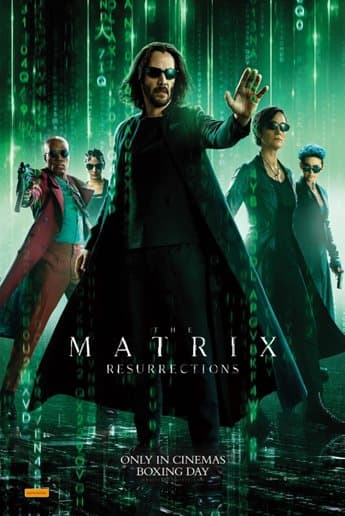
I have rewatched the original Matrix trilogy a couple of times and every time I do, I feel like I understand the philosophy underlying the action a bit more. Matrix Resurrections threw a spanner in a lot of the comfort I took in finally feeling satisfied with my comprehension of Matrix lore, bringing back old characters (albeit with new struggles) and introducing vastly different ones. Likely an attempt at a “resurrection” of the series, Matrix Resurrections sets us up for a journey that is either a lesson in the power of creativity or a reminder that not everything needs a reboot.
There are spoilers below this line:
Matrix Resurrections starts off with a smokescreen – Bugs (a human who is plugged into the Matrix) finds herself in contact with a program version of Morpheus (played not by Laurence Fishburne but instead by younger and more athletic Yahya Abdul-Mateen II). Together, they hypothesise that Neo may still be alive. However, the movie takes a bit of a twist and shows Keanu Reeves as Thomas Anderson, a game developer who created The Matrix as a game series and is now a successful professional who has the classic collection of anxieties and their associated coping mechanisms. There is a good 20-30 minute segment that brings us on a path to believing that Matrix Resurrections is about to be an introspection of why the human mind is so keen to believe a reality where the Matrix could be real.
Of course, Bugs and Morpheus break into Neo’s world and help him realise that he is actually stuck in the recreated Matrix, built by Neil Patrick Harris’ The Analyst, which leverages human desire and emotional turmoil rather than pure math and logic. Trinity too is stuck in a similar state as Neo, with her memories locked away. While The Analyst represents a faction of the Machines that wanted to maintain the old regime in some ways, the Humans also introduce us to a collection of Machines that were inspired by Neo’s act of sacrifice and instead left the Machine world to co-exist with Humans. This too represents a generational shift in the Matrix universe.
The rest of the movie follows Neo, Morpheus and Bugs (and her crew) as they work to free Trinity from the Matrix. There is some dialogue about making a decision between facing the truth and living in blissful ignorance, but eventually, Trinity frees herself and joins the crew. This is where I get very confused because she seems to have more powers than Neo (who frankly just does a lot of freezing bullets), and they eventually claim they are going to remake the Matrix the way they see fit.
I thought there were some good elements in the movie, such as the introduction of Io – the new human refuge that has found a way to incorporate Machines as partners and is actually enabling a better quality of life for its residents. I also thought the Analyst’s shift to use emotional desire and struggle as a basis for reality was intriguing, mostly because it made me question my own reality. But there was a lot of issues with characters and plot lines. For example, Agent Smith’s reprisal was annoying at best and felt completely unnecessary. The most incongruent plotline was how Trinity and Neo claimed they were going to recreate the Matrix how they saw fit, mainly because I felt like the whole rebellion seemed directed at the idea of being controlled by someone other than one’s self. Why would Trinity and Neo be any better a world-builder than the Machines?
All in all, I left Matrix Resurrections rather confused but cheaply entertained. There were some good action sequences and there was some fan service with the characters but the plot development got lazy towards the end and felt underwhelming. Let’s see if they actually do go ahead with a full sequel series – I’ll want to see what they come up with.
Here are my ratings:
Cinematography: 4/5
Screenwriting: 3/5
Musical Score: 3/5
Acting/ Performance: 3/5
Overall: 3.25/5