rovik. reads: winners take all
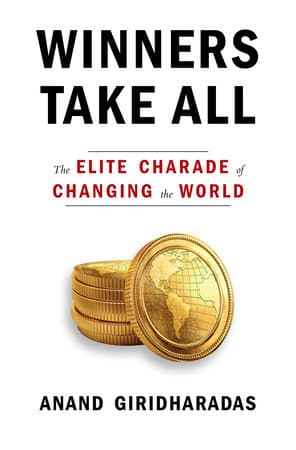
The topic of power is a curious one. We normally engage in conversations around power in domains that seem relevant: politics, business and even religion. But the realm of philanthropy and social good has always escaped scrutiny because of the focus on doing good. Giridharadas upends all of this in his controversial book, Winners Take All, where he spotlights the entrenchment of power and the exacerbation of inequality through the very tools people use to “solve the world’s problems”. If we were ever to question the ethics of doing good by profiteering, this book would be a good starting point for it.
“By refusing to risk its way of life, by rejecting the idea that the powerful might have to sacrifice for the common good, it clings to a set of social arrangements that allow it to monopolize progress and then give symbolic scraps to the forsaken—many of whom wouldn’t need the scraps if the society were working right.”
The thesis of the book is an relentless one. Doing good has been a mission co-opted by the rich and powerful to entrench itself in power while protecting itself from social critique. The institutions and systems that have been set up over the past decade have translated solving problems such as poverty and climate degradation into opportunities for the young and talented to join big banks and corporations as a platform to achieve solutions. The mantra chanted is still one of the growth mindset – earn more, give back more and don’t think too much about the fact that the system you’re part of blocks opportunities from others.
“Yet we are left with the inescapable fact that in the very era in which these elites have done so much to help, they have continued to hoard the overwhelming share of progress, the average American’s life has scarcely improved, and virtually all of the nation’s institutions, with the exception of the military, have lost the public’s trust.”
While Giridharadas’ book is American-centric, his critiques are applicable to most liberal or social democracies where the job of addressing social issues are being relegated away from government and civic groups and into the hands of entrepreneurs, philanthropists and owners of wealth. These new “do-gooders” while adopting a new veneer of morality still partake in practices that do not completely recognize the reality of injustice. Lingo such as “win-win”, “shared value” and “social responsibility” mask growth strategies with PR spin that make it look like the world is being improved when in fact, benefits are still concentrated to the powerful. Giridharadas highlights that most solutions may in fact be sacrificial in nature, requiring loss on the side of the powerful for those in need to gain a foothold of opportunity. The reaction from those well-off is of course adverse when they realize they stand absolutely nothing to gain from their actions except the knowledge that someone else is now better off. We’ve bought into the self-satisfying narrative a bit too much.
“Conferences and idea festivals sponsored by plutocrats and big business host panels on injustice and promote “thought leaders” who are willing to confine their thinking to improving lives within the faulty system rather than tackling the faults”
“Elite networking forums like the Aspen Institute and the Clinton Global Initiative groom the rich to be self-appointed leaders of social change, taking on the problems people like them have been instrumental in creating or sustaining.”
A member of such forums himself, Giridharadas highlights how the new world order, made up of market lovers, neoliberals and the new wealth class, have created a game of mutual dependence through assurance of growth and self-praise. Everyone wants to be a part of the elite and so they play the game to reach such platforms, never realizing their actions in themselves exacerbate the issues the platform aims to address. The focus on wealth and growth is inevitable in such sustained forms and can create major impediments to actual democratic solutions.
Winners Take All is an eye-opener. Using a series of anecdotes, this book dissects a problem not many people are even aware about and puts the mirror in front of the reader. How much have we, the people likely to even pick up this book, been part of the problem, especially when we thought we have been trying to be part of the solution. Giridharadas is diverse in his selection of stories, drawing from his many experiences, and communicates effective points on the flaws in the system. He fails in the one regard many other similar writers do though – he gives no indication of what a solution could look like. While briefly mentioning American-style B-Corps (which the author himself recognizes as limited), the book lacks even a description of the necessary values to be inscribed in a potential fix. This, of course, leaves the reader very uneasy at the end and in a stasis of how to move forward. Regardless, most of us who are part of this new era of do-gooders must understand the systems we are a part of and our roles in changing the dynamics of power and wealth. If we truly care about helping others, it must be even if it could be at some of our own cost.
Here are my ratings:
Readability: 5/5
Intellectual Stimulation: 4/5
Perspective Shifting Capability: 5/5
Would I Recommend? – Yes! But it can’t stop with this book.