rovik. reads: ways of seeing
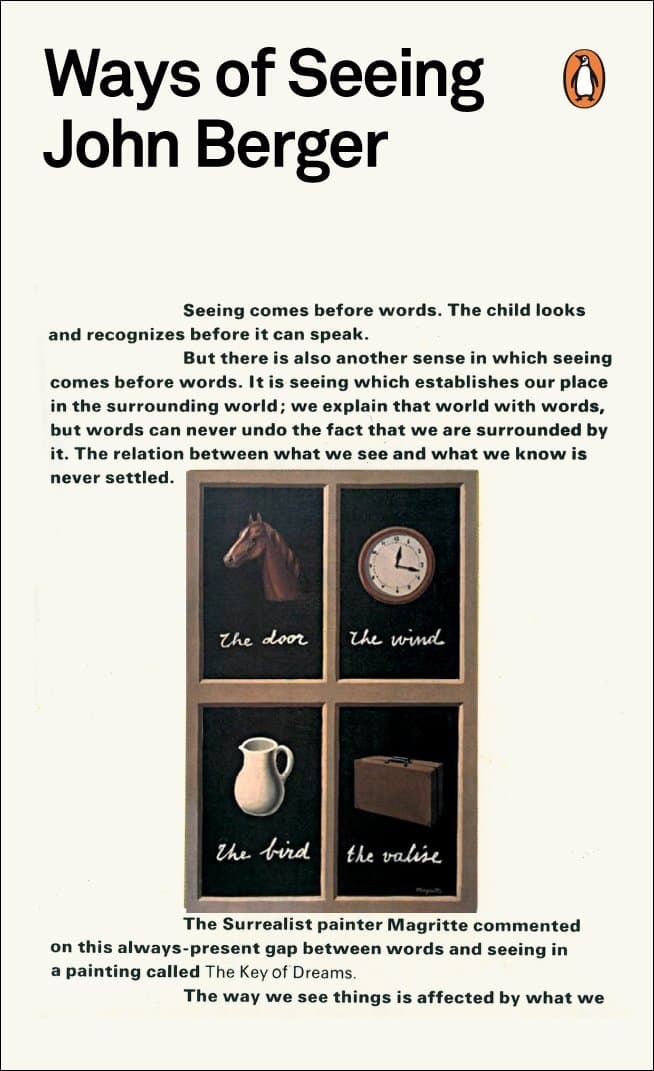
The book club met again and this time we chose to discuss the book Ways of Seeing by John Berger. This was a really interesting book for me, primarily because it was the first time I was intellectually exploring art beyond the spontaneous discussions I would have in museums. In fact, critical appreciation of art was not something I was exposed to, either in my family or school. It was my travels and own innate curiosity that drove me to develop an appreciation for the visual arts, and I’ve found a place for it in my life. John Berger’s book came at a good time then, because as I was traveling through parts of Europe and visiting some of the world’s most spectacular museums, I realized there had to be more than what just met my eye. What started out as just aesthetic appreciation was now enthralled in the drama of politics, sexism and pop culture.
The discussion was thankfully led by a member of our club who is an art history major so he provided tons of context and challenges to the text. Ways of Seeing exists also as a TV show that you can find here, and with the year it was released, one can infer some political leanings to the material. Berger was a prominent Marxist, who in his critique of art, was making a stand to the bourgeois culture and society. While he was brilliant in identifying themes and patterns in the art of the Renaissance movement and comparing them to recent (then) trends, he also was pushing an agenda that in itself needs to be examined.
Berger explores three key themes in the book. The first is the notion of context and how the meaning of a painting (or the way we see it) is a function of our own mindsets and the environments in which we consume them. Paintings were made with the notion of a location in the past. For example, a church would commission an art piece to be put above an altar and so the eyes of the subject would glance towards a physical statue of Jesus known to be placed there. Take the painting out of the church, and now the direction of the eye stare can suggest something else altogether. The reproducibility and mobility of art played a huge role in the new modes of perception presented in Cubism to Impressionism and suggests why we have inherited such a diverse range of interpretations for Renaissance art. With film and photography, the art piece itself is now simply an object rather than a portal into a singular moment in time. The value of art is now less a function of its purpose and is more a function of its uniqueness.

The second theme and perhaps the most impactful is the notion of the female self and nudity. Berger makes a strong claim that while in most Renaissance art, men were portrayed in terms of the power they held, women on the other hand were presented as how they wanted to be observed. The language still escapes me so I’m going to quote another critique I found online:
On the other hand, Berger says, a woman’s presence is always related to itself, not the world, and she does not represent potential but rather only her herself, and what can or cannot be done to her, never by her. The sources of this identity are for Berger the age old notion that the woman was destined to take care of the man. He argues that as a result the woman is always self-conscious, always aware of her own presence in every action she performs. The woman constantly imagines and surveys herself and by this her identity is split between that of the surveyor and that of the one being surveyed – the two rules that she has in relation to herself. For this reason, Berger notes, her self value is measured through the manner in which she is portrayed, in her own eyes, in others’ eyes and in men’s eyes.
This was a very revealing explanation as I started to notice the prevalence of women starting at either the viewer or a reflection of themselves in a lot of classical paintings, as in the painting of Susanna at her bath above. He goes on to explain that classical art also pushed the idea of nudity beyond just nakedness. Nudity encouraged an appreciation of the naked form, designed to be visually appreciated and indulged in. Berger states that while in other forms of art around the world, mutual attraction is present between the male and female form, in classical European art, it is mainly the female nude form that is adored and stared at.
The implications of these are incredible because they prove that objectification of the female form has been codified in our history and subliminally always been part of our consciousness. There is some valid pushback – that the male form also has its share of nudity and that men too are victims of objectification – but it’s easy to see that from the various (actually, numerous) pieces of art that womanhood has been given a worse serving of this artistic phenomena. Many claim this to be one of Berger’s biggest contribution to the feminist moment in realizing how much we have been indoctrinated.
Berger’s final point combines elements from the first two in stating how art now is a tool to indoctrinate desired traits and realities. With the advent of oil painting, art took on a role of providing luxurious and indulgent depictions of reality, causing owners to see art as a way of improving their social worth. He goes on a bit of a rant here, describing more on how this ultimately benefits the wealthy class and planted the seeds of capitalism (the industry of desire), before finally tying it to the culture of advertising we see these days. Art and advertising are intertwined intimately, in their shared intention to create prestige and project new realities. Ultimately, art has moved from depicting real objects and people in a context-laden environment to being context-flexible material designed to be stared at, indulged and used as a tool for material wealth.
The level of generalization in Berger’s work is stark and anyone who has visited a sufficient number of art museums will be able to point to a piece of art to contest any claim Berger makes. But I think that improves the importance of this book – it’s another tool in your toolbox to understand the world and the cultures we inevitably are a part of. It cannot answer all questions but it can answer some, and that’s more than we can ask for sometimes. The reading level hops between being easy and jargony and the context is old so there is some active understanding required. However, it is a short book and can be read in one day. Here are my ratings:
Readability: 3/5
Intellectual Stimulation: 4/5
Perspective Shifting Capability: 4/5
Would I Recommend? – Only if you’ve developed some basic understanding of art and an appreciation of their contexts.