rovik. reads: this is what inequality looks like
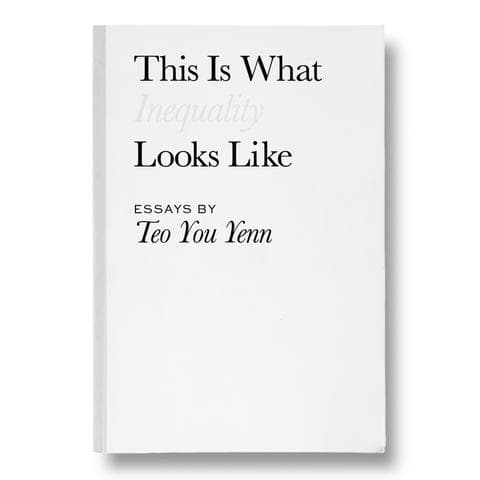
I’ve finally found the opportunity to get my hands onto some local publications in Singapore and what better one to start with than the controversial “This is What Inequality Looks Like” by Teo You Yenn. I remember hearing about this book all the way while I was in the UK and how it articulated some of the sensings on the ground that life in Singapore wasn’t as bright and chirpy as expected. I also remember learning how it was a huge thorn in the foot for a lot of civil servants who were trying to rationalize existing policies to their superiors. What could it be about a book that would cause such a commotion in stable Singapore? A lot, apparently.
“Our national discourse emphasizes sacrifice, community, greater good. Our institutions, our everyday lives—they regulate and compel individualism, competition, self centeredness.”
Teo takes us on a smooth arc to her thesis that inequality in Singapore is a result and manifestation of policies that inadvertently exclude and discriminate groups that do not fit the dominant narrative of the country. I found this especially interesting with Singapore’s recent brand campaign on “Impossible SG”, focused on the victors and underdogs of the country. Teo rightly points out that country is so obsessed with values such as meritocracy and success that when one does fall short, every part of their identity is also deemed substandard. The book goes through an ethnographic capture of different parts of the lives of Teo’s subject, from employment, where wages are kept low, to childcare, where a parent’s investment in a child’s future often comes at the expense of the parent’s ability to pay their bills. The book challenges the economic rationale behind policies and institutions to share the very real outcome of a dual Singapore – the main narrative of a prosperous nation we see in posters all around us at odds with the narrative of reality encountered by those at the lower end of the inequality balance.
“To be embedded in a consumerist culture without money is to be constantly reminded of [one’s] inability to meet [one’s] child’s desires.”
Singapore’s notorious stance on means-testing is also taken to court in the book and languished as demeaning and tiresome way of getting aid in the country. For those unfamiliar, means-testing is Singapore’s favorite way of providing assistance, by ensuring the right amount of aid for the right amount of need. This is achieved through a series of rigorous interviews, documentation, and spot-checks. Teo rightly points out that those of us who encounter privilege and inherited wealth/ access can live our lives never having to worry about justifying our incomes to get access to public services. Yet, because of one’s unfortunate circumstance, the burden of proof is increased greatly to “prevent abuse”. The “special-case” policy principle of Singapore’s safety-nets cause adults to see themselves as failures of a system that rewards you for your ability to do well in life. Parents undergo internal identity crises, having to hate who they are to encourage their kids to be better than them. There is little, if any, regard for the innate value of human life. There is a lack of recognition that aid should be provided on the pure virtue that one is human and not that they are an unfortunate exception to the rule.
“Low-income parents find themselves having to do this immensely difficult thing: they have to tell their kids to listen to them and yet also send them the message “don’t be like me.” It is difficult to exercise authority under these conditions. To have one’s parenting practices be unintelligible, unacknowledged, deemed less worthy, is a profound form of attack on the self, especially when being a parent is a central part of one’s identity.”
Teo has two main calls to action, both aimed at the Government and existing institutions. She calls for a more universal welfare system that reduces the stigma-creating effects of means-testing. She also argues for better resources to support parents of children such that they are empowered to support their children in their most important years of self-determination. It is insufficient to simply blame the family unit but only help the child – the whole family unit must be empowered. There are worthy debates to be had around these ideas, but what I’ve noticed in conversations is the polarization around them rather than deep engagement. There is value in recognizing that means-testing has caused exacerbation of inequality in Singapore. There is also value in recognizing that some of our best dogmas around family and meritocracy stand on weak ground when we observe the effects in poorer communities. These positions allow us to then think hard about how we can move to evolve some of our policies and attitudes to respect the poorer and less fortunate amongst us as equally deserving of the opportunity, happiness and the right to call themselves Singaporean.
I do have my critiques of Teo. She mentions policy regularly in her book but she rarely quotes, provides data or even attributes specific policies. I found myself wondering how I can verify and confirm some of her ideas. While her dominant methodology was one of ethnography, I found myself dissatisfied with certain conclusions without more evidence of the truth. Teo also does a decent job of addressing some of her main criticisms – that of the abuse of universal welfare systems by those who would game the system, as well as that of the clear absence of the race-angle in her research. Yet she doesn’t deeply engage those criticisms – she merely acknowledges them and makes comments that come across as lazy.
The book as an overall product is one well aligned with national conversations but lacks the firepower and intellectual rigor to truly inspire a rethink of the system. It has led to the simplistic and reductionistic retorts by policymakers that I am familiar with and bored by: 1) Existing programs are the best we got 2) The Government can’t do everything 3) Education is the great leveler. These statements have become such truisms that they stand no value in addressing the reality of inequality in Singapore. All of the retorts have glimmers of sensibility, but they are shrouded by rhetoric. We need to dive into the messiness – pair narratives with data and vice versa, and learn about how we can expand the dominant narrative in our country to recognize those who are not the bank owners and real estate moguls. We need to legitimize the lives of our fellow citizens.
We cannot simply state that that’s the way the world is – we need to believe it’s worth improving.
Here are my ratings:
Readability: 4/5
Intellectual Stimulation: 3/5
Perspective Shifting Capability: 4/5
Would I Recommend? – As a first take on Inequality in Singapore, but then quickly followed by more academic studies on the subject. This book is in no way a conclusive take on the subject.