rovik. reads: the true believer
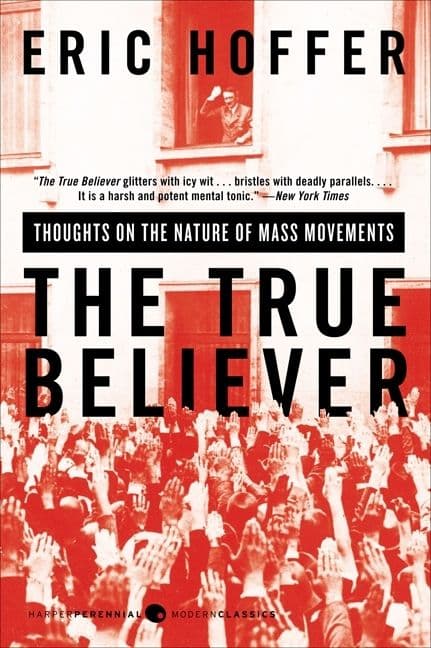
To stretch the idea of connection, I wanted to explore why people find refuge in mass movements and causes. Do we give ourselves to such communities in order to find solidarity and connect with others who are like-minded. Eric Hoffer’s 1951 book The True Believer takes a big picture view on why people participate in movements, fanatical or otherwise. His ideas have shaped generations of thinkers and from our book club, it was obvious that it had influenced us too.
“The permanent misfits can find salvation only in a complete separation from the self; and they usually find it by losing themselves in the compact collectivity of a mass movement.”
Eric Hoffer
I’ll be honest – when I was found this book, I was expecting Hoffer to be describing how people seek communities or affirmation from others in the movements that they join. But Hoffer’s lens is a very individualistic one, focusing on the urge for the person to shed their old identity by taking on one that is promised by a mass movement. Whether it’s religious or political, such movements allow people who are frustrated with their own identities to revoke their old selves in favor of one that promises security and prosperity.
There is in us a tendency to locate the shaping forces of our existence outside ourselves. Success and failure are unavoidably related in our minds with the state of things around us. Hence it is that people with a sense of fulfillment think it a good world and would like to conserve it as it is, while the frustrated favor radical change. The tendency to look for all causes outside ourselves persists even when it is clear that our state of being is the product of personal qualities such as ability, character, appearance, health and so on.
Eric Hoffer
Of course, by virtue of the individualistic imperative, there is no connection in such mass movements. Connection serves the ends of advancing the cause of the movement, to organize selves and drive agendas. Hoffer is very much influenced by the movements of his time, having just witnessed the rise of Soviet Russia and Nazism where people hateful of the past find a way to work towards a future, despite the suspicion towards everyone but themselves.
The concept of time is also material to Hoffer’s arguments. Movements are obsessed with the future, discounting the present to large degrees and proselytizing others to despise the past. Such trends are not confined to the 1950s – in fact, it could be argued that many nationalistic movements today tap onto similar energies. Yet, the movements of today look very different, drawing on the affordances of technology.
“Hatred is the most accessible and comprehensive of all the unifying agents. Mass movements can rise and spread without belief in a god, but never without a belief in a devil.”
Eric Hoffer
What does stay the same is the hatred tap drives a lot of these movements. Again, when it is hatred and not vulnerability that forms the basis for relationships, it is unlikely that connection happens. Rather, you have coordination and compromise towards an agenda, but the value of relationship building is absent among fellow fanatics. Hatred is not a scarce energy. It can be easily ignited and even more so manipulated. How we handle our own inclinations speaks to our ability to not be swayed by the sweet words of fanatics.
“A movement is pioneered by men of words, materialized by fanatics and consolidated by men of action.”
Eric Hoffer
Hoffer makes no claims to be scholarly in his book – he is an observer and philosopher and shares his hypothesis as a means to spark ideas and discourse. As a corollary, many of the arguments he makes can seem hyperbolic but his last chapter is one of my favorites. This chapter has little to do with the idea of connection but explores the key players in a mass movement. It starts with the dissatisfied intellectuals who start to pick up a cult-ish following, accompanied quickly by a spark and an explosion of fervor led by fanatics and then finally sustained by men of action and pragmatism who wish to consolidate the new status quo. Such patterns become obvious in retrospect when we look at many other movements in the world.
This is a book of ideas. It’ll sway you emotionally and force you to think critically if you want to stomach Hoffer’s ideas. But it delivers on its promise – it provides a dependable way to view the world of fanatics and mass movements that if not completely true, provides some reliable predictions. In fact, it’s been picked up as a must-read by many leading thinkers including President Eisenhower and Hilary Clinton to explain the times as they unfold. Will we be able to predict the next fanatical movement, and what can we do to prevent exploitation those among us who are struggling with who they are? These are questions I found myself asking at the end of both the book and the book club discussion. Here’s hoping I find my way to the answers soon.
Here are my ratings:
Readability: 5/5
Intellectual Stimulation: 4/5
Perspective Shifting Capability: 3/5
Would I Recommend? – Foundational book to view global affairs and politics – so yes!