rovik. reads: the stranger
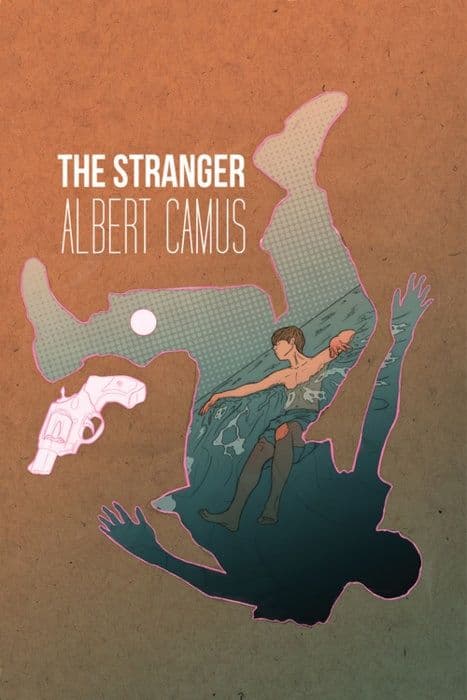
Albert Camus has been a curious philosopher that I’ve personally taken to over the past few years. From Rick and Morty to Bojack Horseman, Camus is visible through the absurdism in most of our self-aware pop culture. So I was excited when our book club chose to read one of Camus’ original works – The Stranger, a short novel about Mersault, an indifferent character who is put on trial for shooting someone and not having too much opinions about it.
“I opened myself to the gentle indifference of the world.”
Camus wrote short stories for the same reason as many other philosophers – to illustrate the application of his worldview. In this iconic narrative, Mersault is introduced as a character who is not foreign to the vagaries of life – the story starts with the announcement of the death of his mother. Yet, while life throws him curveballs and opportunities, Mersault is inwardly indifferent to any emotional impact. He is fully conscious of society’s norms but chooses to not participate because they do not make sense to him in contrast to the unexpectedness of life.
“I may not have been sure about what really did interest me, but I was absolutely sure about what didn’t.”
Mersault is familiar with pain and pleasure. The day after his mother’s funeral, he flirts with Marie and has sex with her, choosing to enjoy the physical satisfaction rather than dwell on the fact that his mother has died (since she’s gone regardless). Through a series of events, he makes friends with a thug named Raymond and ends up assisting him to shoot an “Arab” who was attempting to hurt him. Mersault is arrested and put on trial, a good allegory for the way his moral choices are now up for evaluation by the reader.
“I had only a little time left and I didn’t want to waste it on God.”
It is this part of the book that I found personally interesting. Mersault is given many opportunities to demonstrate guilt or remorse, but he does not. In fact, he admits that he killed the Arab but that he did not think he did wrong. He simply did. The judge almost makes it a personal mission to get Mersault to seek forgiveness, using God as his basis. This angers Mersault as he considers the concept of God a waste when put into context of the larger forces of the universe and its violent uncertainty. The court eventually finds him guilty, not just of murder but of being a poor human being. It is at this point that Mersault feels truly liberated.
“Nothing, nothing mattered, and I knew why. So did he. Throughout the whole absurd life I’d lived, a dark wind had been rising toward me from somewhere deep in my future, across years that were still to come, and as it passed, this wind leveled whatever was offered to me at the time, in years no more real than the ones I was living. What did other people’s deaths or a mother’s love matter to me; what did his God or the lives people choose or the fate they think they elect matter to me when we’re all elected by the same fate, me and billions of privileged people like him who also called themselves my brothers? Couldn’t he see, couldn’t he see that? Everybody was privileged. There were only privileged people. The others would all be condemned one day. And he would be condemned, too.”
I thought Mersault was an interesting protagonist, if a protagonist at all. He legally is only guilty of murdering the Arab but the book puts him on trial for all sorts of moral choices that are not in entirety amoral. His choice to not mourn his mother, to have sex the day after, even to ally with the thug Raymond, are justified in Mersault’s mind as mere choices with consequences. The universe doesn’t care what choices he makes and so why should he? Yet, society feels the need to demand a way of life from him that is in line with the ethical norms of society.
It brought to question my own quest for a sense of morality and my expectation that others define ethical directions for themselves. I have no personal qualms with the absurdist notion of things but I am more sympathetic to the consequence of the “meaninglessness of the universe” in that we then choose to make personal sense of the world. Mersault has chosen that his personal sense is indifference whereas mine would be more aligned to the reduction of suffering.
“Mostly, I could tell, I made him feel uncomfortable. He didn’t understand me, and he was sort of holding it against me. I felt the urge to reassure him that I was like everybody else, just like everybody else. But really there wasn’t much point, and I gave up the idea out of laziness.”
There are those who would call Mersault a psychopath and I don’t think they would be too wrong. But I also wonder if it is because we have imposed our finite view of the universe onto him.
My book club also pointed out some really good modern critiques of masculinity and mental health to the narrative that was not common to the 1950s set of critiques. Mersault did practice some overall hyper-masculine traits (not crying at the funeral etc.) and was in a lot of ways unwilling to deal with his emotions and mental state. How do these relate to those who embrace absurdist philosophy? I thought these were good questions.
A good book makes you think and I definitely felt uncomfortable at the end of the story. My ethical views are in definite need of strengthening or evolution and that’s how it should be. I’d definitely value that impact of this book.
Here are my ratings:
Readability: 5/5
Intellectual Stimulation: 4/5
Perspective Shifting Capability: 5/5
Would I Recommend? – Yes. Make sure to read some critiques after!