rovik. reads: the second machine age
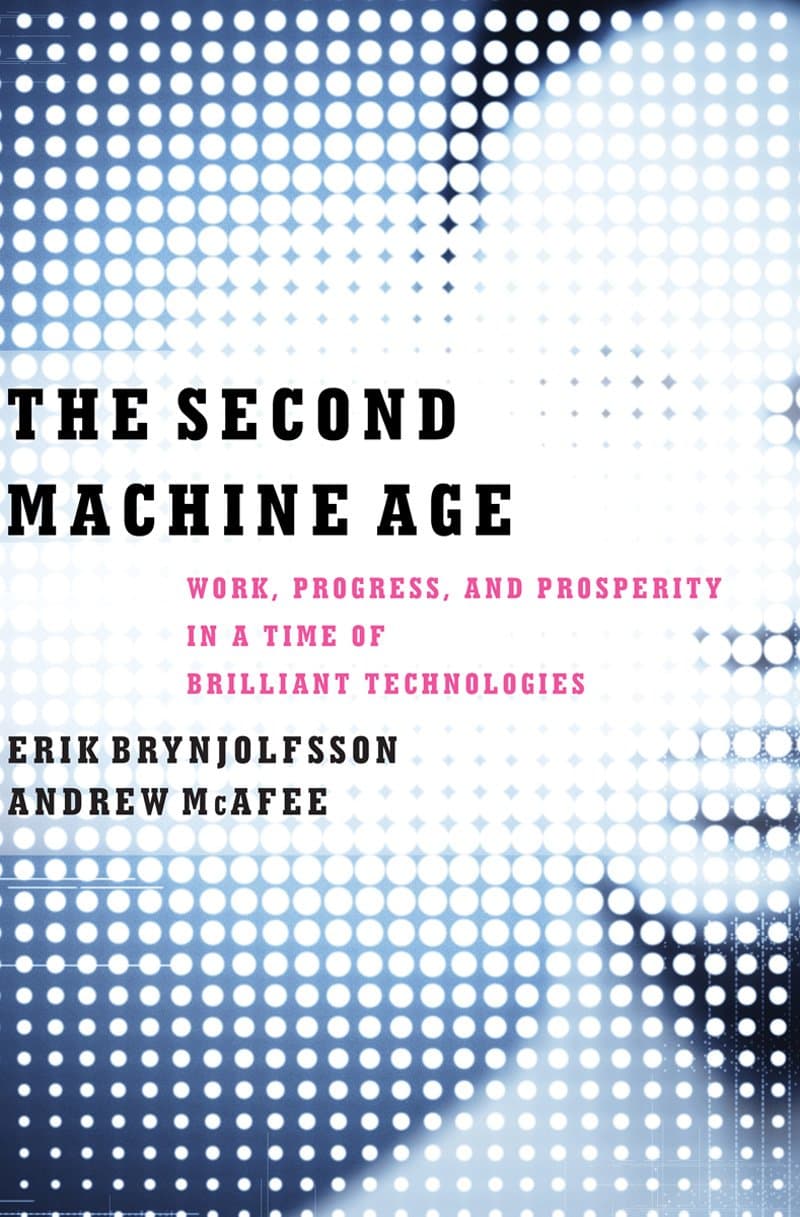
Part of my preparation for my Master’s program in LSE includes going through a reading list. The Second Machine Age was one of the books on the list and it spoke to me because after reading Sapiens, I had developed a new curiosity in evolutionary theories. As a self-declared technologist, this book seemed like a good way to carry on the research into how our world is evolving in tandem with the growth in technology. Brynjolfsson and McAfee are MIT professors who have separately published books and studies on technological development and their effects on societies. Coming together to produce this book consolidates some solid insights into how technology is rampantly transforming our world and what we ought to be thinking about moving forward.
As a quick summary, the authors claim three main factors as the drivers of technological growth and advancement in the past few years. The first is the increase in cheap hardware – something we’re familiar with through Moore’s law and the miniaturization of products. The second is the digitization of a vast number of resources and processes – making it much easier to think of anything as manipulatable by a computer program. The last is recombinant innovation – the ability to remix, recreate and to iterate through infinite possibilities, of which each promises to possibly change the way we interact with the world altogether. Think about Instagram, for example. Instagram took advantage of the mobile smart-phone (cheap hardware) to digitize the process of taking photos. While there were already photo publishing apps online (such as Flickr), Instagram is now the leading photo sharing app simply because it made a seamless mobile app that was socially integrated.
The consequences of these trends are what I find especially interesting in this book. The authors claim that because of the internet, markets these days belong to superstars who create a product that is only marginally better than the next best product. Why would anyone choose a second best product when resources are abundant in the digital sphere and one provider can supply an infinite number of clients/customers. While the first machine age, known popularly as the Industrial Revolution, allowed anyone who took advantage of productivity tools to gain an increase in their market access, the current machine age is not as simple. It’s a winner-takes-all market these days and with the transference of capital to owners of digital products, the aggravation of an increasing poor-rich divide is even more prevalent.
The worst note about this future that is painted is how far behind people are economically if they don’t even have a habit of trying to catch up with technological trends. Because of the nature of exponential growth in the sector, by the time skills are learned to manage the current state of technological needs, the next innovation is introduced and a whole new set of advanced skills are in demand. For example, right now there is a burgeoning demand for data scientists who actually are able to engage with complex and large forms of data and make clarity out of it. Data scientists are not only lacking, but those who exist don’t have the courage to make sense of data beyond standard statistical tools. Schools these days are offering courses in data science and handling, but technology firms that have a solid data science team are already moving on their next challenge. There’s really no promising what is or isn’t possible with technologies these days, simply because of the nature of exponential growth.
The authors do provide a lot of suggestions for solutions, from a range of levels. The most interesting was to teach everyone to start working alongside with robots and technologies rather than necessarily compete with them. It seems like an easy enough recommendation, but I truly believe we need a paradigm shift amongst the entire workforce from the moment they start education to see computation as a skill just as essential as mathematics or language appreciation. By learning to understand how to embrace technology and how to work together with trends rather than compete with them, the labor force is much better prepared for an economy that is changing at a much faster rate than ever before.
The book does lack some focus on how to push some of its policy recommendations past their current constraints. Most policy recommendations aren’t new and in fact, I skimmed through most of these, looking for only those that seemed novel, which were few. What would have been useful is a more honest discussion of why some of these policy ideas are stuck with lawmakers and not moving towards becoming fully implemented.
At the end of the day, Brynjolfsson and McAfee have taken a number of known and established ideas and put them together in a cohesive and readable manner, drawing connections that elucidate larger trends and patterns in our economy and society. In that way, this book is an important reading for any technologist wanting to understand what’s happening around them and how to ride the wave moving forward. It took me two weeks to finish reading this book and it’s easily readable in a shorter time if you want to give it the effort. Here are my ratings for it:
Readability: 5/5
Intellectual Stimulation: 3.5/5
Perspective Shifting Capability: 4/5
Would I Recommend? – Yes