rovik. reads: the present age – on the death of rebellion
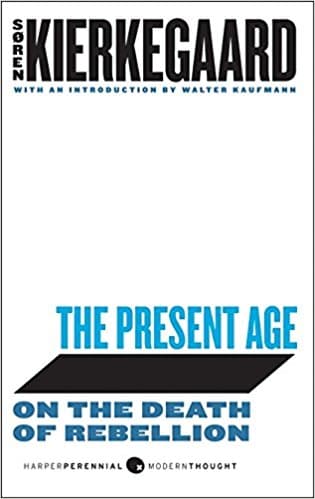
Engaging in discussions on philosophy is a useful occasional activity. It improves the rigor of the mind and sharpens the wit. It’s not something I enjoy to a dense degree – I can’t quote Plato or Nietzche off the top of my head, but I believe the main trains of thought have shaped a lot of modern thinking and are worth some consideration, especially as we strive to champion new forms of living. Kierkegaard stands in this line as someone who is worth reading. One of his seminal works, The Present Age is ripe with conjecture and contemplation on the nature of self-reflection and the controversy of the media, providing a solid challenge of perspectives that are relevant to this day.
Kierkegaard lands two main points in this work: the first is that we have become overindulgent in acts of ‘reflection’ and have lost the passion for action and the second is that we all have become leveled by institutions such as ‘the public’ and the media.
Reflecting in lieu of Acting
Kierkegaard distinguishes between two ages – The Present Age which is indulgent in discussions and reflection and The Revolutionary Age, referring mainly to the time before the present when passion drove action.
“Our age is essentially one of understanding and reflection, without passion, momentarily bursting into enthusiasm and shrewdly relapsing into repose.”
It’s worth noting that Kierkegaard is an established theological philosopher, passionate about his faith and thus ties much of his thesis to it. According to him, we have evolved as individuals in caring more about the discussion over action instead of the actual act itself. Sometimes, discussing the act satisfies our conscience and provides no impetus to actually engage in the act itself.
“Intelligence has got the upper hand to such an extent that it transforms the real task into an unreal trick and reality into a play.”
We can think of relevant examples almost immediately – when we ask someone why they don’t engage in charity, their ability to rationalize it reduces the focus on the fact that it’s simply the right thing to do. Passion is lost, and self-reflection has become an indulgent frivolity of the individual. Kierkegaard makes a relatable snipe to the fact that sometimes we engage in discussion over the topic so much that we choose not to act out of exhaustion.
“Reflection is not the evil; but a reflective condition and the deadlock which it involves, by transforming the capacity for action into a means of escape from action, is both corrupt and dangerous, and leads in the end to a retrograde movement.”
There is, of course, a large area for critique here. Firstly, it is widely agreed that action without thought is a recipe for disaster, especially with politically and economically complex decisions. It’s also worth noting that Kierkegaard himself is subject to his own meta-critique. He is a philosopher who engages in acts of thought rather than action. He is ultimately evidence of the need for reflection. But it is this quote which lands his point the best:
“What is talkativeness? It is the result of doing away with the vital distinction between talking and keeping silent. Only some one who knows how to remain essentially silent can really talk–and act essentially. Silence is the essence of inwardness, of the inner life. Mere gossip anticipates real talk, and to express what is still in thought weakens action by forestalling it. But some one who can really talk, because he knows how to remain silent, will not talk about a variety of things but about one thing only, and he will know when to talk and when to remain silent. Where mere scope is concerned, talkativeness wins the day, it jabbers on incessantly about everything and nothing…In a passionate age great events (for they correspond to each other) give people something to talk about. And when the event is over, and silence follows, there is still something to remember and to think about while one remains silent. But talkativeness is afraid of the silence which reveals its emptiness.”
How do we engage in a discussion that is valuable and in relation to producing and engaging in action rather than viewing an action as a distant object? How do we stop contemplating and start generating? These are worthy ideas to think about because as society evolves and humans become subject to the ‘system’, our ability to act gets reduced and we become satisfied with the mere contemplation of acting. It is this trap that we must escape from and that Kierkegaard continues to expound on.
The Societal Leveling of the Individual
“In order than everything should be reduced to the same level, it is first of all necessary to procure a phantom, its spirit, a monstrous abstraction, an all-embracing something which is nothing, a mirage–and that phantom is the public.”
Kierkegaard has a known disregard for the media, especially since historically, the media at the time critiqued some of his earlier work to a perhaps unfair degree. But he makes an important claim here: the reflective state is a result of a desire to be appreciated by a phantom ‘public’.
“A revolutionary age is an age of action; ours is the age of advertisement and publicity. Nothing ever happens but there is immediate publicity everywhere.”
The media is a big pusher of this trend, citing the ever notorious ‘public’ as a reason or cause for desire or disruption. Are we not merely a collection of individuals rather than a homogenous group? How can the public want one thing? Even if it is 60% of them according to a survey, every individual is almost guaranteed to want a different version of the same thing. This societal leveling of the individual reduces the desire to become a passionate being and instead relegates the person to merely a constituent of a larger phenomenon.
“The levelling process is the victory of abstraction over the individual. The levelling process in modern times, corresponds, in reflection, to fate in antiquity.”
This can be seen in art and advertising mostly, where the desire to be accepted and seen by the ‘public eye’ drives work. It is this reinforcing system, where art and advertising are products of the reflective state and yet encourage more of it too. Kierkegaard drives a lot more focus on this point in the direction of religion and Christianity, areas worth exploring if you are a theologist or interested in religion, but these are extendable from the points laid above and not as widely relevant as the application in media.
___
This book was a tough read. It’s extremely short (some even call it a pamphlet rather than a book) but it’s very dense and takes a lot of pauses to fully understand Kierkegaard’s main points. Perhaps it is because it challenges almost every major tenant of our modern society which is built on discussion, debate, and rhetoric rather than actual action. It is worth noting that while major actions have shaped our history, the work behind those actions spanned many long and arduous discussions. Is Kierkegaard relevant to our society or is he a dangerous influence? I’d argue it’s worth considering his skepticism of modern society at a personal level. Can we avoid the leveling of society and find passion in our individuality? Can we catch ourselves when we become indulgent in reflection rather than in relation to action? These are worthy checks to add to ourselves to become stronger as individuals. Because our worth comes not just from our participation in a global ‘public’ pool, but also in our ability to be an individual and be unique. We cannot lose the essence of who we are.
Here is my review of the book:
Readability: 2/5
Intellectual Stimulation: 5/5
Perspective Shifting Capability: 5/5
Would I Recommend? – As part of a wider philosophical exploration, yes.