rovik. reads: the narrow corridor
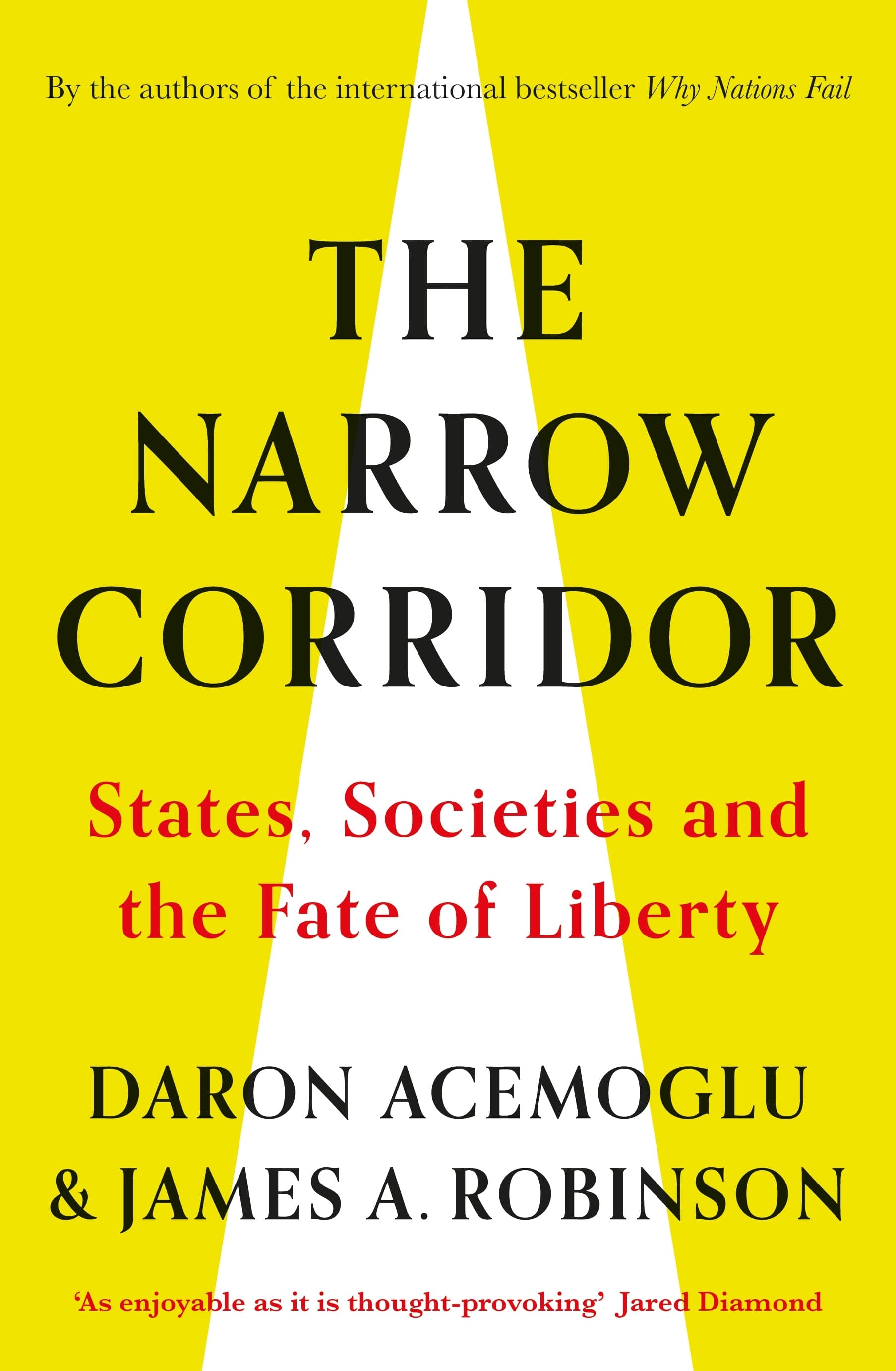
At the beginning of the circuit breaker period, I had asked for book recommendations to occupy my time. When Wolf recommended The Narrow Corridor, I wasn’t expecting a massive compendium of stories of governance across time and geography, but I should have known the same author behind Why Nations Fail would be comprehensive in his approach to describing The Narrow Corridor – a socio-political scenario in which state and society are both engaged in increasing their capacities such that liberty and governance are both achieved.
“The only way of achieving durable liberty is to . . . forge the balance necessary for building a Shackled Leviathan. True liberty can flourish neither without a state nor under the yoke of a Despotic Leviathan. But there is no universal way of building a Shackled Leviathan . . . Every country’s prospects are molded by its unique history, the types of coalitions and compromises that are possible, and the exact balance of power between state and society.”
Acemoglu and Robinson work off Hobbes’ Leviathan, the machine of state that takes over powers of policing, military and taxation amongst others, to identify the circumstances in which effective governance and liberty can be developed. It is his view that without the presence of participative society that has an ongoing hold on the state (not just at elections), we face the likelihood of the Despotic Leviathan, a state that seeks to increase its capacity to benefit preferred parties rather than the country as a whole.
The book is in essence an exploration of the various types of Leviathans, whether it’s Absent (as per some of the tribal communities that exist to this day), Despotic (Acemoglu and Robinson use China as a long-lasting example of this), Paper (as is Argentina where neither state nor society increases its capacity) or Shackled (highlighted by some of the Western democracies that exist).
There are a number of factors that shape how countries move among these permutations, including existing norms (here called “cage of norms”) as well as pressure from international bodies and Acemoglu and Robinson take an extensive look at how these can be significant in their influence. Norms such as the Caste System in India can block a country from ever achieving liberty.
“Liberty needs the state and the laws. But it is not given by the state or the elites controlling it. It is taken by regular people, by society. Society needs to control the state so that it protects and promotes people’s liberty rather than quashing it like Assad did in Syria before 2011. Liberty needs a mobilized society that participates in politics, protests when it’s necessary, and votes the government out of power when it can.”
Acemoglu and Robinson are consistent in their reference back to the Corridor and the Leviathan concepts, but as they explores the varying degrees of how states and societies interact, it becomes increasingly difficult to believe that the Corridor is a helpful guide for viewing the world. There are often numerous factors that would explain why a country is as it is. For example, in the US, with a federal government and power to the states, it is expected that the country would actually be well poised for the Shackled Leviathan and concepts of liberty. But actually, the terms under which state and society contract between themselves, including the role of private-pubic partnerships as well as state policing powers, leads to oppression of minority communities. Therefore, every case continues to be unique and requires an analysis of deeper trends and policies, not all of which can be captured by the Corridor/Leviathan analysis model.
There is an interesting point on the rise of populism stated towards the end. Wherever the elite and those in power refuse to participate in good faith negotiation with society, we see the rise of polarization, populism and toxic politics where society feels the need to elect a “prince” or populist leader to re-establish a place at the table, even if it could lead to despotism in the long run. Acemoglu points to this case of tug of war as the driver behind the rise in populism globally.
Of course, I am curious to how all of this applies to Singapore. Our society’s participation in governance is often constrained to the regular elections as well as some engagement of local representatives, but it is nowhere the levels encouraged by Acemoglu to ensure liberty. It may even be argued that liberty is not an intended outcome of governance here in Singapore. I’d be curious to hear Acemoglu’s views on that and a number of other things. All in all, there was a lot to unpack but most sections will shape your worldview.
Here are my ratings:
Readability: 3/5
Intellectual Stimulation: 5/5
Perspective Shifting Capability: 4/5
Would I Recommend? – The book is a useful frame to view the world and the politics of governance but be prepared for a long read.