rovik. reads: the handmaid’s tale
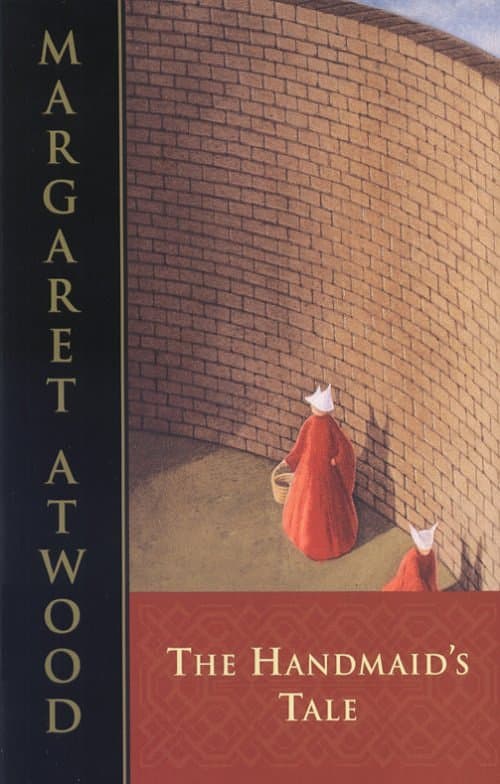
It had been a while since I read a fictional book, and when it came to it, Margaret Atwood’s The Handmaid’s Tale was high on my list of books to explore. I had heard a lot about it, especially since it was made into a TV series on Hulu and was compared to as the possible dystopic future that Trump’s election signaled. A year has passed since his election and we know now that while he is heavily problematic, Atwood’s future is still a bit far away from Trump’s reach. Is the book feminist literature? Is it worth the literary analysis beyond simple appreciation of the content? Atwood herself debates some of these topics in her foreword in the latest edition and paints a more complex understanding of the book than I thought of before.
The Handmaid’s Tale has a striking premise. Multiple dystopic elements have come into play – fertility rates are incredibly low, civil war breaks out and warring governments take territories. One of these is Gilead, a theocratic Old-Testament abiding dictatorship that stratifies the population. Women are stripped of most of their rights, and a hierarchy is established in society. Men, especially those who are officials within the dictatorship, are the most important, and their blue-clothed wives enjoy the privileges that come with the association. Women are divided into green-clothed Marthas (helpers), striped-clothed lower class women, Aunts (older women who indoctrinate the lessons of the land) and red-clothed Handmaiden. This is where Offred (meaning the woman of Fred) comes in. She’s a Handmaid who has had her kid and lover taken away from her, been brainwashed into becoming subservient and then been sent to bear children on behalf of the family where the wife is no longer fertile. It’s a highly plausible social structure when given proper thought, and one that is scary yet oddly familiar.
There are many things that I enjoyed about Atwood’s book. The evolution of Offred throughout the story is initially subtle and then all of a sudden, bold and daring. The feminist moment isn’t forgotten, and in fact, it is mentioned that Offred participated in college protests and other forms of activism on the issues surrounding womanhood. Yet, here she is faced with a situation where her body and self are made separate in function.
I used to think of my body as an instrument, of pleasure, or a means of transportation, or an implement for the accomplishment of my will . . . Now the flesh arranges itself differently. I’m a cloud, congealed around a central object, the shape of a pear, which is hard and more real than I am and glows red within its translucent wrapping.
The book explores various ways Offred tries to maintain control of parts of her life. She initially refuses to accept the situation as permanent, believing that things will tide over. The book is divided into chapters labeled ‘Night’ and then other names (occurring in the day). We can see a sharp distinction in Offred’s inner thoughts at night where she is mostly alone and must confront herself, the one person that is hidden in all but body in the day. The days are not without routine, and over time, Offred faces a possible reality where she becomes accustomed to her new life.
Ordinary, said Aunt Lydia, is what you are used to. This may not seem ordinary to you now, but after a time it will. It will become ordinary.
Separately,
I wait. I compose myself. My self is a thing I must now compose, as one composes a speech. What I must present is a made thing, not something born
Eventually, two main twists prevent this from happening. The first is the manipulation by Fred, the commander and man of the household. Fred wants to engage in the ‘fun’ that comes with promiscuity and treats Offred as a mistress, breaking the implicit contract that is placed between the handmaid and the commander where the relationship is purely physical without emotions.
The problem wasn’t only with the women, he says. The main problem was with the men. There was nothing for them anymore . . . I’m not talking about sex, he says. That was part of it, the sex was too easy . . . You know what they were complaining about the most? Inability to feel. Men were turning off on sex, even. They were turning off on marriage. Do they feel now? I say. Yes, he says, looking at me. They do.
The second is the involvement of Offred in ‘The Resistance’, an underground movement mainly driven by others in the community and that Offred only is tangentially involved in.
“I believe in the resistance as I believe there can be no light without shadow; or rather, no shadow unless there is also light.”
As a reader, I do not know how I feel about Offred. Compared to most fictional books, Offred is a pretty underwhelming heroine. At the end, she is still at the whim and mercy of the people around her. Perhaps that’s an unfair comparison, given that if the situation was truly plausible then so too must be the impossibility of escape or control. Offred truly is a character to be both sympathetic to and yet in some regards, in admiration of. She has found aspects of her life she can control, and she has found ways to navigate the system to give her her own small victories. It isn’t a rallying cry for women but still consoling that all is not lost.
Literarily, the book has a lot to enjoy. The use of colors and symbols is strongly visible throughout the book, from the color of the uniforms people wear to the use of biblical constructs almost ironically. The use of a dictatorial structure to instill control is strongly juxtaposed with Offred’s fight for her own control of her personal being. Perhaps the most memorable takeaway is the quote etched for Offred by the previous handmaid:
“Nolite te bastardes carborundorum. Don’t let the bastards grind you down.”
It sounds like Atwood’s message to us all. The book has no ending, no real conclusion. It leaves the possibilities open and has an afterword that adds more to our understanding of Gilead rather than of Offred’s eventual path. I imagine it’s because Atwood doesn’t really want us to focus on what happens to Offred eventually, but what has happened in the story already described. Is the horror of Gilead insufficient to stimulate your mind or must you really need a knot to tie things up neatly for the story to provoke you? The message is the battle we must fight and the oppression we must tackle. The process is more important than the result.
I haven’t had a piece of fiction that has been as intellectually delicious to read in a while so The Handmaid’s Tale was a very welcome pleasure. Here are my ratings for it:
Readability: 5/5
Intellectual Stimulation: 4/5
Perspective Shifting Capability: 4/5
Would I Recommend? – Definitely a must-read modern novel for today’s young people