rovik. reads: the better angels of our nature
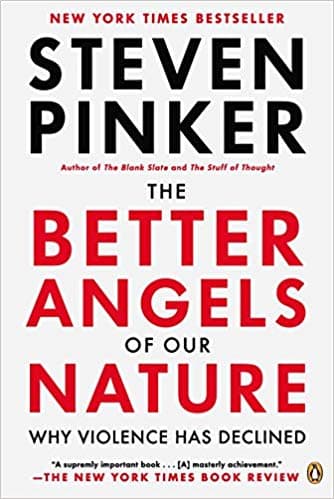
Goodreads notified me that I had been slowly pecking away at this 700-page behemoth of a book since December 29 2017. It had already been a year and I was only 60% through, partially because Pinker’s major work on the history of violence was one of the densest things I had read in a while and mostly because I had chosen to read this in addition to my monthly book club selection. So those around me may have noticed me spending hours just face-in-Kindle, churning away at the next few hundred pages to finish The Better Angels of our Nature before 2018 was up. I’m glad to say not only did I actually complete the book, I feel extremely excited for how it’ll shape my thinking for 2019.
We’ll want to address the length of Pinker’s book first. I decided to get past the intimidating size at first glance because Bill Gates had cited it as one of his most important reads of the decade. The topic matter is something I was already intrinsically captivated by and hearing that it had such an impact on some of the world’s sharpest thinkers compelled me to challenge myself. I will say this – the book is meant to be read in chunks. Pinker divides the book into unequal parts.
The first is a historical look at violence since the beginning of time, categorizing them into iconic eras. These are namely
- The Pacification Process – where we moved from hunters to farmers
- The Civilizing Process – where formed larger communities and towns
- The Humanitarian Revolution – where we stopped being vulgar and uncouth due to establishments such as the Church
- The Long Peace – where post World War II politics avoided conflict
- The New Peace – where overall violence including genocides and authoritarian rule has decreased
- The Rights Revolution – where marginalized groups even animals are reducing exposure to violence
Each chapter is detailed and rich of examples, data and thorough argumentation. Pinker has drawn from not only raw data but also established scholarship and has found contradictions and commonalities across them all. He comes to his conclusions having only given any counter-argument its full weight in rebuttal and this is something you can at least feel comfortable in knowing. Logical leaps are few and far between in this book. From these historical eras, Pinker points to the following exogenous developments that have contributed to this reduction of violence: The Leviathan, Gentle Commerce, Feminization, Cosmopolitanism, The Escalator of Reason.
The second part of the book elucidates both from the historical analysis above but also from modern neuroscience and philosophy the inner demons and better angels of humanity. The inner demons (drivers of violence) are Predation, Dominance, Revenge, Sadism, and Ideology. The better angels (reducers of violence) are Empathy, Self-Control, Moral Sense, and Reason. These are intrinsic human motives and forces that drive us and have contributed to the state of violence over time. This part of the book is dense in a biochemical commentary, with doses of social science experiments and a lot of comparative literature analysis. It is basically a psychology major’s dream read.
“I am sometimes asked, “How do you know there won’t be a war tomorrow (or a genocide, or an act of terrorism) that will refute your whole thesis?” The question misses the point of this book. The point is not that we have entered an Age of Aquarius in which every last earthling has been pacified forever. It is that substantial reductions in violence have taken place, and it is important to understand them. Declines in violence are caused by political, economic, and ideological conditions that take hold in particular cultures at particular times. If the conditions reverse, violence could go right back up.”
Unlike previous book reviews, I don’t really know how to approach a critique of this book. It’s so broad and complex that it is difficult to make any comprehensive criticism. In its entirety, I would agree that the Better Angels of our Nature is a perspective-shifting and fascinating read. It provides empirical and logical reasons for why the fear-mongering perpetrated by politicians and journalists are myopic and not contextualized well. I have identified two personally relevant takeaways that I thought I could dive into, the first is the role of government and institutions in reducing violence and the second is the face of morality.
The Leviathan and its Role
“Violence between the combatants may be called war; violence by the bystander against the combatants may be called law. The Leviathan theory, in a nutshell, is that law is better than war.”
Pinker is an obvious supporter of the Hobbesian approach to human nature – that we are all brutes and that a governing force is necessary to placate us. He points to various examples of this and how any form of tribal conflict has been reduced when violence was monopolized by the state. This, to me, was a fascinating justification for the rule of law in a country. Regardless of the implicit morality encoded within legislation, it has been crucial in the development of humanity that violence be controlled and coordinated rather than dispersed and sporadic.
There is, of course, then the subsequent and valid critique of the corrupt and oppressive power of governments, which I am well aware of. One only need to look at cities and towns in the US where Black and Hispanic communities are frequently left with no recourse against the violence dealt unto them. According to Pinker, this is where the use of Rights has a complementary role in advancing the reduction of violence wholly. Rather than simply rely on the concentration of violence, we must also value life for its intrinsic value and seek to prevent any enactment of violence as much as possible.
The creation of international bodies and watchdogs have also created new forms of pseudo-Leviathan on national governments that may want to wage war on each other. NATO is a good example of a key deterrent that while not monopolizing violence provides a coordinating eye on global affairs. Overall, the Leviathan and the role of government in reducing the rate of violence is an under-appreciated feature of our history that requires more sharing.
The Face of Morality
“The universality of reason is a momentous realization, because it defines a place for morality. If I appeal to you do do something that affects me—to get off my foot, or not to stab me for the fun of it, or to save my child from drowning—then I can’t do it in a way that privileges my interests of yours if I want you to take me seriously (say, by retaining my right to stand on your foot, or to stab you, or to let your children drown). I have to state my case in a way that would force me to treat you in kind. I can’t act as if my interests are special just because I’m me and you’re not, any more than I can persuade you that the spot I am standing on is a special place in the universe just because I happen to be standing on it.
You and I ought to reach this moral understanding not just so we can have a logically consistent conversation but because mutual unselfishness is the only way we can simultaneously pursue our interests. You and I are both better off if we share our surpluses, rescue each other’s children when they get into trouble, and refrain from knifing each other than we would be if we hoarded our surpluses while they rotted, let each other’s children drown, and feuded incessantly. Granted, I might be a bit better off if I acted selfishly at your expense and you played the sucker, but the same is true for you with me, so if each of us tried for these advantages, we’d both end up worse off. Any neutral observer, and you and I if we could talk it over rationally, would have to conclude that the state we should aim for is the one where we both are unselfish.
Morality, then, is not a set of arbitrary regulations dictated by a vengeful deity and written down in a book; nor is it the custom of a particular culture or tribe. It is a consequence of the interchangeability of perspectives and the opportunity the world provides for positive-sum games.”
One of my favorite parts of Pinker’s book is how he dissects the the different forms of Morality and why people can argue in completely moralistic terms but never seem to agree. Building on the works of others, we are exposed to four key types of morality:
- Communal Sharing – The Tribe as the focus
- Authority Ranking – The Ranking Member as the focus
- Equality Matching – The Individual as the focus
- Market Pricing – Rationality as the focus
Pinker argues that we have evolved to allocate certain types of moralities for certain areas of our lives. We would never aim to “price the sale of a baby” because we have traditionally deployed Communal Sharing morality to children. Simultaneously, we are able to deploy Market Pricing morality for the issues around environmentalism and not see the need for any other faculties used. This goes a long way in explaining the current heat around complex and difficult issues such as abortion. There is a bias in the book towards Reason as the superior form of morality, avoiding the ideological bend of former civilizations and proceeding towards a more uncertain yet robust dependence on debate and dialogue.
I am sympathetic to this view, only because I am convinced by the book’s description of ideology as never needing absolute proof. Ideology claims its proof in its fulfillment – one would only know the benefits of ideology when it is fully manifested and therefore any barrier in the interim must be unabashedly eliminated. We still see factions in society stick to such ideological positions without regard for the impact on very real lives, and while I am not arguing for necessarily liberal positions, I recognize the need for tools commonly used by enlightened citizens: facts and logic.
The Better Angels of our Nature is a treasure trove of powerful quotes, data, and perspectives. Pinker is an entertaining writer and does a great job at communicating what could be otherwise dry knowledge in a compelling way. I may take a break from books tackling war and violence for a while but I definitely feel empowered to have some difficult conversations regarding morality, politics, and war in the next few months.
Here are my ratings:
Readability: 4/5
Intellectual Stimulation: 5/5
Perspective Shifting Capability: 5/5
Would I Recommend? – Yes. Do be prepared for a lengthy read!