rovik. reads: the art of gathering
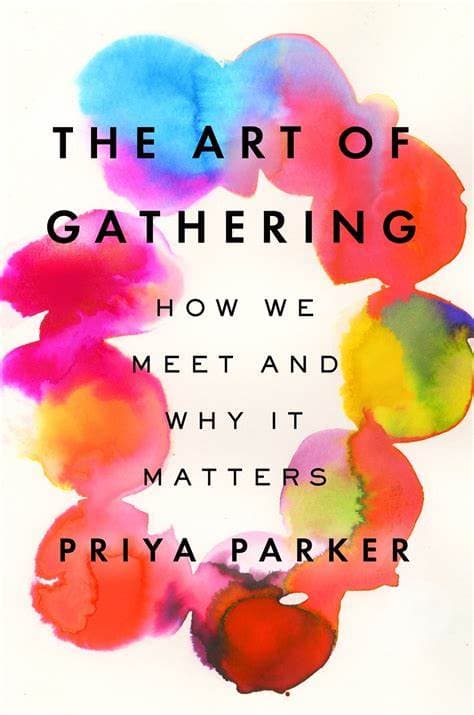
It’s no secret by now that I love bringing people together, especially when there’s an outcome in mind. I’ve found immense joy in seeing how people can connect over topics and leave a setting feeling emotionally satisfied. Best friend Jacob Kerr, often pointing towards me the best for my career, suggested I pick up this book by Priya Parker on the Art of Gathering and see if I wanted to build a niche in this area. I was hooked from the get-go. Our lives are filled with meetings, often meaningless, so having someone guide you on how to facilitate and lead powerful conversations was a welcome treat.
“We end up gathering in ways that don’t serve us, or not connecting when we ought to”
It’s easy to assume that we don’t need such a guide. We’ve been inundated in gatherings since we were a child – just think of that first birthday party you were invited to. Or how about that wedding you went to of someone your parents knew? Or even the weekly meetings you chaired for your school club? We’ve been lured into a sense of comfort that running meetings is all about agendas and timelines that we forget that the best gatherings are those that are intentionally hosted and led with purpose. We need to start with first rejecting the idea of the mediocre gathering.
“When we gather, we often make the mistake of conflating category with purpose.”
Parker anchors her guide around the concept of a purposeful gathering. A purpose is different from an agenda, or worse a category (e.g. birthday). A purpose tells you why the people you’ve specifically chosen must gather on that date in that place. For example, a birthday’s purpose could be to “bring the people the birthday person cares the most about together so that he can show his love for them”. A purpose decides many of the most important parts of a gathering, including the flow of the event, the dynamics between guests and even how to navigate last-minute changes.
We can fall into the trap of conflating category and purpose, often repeating motifs and schedules all while finally forgetting why people were set to gather in the first place. Work meetings are common victims of this. Sometimes I have to ask myself why some meetings even existed in the first place.
“To get the group to be vulnerable, he said, we facilitators needed to share an even more personal story than we expected our clients to. We would set the depth of the group by whatever level we were willing to go to; however much we shared, they would share a little less. We had to become, in effect, participants.”
The role of the host is a big one in Parker’s world. She calls for many things including the need to be selective and principled. Being a “chill” host helps no one and in fact is one of the more selfish things a host can do. Rather, by choosing the right people to come for your event and by having guests follow your plan for the evening (granted that you’ve planned it around their enjoyment and not yours), your role as a host can transform what would have been just a template evening into a transformative gathering for people. At the heart of it is the creation of a safe where people can be vulnerable and open, and where they can enter into a temporary portal before coming back into the real world. A lot of the vulnerability comes by emulation – the host must have the emotional capacity to engage and inspire.
“After the initial shock therapy of honoring and awing, you have your guests’ attention. They want to be there. They feel lucky to be there. They might well be considering giving the gathering their all. Your next task is to fuse people, to turn a motley collection of attendees into a tribe. A talented gatherer doesn’t hope for disparate people to become a group. She makes them a group.”
One of my favorite things about Parker’s guide to hosting is that she truly makes an impact through her gatherings. I’ve seen myself wanting to address a lot of issues at the community level and I’ve wondered what my value-add to society could be. Sure I could build tech products because I know how to code, or I could address economic issues because of my job, but at the heart of it, I believe my strength is in bringing people together and galvanizing them to create something beyond themselves. This could be a vision for a future, an appreciation of a phenomena or even the possibility of friendship. Gatherings are underrated yet powerful ways to change the way people live and are effective tools to tackling social issues.
There’s a lot I’ll be taking away from Parker’s book. Hope you get to see them in practice! Here are my ratings:
Readability: 5/5
Intellectual Stimulation: 3/5
Perspective Shifting Capability: 4/5
Would I Recommend? – Yes!