rovik. reads: the alchemist
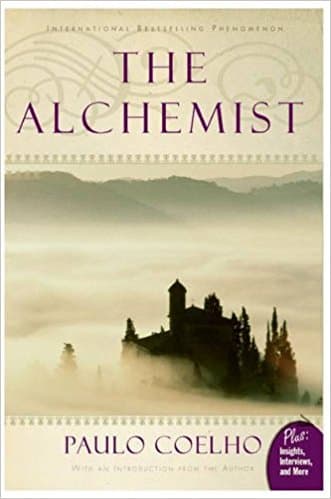
I don’t think I’ve ever read a book more than once so it was interesting to revisit The Alchemist for my book club. In our attempt to choose a short book that would accommodate everyone’s busy summer schedule, Paulo Coelho’s most famous work was shortlisted as a good compromise between being interesting and feasible. The last time I had read the book was when I was 13, so there was a layer of retrospection in seeing to what extent the book had shaped my path thus far and how a more mature (hopefully) perspective would glean new insights.
The Alchemist follows the shepherd Santiago on his journey to find a treasure hidden near the Pyramids of Egypt. He meets a number of characters along the way including an alchemist, a king, a tribal chieftain and even a romantic interest. Each character is meant to challenge or support Santiago in his journey to discover his Personal Legend, an explicit call for Santiago to find his reason for being and the thing to achieve. Ultimately, Santiago’s journey brings us on a thematic exploration through the various forces that interact with the pursuer of the Personal Legend, such as the Soul of the World, a universal binding force, or the greatest lie, a deception away from pursuing the Personal Legend.
Paulo Coelho’s work reminds me of some of my own earlier attempts at writing, where themes were so explicit they became slightly cringe-inducing. It could be because the original was written in Portuguese and the translation is not as poetic, or it could also be because Coelho wasn’t necessarily trying to tell a great story as much as he was trying to convey a message. As an older reader, I had a bit of a cynical lens to some of the simplistic claims made in the book, such as that everything can ultimately be within our control. Reality is not as gracious, and I already consider myself privileged. There are parts of the world where hope faces fierce opposition by oppression, suppression and violence. The Alchemist definitely speaks to a more idealistic class of people.
Having said that, I appreciated Coelho’s mapping of the journey of the pursuer. As a traveller and adventurer, I loved the illustration of Santiago’s journey through Moorish Spain and then North Africa, regions I have seen myself. There are reasons why travel is a useful metaphor for our own journeys to find our Personal Legends and The Alchemist demonstrates this well through vivid descriptions of terrains and ecosystems. The key lessons are also accurate. As someone who is personally coming to the tail end of my existentialist crisis, I recognize the need for features such as a Personal Legend and the Soul of the Universe. These are compass points in the now open-ended landscape I am traversing and useful indicators of how on-track I am.
Coelho is also a master at coming up with powerful quotes. I’ve collected a number for my personal preference but here are my favourites.
“And, when you want something, all the universe conspires in helping you to achieve it.”
“When we love, we always strive to become better than we are. When we strive to become better than we are, everything around us becomes better too.”
“The simple things are also the most extraordinary things, and only the wise can see them.”
“We are travelers on a cosmic journey, stardust, swirling and dancing in the eddies and whirlpools of infinity. Life is eternal. We have stopped for a moment to encounter each other, to meet, to love, to share. This is a precious moment. It is a little parenthesis in eternity.”
Here are my ratings for the book:
Readability: 5/5
Intellectual Stimulation: 2/5
Perspective Shifting Capability: 2/5
Would I Recommend? – Not urgent, but definitely a good short read