rovik. reads: strange rites
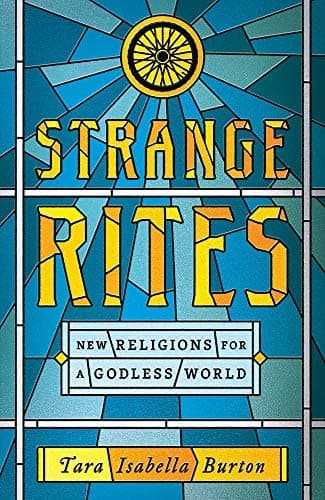
As the book club plotted on in our journey to explore the theme of spirituality, we chose Tara Isabella Burton’s Strange Rites as a focal point to explore recent trends in increased religiosity within non-religious secular communities. In this case, the fanaticism stems from Wellness culture (spin class worship and smoothie communion) or Techno-Utopianism (the algorithm is the bible), amongst other phenomena. Burton provides an engaging and entertaining look at how Americans (but honestly most “first-world” societies) have started remixing spiritual practices to suit individual needs and desires.
“A religion for a new generation of Americans raised to think of themselves both as capitalist consumers and as content creators. A religion decoupled from institutions, from creeds, from metaphysical truth-claims about God or the universe or the Way Things Are, but that still seeks—in various and varying ways—to provide us with the pillars of what religion always has: meaning, purpose, community, ritual.”
Tara Isabella Burton
Burton identifies core elements of religions to be meaning, purpose, community and ritual. I agree with her to the extent that these are patterns across most religions, although these are not necessarily the best criteria to evaluate or assess a religion by. Some religions provide moral guidance, and others suggest obligations that we may have to another, and these are also useful elements of religions that may not be found in some of these new “strange rites”. Nonetheless, we can identify Burton’s core elements across the communities she highlights, which does provide a useful through-thread.
“Today’s Remixed reject authority, institution, creed, and moral universalism. They value intuition, personal feeling, and experiences. They demand to rewrite their own scripts about how the universe, and human beings, operate. Shaped by the twin forces of a creative-communicative Internet and consumer capitalism, today’s Remixed don’t want to receive doctrine, to assent automatically to a creed. They want to choose—and, more often than not, purchase—the spiritual path that feels more authentic, more meaningful, to them.”
Tara Isabella Burton
My favourite takeaway from the whole book was this notion of “remixed” spirituality, which I found myself struggling with sometimes at a personal level. Institutional religions keep hard boundaries, understandable to a degree, but also force many to hide or reject parts of their identities in unhealthy ways. These religions rarely celebrate individuality, focusing instead on the larger institution. This is one of the big reasons why I left the church at 18 – I felt like I didn’t know who I was and the church was unhelpful in helping me discover that. I understood what the Bible said I was but it didn’t make much sense to what I was feeling or thinking at that point. The remixing of different practices and values to our own desires and needs help us support our spiritual needs and can seem like a good replacement for institutional religion. But after a while, I also realised that the lack of a broadly agreed-upon moral imperative can be disastrous for society, especially as we come into conflict with groups or individuals that have a different idea of what is right and wrong.
Unlike wellness or witchcraft, social justice culture has it all. It’s capable of taking American intuitionalism and giving it a clear shape, a clear theology. It provides a compelling nontheistic vision of why the world is the way it is, locating original sin in the structures of society itself and liberation in self-examination and solidarity. It provides a clear-cut enemy: Donald Trump, and the scores of straight white men like him who have benefited from a corrupted status quo. It provides a sense of purpose: the call to self-love (for the marginalized) and to self-denial (for the unduly privileged). It provides a framework for legitimizing emotion, rather than oppressive rationality, as the source of moral knowledge; the discourse of lived experience and embodied identity reaffirm the importance of subjectivity. In the absence of transcendent notions of the soul, or of a universal, knowable truth, or of an objective foundation of being, social justice provides a coherent framework about why and how our personal experiences are authoritative. And it has succeeded in galvanizing a moral community—a church—through its ideology and its rituals of purgation and renewal. If social justice is indeed America’s new civil religion—or, at least, one of them—it comes by that claim fairly.
Tara Isabella Burton
Burton spends most of the book looking at different communities and cultures, from the Harry Potter fandom to Leather culture to even the Incel community, and how they have become sources of spirituality and religion to their constituents. She maps the different elements of religion to each group and analyses how members have found a way to rationalise their beliefs and actions. Some cultures just have an intrinsically alluring calling while others are in ardent rejection of traditional institutions, but they all elevate the individual over anything else. In a lot of ways, “intuitional” spirituality, as Burton calls it, is an outright rejection of a theistic God and is the deification of the self.
Burton is admittedly a skeptic of most of these communities but I think we cannot reduce these groups to mere stereotypes. There is a core need being served here, whether it’s expression of identity or community support, that cannot be found in institutional religion. As individuals get access to more information online and find out about these groups, they will get drawn not just because these communities offer something, but also because they are feeling scarce back at home. These strange rites may be just the tip of the iceberg.
Here are my ratings:
Readability: 5/5
Intellectual Stimulation: 4/5
Perspective Shifting Capability: 3/5