rovik. reads: silent spring
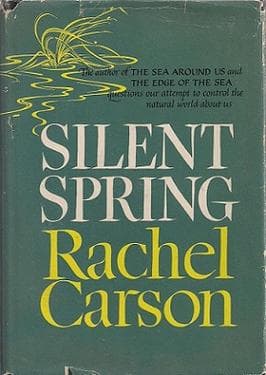
The book club went back to one of the earliest modern environmental activists, Rachel Carson, to select our first book for the quarter. Silent Spring rang the bells in the 1960s on the damaging effects uncontrolled use of pesticides such as DDT had on the health of ecosystems. Painting the image of a spring without birds singing and squirrels scurrying, Carson awoke the American public and got them to advocate for an end to excessive pesticide use. The origins of environmental activism have a lot to do with how Carson evoked imagination and created a sense of urgency.
“We stand now where two roads diverge. But unlike the roads in Robert Frost‘s familiar poem, they are not equally fair. The road we have long been traveling is deceptively easy, a smooth superhighway on which we progress with great speed, but at its end lies disaster. The other fork of the road — the one less traveled by — offers our last, our only chance to reach a destination that assures the preservation of the earth.”
Rachel Carson
Rachel Carson is a really interesting person. She was a marine biologist who started to observe the effects of rampant spraying of pesticides on whole ecologies, and recognised the need to bring awareness to the issue. However, as someone who was more familiar with writing for academic journals, she had to have been really motivated to experiment with a different style to write for public consumption. The risk of losing whole species of plants and animals compelled her to write Silent Spring, one of the world’s first books that tackled the effects big corporations had on environments.
“Nature has introduced great variety into the landscape, but man has displayed a passion for simplifying it. Thus he undoes the built-in checks and balances by which nature holds the species within bounds.”
Rachel Carson
Carson believes the man has fundamentally upended the restorative and self-balancing systems that were in place by nature. With unprecedented levels of inorganic intervention on the environment, nature has been critically altered at a pace that nature cannot keep up with. In the case of pesticides, this does not just have to do with the plants themselves, but even the soil, groundwater, rivers, insects, birds and even larger animals such as cows. Chapter by chapter, Carson looks at how our whole environment has been damaged by the seeping of pesticides into our nutrition chains, and how even our own bodies can suffer.
“Have we fallen into a mesmerized state that makes us accept as inevitable that which is inferior or detrimental, as though having lost the will or the vision to demand that which is good?”
Rachel Carson
More relevantly, Carson acknowledges the tensions between economic convenience and environmental sustainability. Even in the 1960s, big corporations were lobbying farmers and townships to increase adoption of pesticides even where it was excessive. Carson knew that she had to tackle common critiques head-on, frequently having to clarify that she was not for the outright ban of DDT, but rather the use of DDT within an integrated pest management response that include more biological tactics. The one area she was able to push through in was in creating a sense of possibility for citizens to change the future and lobby their elected representatives to save the environment and protect their health.
Carson has inspired many environmentalists and more significantly, environmental writers and content creators. Her ability to convey the technical science of pesticides to something that readers could comprehend was rare in her time, and encouraging for many others in her field.
All in all, Silent Spring is useful context-setting for the theme of sustainability that the book-club is exploring this quarter. It sets up the key tension areas and gives us a glimpse into how activists have tried to engage the larger public on the topic. The book itself is rather repetitive after the first few chapters, and is clearly outdated at some areas (Caron’s chapter on cancer really shows us how far science has come today), but it is an important piece of history.
Here are my overall ratings:
Readability: 3/5
Intellectual Stimulation: 3/5
Perspective Shifting Capability: 3/5