rovik. reads: Sapiens
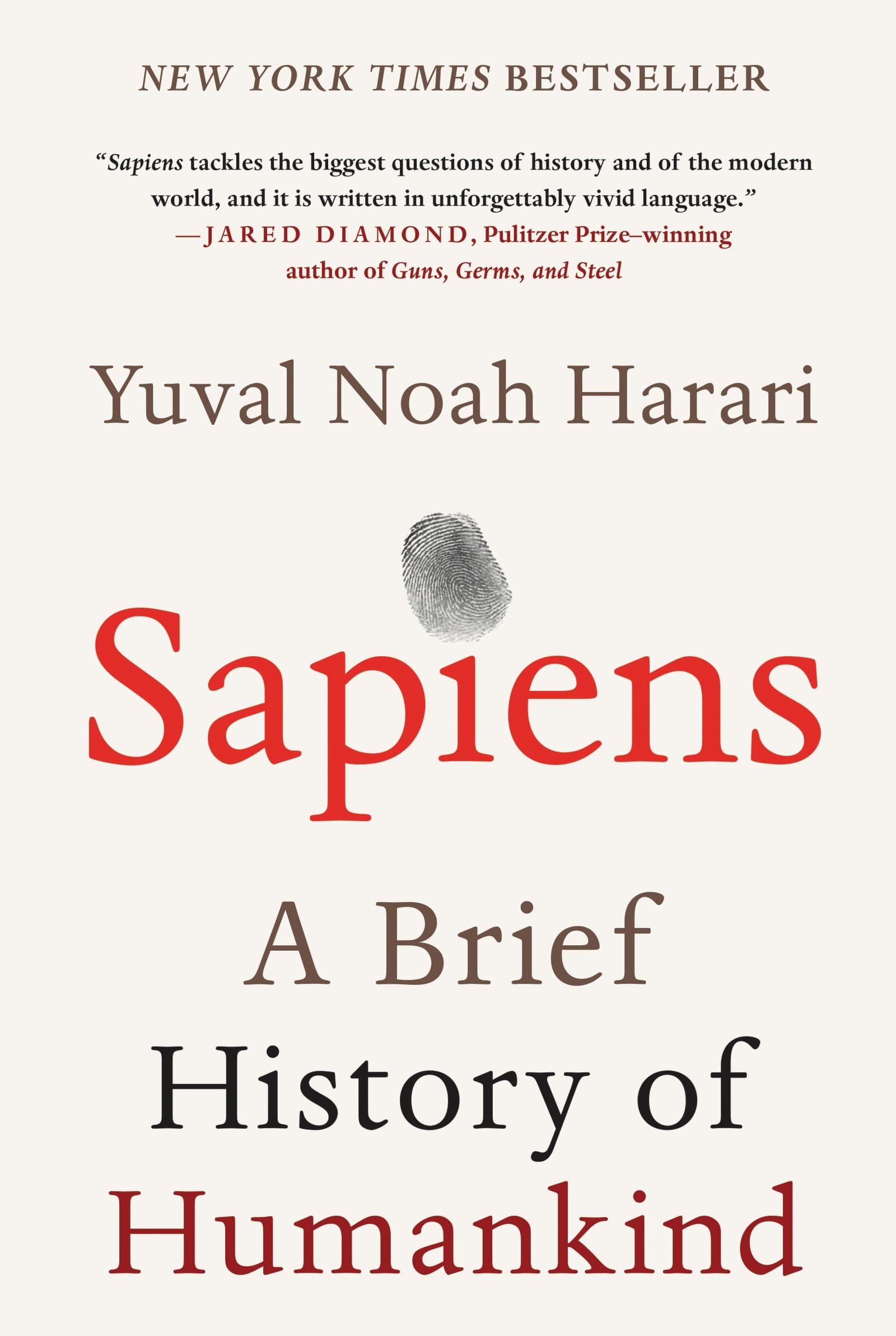
I’m going to start by saying Wow. This book shifts your perspective. I was recommended this book a friend of mine in college while we were talking about our views on life. He kept referring back to ideas postulated within these pages and while not necessarily rigorous, they seemed interesting enough for me to want to actually give it a read myself. I’m very glad I did because I now feel like I’ve been given a new pair of lenses to look at the world with.
Sapiens is written by Yuval Noah Harari, a professor at Hebrew University of Jerusalem and historian. The book works on the premise of answering some of history’s biggest questions, but essentially the overarching one of “How did we get here?” There are four main parts, each encapsulating what Harari claims to be the four big inflection points in human history:
- The Cognitive Revolution i.e. when humanity first imagined
- The Agricultural Revolution i.e. when humanity built society
- The Unification of Humankind i.e. when humanity developed money, religion, and empires
- The Scientific Revolution i.e. when humanity indulged in its curiosity and developed science
The book itself is a long read. It took me three weeks to read it and it has around 20 chapters. It is to be noted that while you could potentially breeze through the book in a week, it was impossible for me to read a portion of the book without wanting to put it down and chew on it for a while. It made me want to talk to someone about the implications of what Harari was writing and actually give it some rigorous evaluation. That’s this kind of book. It’s not for a casual read on the beach. This is a book that you want to dedicate brain power to because regardless of whether you agree with Harari’s claims, you will finish with a much more open and stretched mind.
I want to use this review to discuss one of the biggest implications of the book: that humanity’s ultimate strength is its ability to create fiction.
One of Harari’s main premises is that to truly understand the constraints we live by we have to start with physics, move on to chemistry, then on to biology and then finally history. History begins when we stop being able to explain our lives by biological terms. For example, the concept of culture cannot be explained by biology.
“Culture tends to argue that it forbids only that which is unnatural. But from a biological perspective, nothing is unnatural. Whatever is possible is by definition also natural. A truly unnatural behaviour, one that goes against the laws of nature, simply cannot exist, so it would need no prohibition.”
This is a fascinating insight because this belief single-handedly begs us to question everything we believe. Humanity’s main evolutionary advantage came when it was able to focus less on what was immediately visible and to focus more on what could be. Its ability to create fiction allowed it to build societies that agreed on common laws (fiction), hierarchies (also fictional) and even rights (ultimately, still fictional).
“Ever since the Cognitive Revolution, Sapiens have thus been living in a dual reality. On the one hand, the objective reality of rivers, trees and lions; and on the other hand, the imagined reality of gods, nations and corporations. As time went by, the imagined reality became ever more powerful, so that today the very survival of rivers, trees and lions depends on the grace of imagined entities such as the United States and Google.”
It seems heretical to say that human rights are a fictional construct but nature does not provide anyone any innate right. One may believe that God or religion did, but even then, they’re basing that on what could also controversially be claimed to be a construct. Harari delves deeper into the evolution of religion at a sufficiently rigorous level that you have to seriously ask yourself first if what you’re believing is truly from God or by Man trying to speak for God and secondly whether God can even exist considering how we have evolved.
“How do you cause people to believe in an imagined order such as Christianity, democracy or capitalism? First, you never admit that the order is imagined.”
The implications of this are monumental. Yes, there’s a lot to question about the contexts in which we live, but I’m more excited about what that means for the future. We get to shape our realities and the fictions around us. We choose what is important because we decide they are valuable. Yes, human rights may be fictional, but they’re essential and I choose to value them. It is not about being nihilistic, but about ultimately deciding we have the power to break out of constructs and shape reality around us. That’s exciting.
This is only one of the bold claims made by Harari. He documents his research well and his focus is on conveying the narrative, so for an outside reader like myself, it was very easy to start chewing on his literature. There is a fair criticism that sometimes he makes leaps and jumps, but Harari never claims to provide definitive truths and instead offers his perspectives and views. History is so muddled by itself that his work provides more clarity than it does confusion. One can trace some of his research back from the References section if they truly want to make a rigorous exploration of his ideas. I would call out that while in the early parts of his book he shows more of his balance in views, the latter shows more opinionated perspectives that one must navigate carefully. These especially seem to be in topics that he cares about passionately such as veganism and capitalism. A more comprehensive critique of the book can be found in this response written in The New Atlantis Journal.
I’m scheduled to have a book club discussion about this in a couple of weeks and I can’t wait to hear more views on this book, especially those that are counter to his claims. If you’ve read the book and have views, I’d love to hear them. It’s really exciting to hear what other ideas people have developed as a result of reading this book.
Readability: 4/5
Intellectual Stimulation: 5/5
Perspective Shifting Capability: 4.5/5
Would I Recommend? – Yes