rovik. reads: reincarnation blues
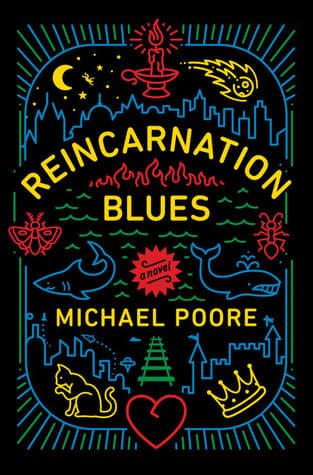
The final book in our book club’s theme of spirituality looked at a paradigm we had not discussed before: reincarnation. Thankfully, this fiction book provided an accessible entry point to the worldview, while also delivering some fun narratives in its chapters. Poore’s Reincarnation Blues follows Milo, a character who has just five lives more left to live and achieve “perfection” before he hits a 10,000 life limit. Milo, just like the rest of us, is forced to ask himself what makes a good life and whether perfection is all that worth it.
“It was yesterday, or it was a thousand years ago. There wasn’t really a difference. Time was a swamp inside a giant washing machine.”
Michael Poore
The book does not take itself too seriously, which actually is not a bad thing. Poore explores the life of Milo through the mix of an anthology style life-by-life retelling as well as more continuous narrative that follows Milo as he reaches his 10,000 life limit.
Milo’s lives are comical most times and tragic others, but he’s learned to accept, at least when he is self-aware in the transitory “afterlife”, that time does not really matter when it comes to living a life. He has been a fisherman, a space prisoner, an inventor and even a companion of the Buddha. His lives convey an important lesson: we play with the cards we are dealt with, whether we are born in the early days of civilisation or in the apocalyptic future of tomorrow. Common elements play out in all timelines – anxiety, hope, love and death.
“A life is like a wave in the river. It rises and then disappears back into the river. It rises again somewhere else. The rising and falling doesn’t make a lot of difference.”
“You mean it doesn’t matter,” said Ompati, “if Milo saved your life.”
“It doesn’t matter,” said the Master, fixing his eyes on Ompati, “to the river.”
Michael Poore
Acknowledging that time and existence is likely not to care about our individual choices, we must then confront what is the purpose of our lives on earth. This existential crisis is a common starting point in most spiritual worldviews but the reincarnation paradigm focuses on the individual and their relationship to those around them. Commonly understood as nirvana or moksha, the goal is to release oneself from the clingings of the material world and to achieve some form of transcendence.
“It’s something a wise man or a wise woman knows how to do: shake off your self pity and your obsession, and put one foot in front of the other and keep moving.”
Michael Poore
“Perfection is being happy with what you are right now.”
Michael Poore
While each individual life is an interesting read, the main value I got out of the book was Milo’s struggle and tension with what it means to achieve “Perfection” and whether it was even worth the effort. The wisdom and experience of lives past provide Milo with the basis to make courageous choices in his last lives, using his full character to make an impact to those around him.
While I am skeptical of the idea of reincarnation, I can see the value of a similar perspective in how we draw from the experience and wisdom of those who have walked before us. If we were to incorporate their life lessons into our being, perhaps we too could evolve to be able to bravely take on our lives.
Poore’s book is an interesting and refreshing read from a theme and topic perspective, but his writing style is, in my opinion, gratuitous and slightly amateurish. There were some literary elements I found questionable, such as the effeminization of “Death” as Suzie, a character who ends up having sex with Milo. His lack of care with topics such as rape and slurs is also off-putting at times. However, if you can survive past these elements, the book could still be a fresh read.
Here are my ratings:
Readability: 4/5
Intellectual Stimulation: 2/5
Perspective Shifting Capability: 2/5