rovik. reads: range
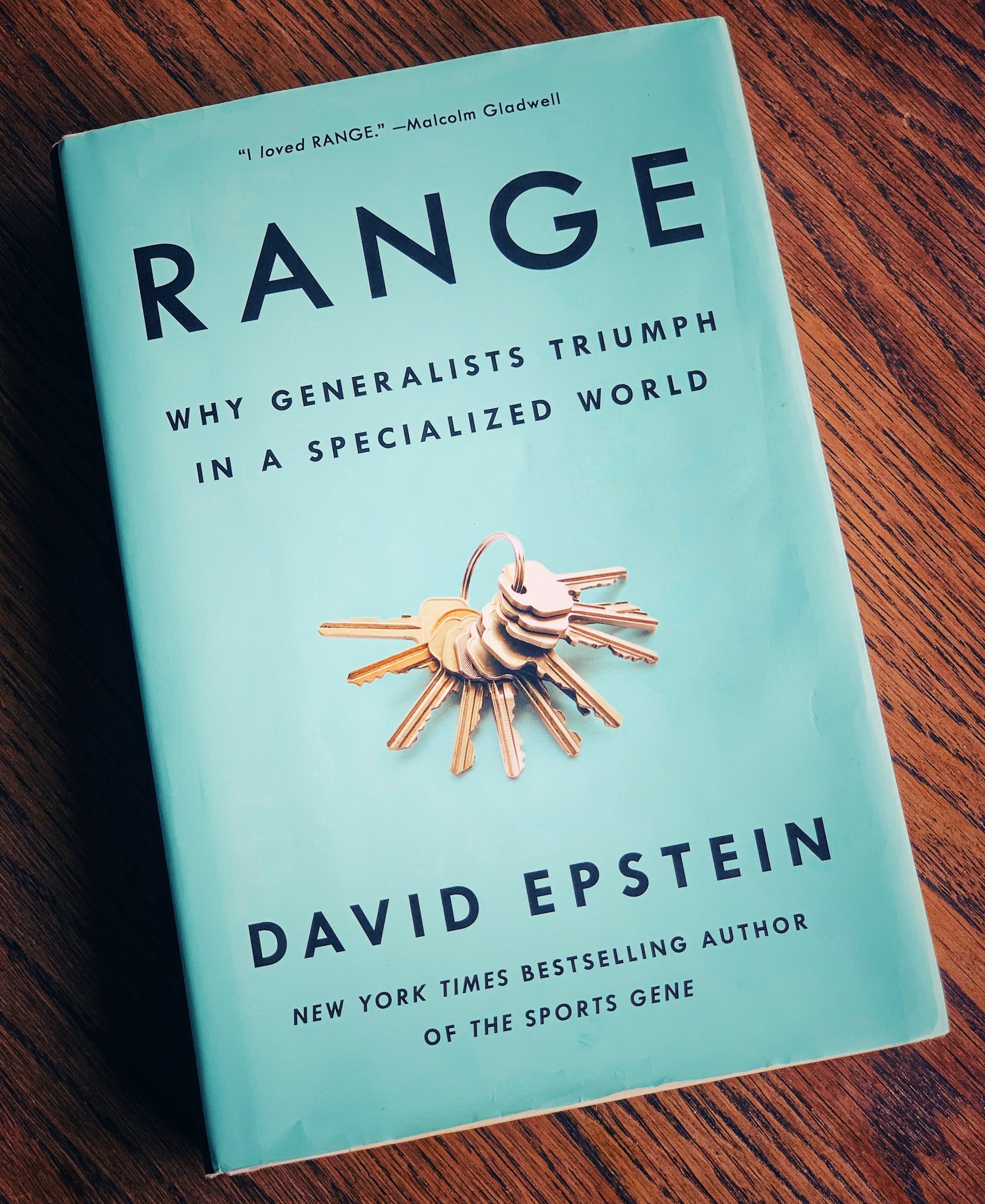
We’ve all probably heard the saying “Jack of all trades, master of none”, but few of us know that it goes on to include “but oftentimes better than a master of one”. David Epstein’s Range is a redemptive book for all of us who have valued diversity of experiences and the opportunity to build expertise from integration rather than repetition. For problems of the future, it is not those who have spent years honing their craft that will necessarily be the best in what they do, but rather those who are able to deduce patterns and identify opportunities.
“In a wicked world, relying upon experience from a single domain is not only limiting, it can be disastrous.”
Emulating Malcolm Gladwell’s style, Epstein’s book is a look at different aspects of the same thesis: people build range from variety rather than singular focus. He introduces this thesis by explaining that the problems of the future i.e. the issues people will be trying to address, are “wicked” ones. I was actually introduced to the concept of wicked problems in my Masters program to sensitize us to the notion that there are some problems that can never be solved, mainly because the requirements change frequently and the factors are difficult to control. Wicked problems don’t assume just one solution, in fact, it may require mitigation factors or satisficing strategies more than anything else. Such approaches don’t come from repeating something done in a previous scenario but from the ability to find patterns, call out blind spots, manage risk and make changes on the go. These require a broad set of experiences.
“Modern work demands knowledge transfer: the ability to apply knowledge to new situations and different domains. Our most fundamental thought processes have changed to accommodate increasing complexity and the need to derive new patterns rather than rely only on familiar ones. Our conceptual classification schemes provide a scaffolding for connecting knowledge, making it accessible and flexible.”
So on one hand, we have problems that require new approaches and on the other hand, we have knowledge that is increasing in complexity and in need of synthesis. It is no longer sufficient to just acquire new knowledge but to also be able to connect the dots and find intersections. Often these intersections cannot be found in the specializations, they are found through people who cross the lines and who perceive beyond their boundaries. These are explorers, experimenters and connectors.
“The challenge we all face is how to maintain the benefits of breadth, diverse experience, interdisciplinary thinking, and delayed concentration in a world that increasingly incentivizes, even demands, hyperspecialization”
Unfortunately, as much as Epstein’s research seems to persuade that building range through breadth is the way to go, he highlights how the world isn’t ready to incentivize such behavior yet. The world prefers certainty – deterministic systems that demonstrate success from past behavior. I can definitely see that from my own work environments, where there is a lack of interest in who people are outside of the workplace or whether they have demonstrated the ability to address wicked problems. Rather, incentives at the junior level drive behavior towards normalization and standardization – great for the short-term organization, horrible for sustainable human capital development.
“The more confident a learner is of their wrong answer, the better the information sticks when they subsequently learn the right answer. Tolerating big mistakes can create the best learning opportunities.*”
Ultimately, if there’s one thing I took away from this book, it’s that my learning quite conceptually can never stop. There will always be new perspectives to be gained and brought back to other domains. Epstein advocates for T-shaped learners, those who have a medium specialization in one area but also have substantive exposure to a broad range of domains. Being hungry for such learning, while having the stomach to make mistakes and grow intentionally, is an ingredient for success that people can do with more.
I really did enjoy Range, the examples were engaging and the points substantively insightful. Here are my ratings:
Readability: 5/5
Intellectual Stimulation: 4/5
Perspective Shifting Capability: 4/5
Would I Recommend? – Absolutely.