rovik. reads: player piano
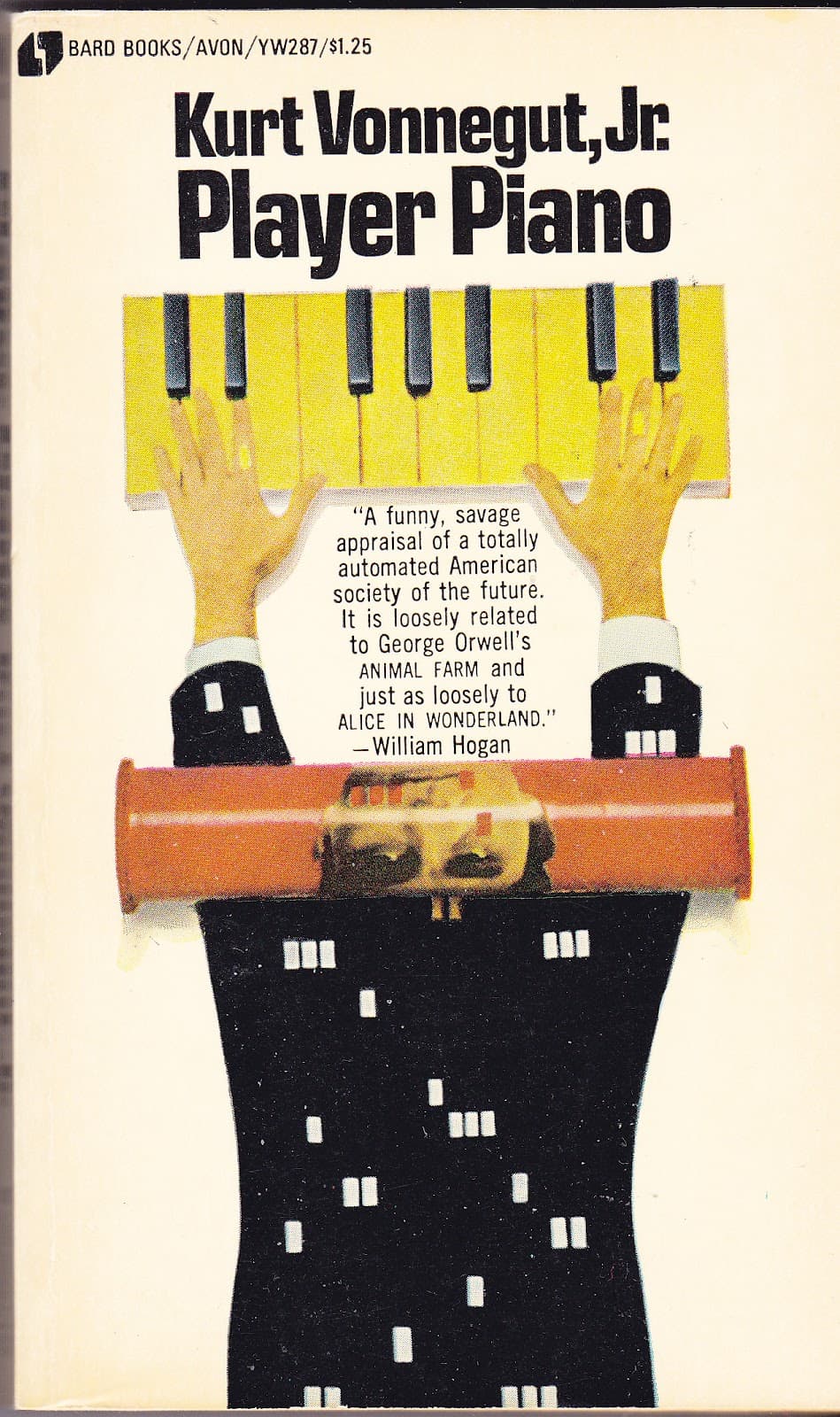
As a Computer Science major with a career dedicated to innovation and technology development, I realized the need to struggle with the ethics of unbridled automation and technology utilization. Thankfully, even before the presence of Deep Mind and driverless cars, Kurt Vonnegut attempted to portray a dystopic world in his 1952 novel, Player Piano. I was encouraged to read it as an early precursor to the current debates around technology and have to admit that I was really surprised by how much Vonnegut got right. Themes around sovereignty, efficiency and revolution come to the forefront in this novel.
The story centres mostly around Paul Proteus, son of one of the nation’s most important industrialists who led the charge in automating most of the nation’s economy, essentially restructuring the country to be industrially focussed. He became more crucial to national decisions than even the President. Paul, however, is conflicted on the role he plays in this giant machine. The increasing automation has displaced many engineers, operators and technicians, causing them to be reemployed under a national program called the Reconstruction and Reclamation Corps, also called the Reeks and Wrecks. A divide happens naturally with engineers staying on one side of the river and the rest living on the other. Paul becomes embroiled in the drama of tension between these two forces, ultimately deciding to join the revolution to overthrow the industry-driven authority.
There are a number of important moments in the book, but perhaps the most important is Paul’s realization that there is something worthy in human aspiration and purpose to preserve. The simple allocation of work according to some automated efficiency metric takes away the choice and autonomy of people to make decisions, bad or good, and learn from them in how they see themselves as people.
“What do you expect?” he said. “For generations they’ve been built up to worship competition and the market, productivity and economic usefulness, and the envy of their fellow men-and boom! it’s all yanked out from under them. They can’t participate, can’t be useful any more. Their whole culture’s been shot to hell.”
There is a stark juxtaposition between the cold, calculative nature of machines and the warm, unpredictable nature of humans. At one point, Paul’s wife, a minor foil in the story, is seen to be as comparable to a machine, with a character saying he could easily program something similar easily. There is an Orwellian string here of the humans who become closely affiliated with the machines to become more and more like machines themselves, yet ultimately failing from their human nature. Humans who become data points and simply factors of production resist the system because it is not aligned with their truths.
“The main business of humanity is to do a good job of being human beings,”
What’s the warning here? Vonnegut only imagined machines as they were back in the day, giant systems of control that were meant to drive efficiency. However, today’s machines are designed to be collaborative, with the human in mind. Machines are meant to assist rather than replace, to enhance rather than deny. Yet, this focus on efficiency and staying within the system is still a present phenomenon. Society has weak metrics for the evaluation of purpose and satisfaction and for good reason: such things are difficult to measure. However, a strong sense of technology determinism to improving the world is both misguided and dangerous for a humanity that was never meant to be cold and calculative.
“I want to stand as close to the edge as I can without going over. Out on the edge you see all kinds of things you can’t see from the center.”
There are a number of other plot moments and characters in the story but they ultimately circle back to these themes. The machines in Player Piano are not sinister like in Terminator nor manipulative as in Space Odyssey. In fact, they are simply machines, with no voice and influence on society beyond the imprinting of purpose and tyranny by their designers. It is this irony that gets me the most. We would be happy to blame the machines, but we must ultimately watch ourselves, the designers and implementers of technology. If anyone was to cause the dystopia in Vonnegut’s Player Piano, it would be us not the machines.
Here are my ratings for the book:
Readability: 5/5
Intellectual Stimulation: 3/5
Perspective Shifting Capability: 2/5
Would I Recommend? – For those looking a good fictional read, add this to your list.