rovik. reads: PAP v PAP
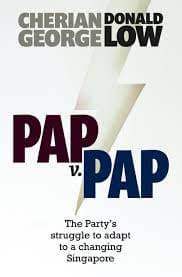
I’m bound by a professional code of conduct, one that I understand the intent of, to avoid voicing commentary on political matters. But I’m also bound by a personal code to avoid being a passive consumer of content, and to read with the intent to generate thoughts and ideas. So this review focuses on the surprisingly not infrequent unpolitical points that Cherian George and Donald Low explore on Singapore as a whole and on the principles of governance, some of which I actually found interesting and worth thinking further about.
“The central prediction of modernisation theory is that once a country is high-income, an educated, prosperous and economically more independent middle class mobilises to push for democratisation. They might so through civic groups, professional groups, unions, universities, the media and various other social groupings and civil society organistions that are not dominated by, or beholden to, the state.”
Donald Low
I found it important to read this book, not so much because I find myself aligned to the theses within, but because I found it important to contrast the common understanding within my circles with those from with-out. Donald Low and Cherian George definitely raise some interesting arguments, most not too new but still made relevant with recent episodes in Singapore’s journey. Singapore has developed fast, and as a result, its citizens want an increased stake in the decision making process for the future. We’ve seen similar patterns in other developed countries so sometimes I’m tickled when commentators seem befuddled for the growing calls for citizen engagement and participation. The rise of the citizen’s voice is inevitable, not just during election seasons, but across multiple domains, and there is a need to consider whether to flow with the energy or spend effort resisting it.
“A strong society comes from embracing diversity, not just in terms of having people who think differently and routinely challenge received wisdoms and government decisions, but more from having the requisite institutions that check and constrain the state…”
Donald Low
Low and George take a restrained position in this series of essays, arguing that it is slight shifts that are needed within the eponymous party, not anything major. Yet they also argue in favor of strong civic society, one that wields diversity to champion progress rather than collapse under the weight of it, in order to complement the state. This is an idea we’ve seen in The Narrow Corridor, which took empirical evidence to develop the same idea. Conventional rhetoric in Singapore may suggest that this is idealistic – I think it’s an idea worth entertaining.
“The deliberative space of the public sphere is not the same as the political sphere, where decisions are made by those with the constitutional authority and electoral mandate to do so. The public sphere has influence, but doesn’t on its own exercise any legal authority.”
Cherian George
I find myself sometimes tired by some of the rhetoric embedded within conversations and mindsets in Singapore – whether it’s the siege mentality, or the fear of social instability. I do not underestimate the potential for these phenomena to manifest but I also not want these to be the energies that underpin our existence. As someone who not only used to play an active role in civic society but still observes it, I find that there is room to celebrate that positive and diverse energies that these voices in the public sphere can contribute. “We the people” is a powerful utterance – one that unifies not by reducing the individual to a blip in the crowd, but by creating common ground for whole selves to engage with one another.
I enjoyed the selection of essays in this book. My biggest (non-political) takeaway was on the potential and power of civic society, something I’ll continue to believe in.
Here are my ratings:
Readability: 5/5
Intellectual Stimulation: 4/5
Perspective Shifting Capability: 4/5