rovik. reads: ministry for the future
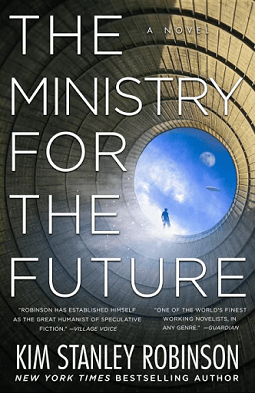
Our last book on the theme of sustainability took us to the past, so it only made sense that the next book should take us all the way into the future. Ministry for the Future is a “cli-fi” novel written by Kim Stanley Robinson, imagining a world where an international body is set up under the Paris Climate Agreement, whose mission is to advocate for the world’s future generations of citizens as if their rights are as valid as the present generation’s. Their goal is not easy to achieve but the journey is worth the read.
“The dead hand of the past clutches us by way of living people who are too frightened to accept change.”
Kim Stanley Robinson
Based on numerous actual events, Robinson paints a world not too different from ours. The first chapter opens with a massive heatwave in India that prompts the developing economy to seed the atmosphere with chemicals that can reduce the transmission of the sun’s waves to the surface, earning international criticism. The tension is brought up immediately – there is a need to protect people in the immediate term from environmental turmoil, but there is also a need to take some short term suffering to heal the world again.
Yet, not many are willing to give up their old ways and the increase in climate effects causes drastic consequences. Climate terrorists form, avenging the environment by punishing those who continue damaging the environment. Economists advocate for different public models, including the creation of a carbon-derived cryptocurrency. The scientists embark on a last-ditch effort to protect the glaciers, preventing rising sea levels. Robinson implicitly posits the question: Must we wait till there’s more suffering before acting now?
“To be clear, concluding in brief: there is enough for all. So there should be no more people living in poverty. And there should be no more billionaires. Enough should be a human right, a floor below which no one can fall; also a ceiling above which no one can rise. Enough is as good as a feast—or better.”
Kim Stanely Robinson
Robinson is clearly translating his ideology into a narrative in this lengthy novel, interwoven with poems and mysterious prose. He advocates for a more conscious form of public utility economics (acknowledging that socialism as a term just evokes too many emotions), where more of the world share responsibility for our environment. He also paints a picture of a world where everyone indeed has global citizenship – but his elaboration on this is weak given that he relents that borders must continue to exist. There are many more of these wild ideas, all tied to climate reform and a liberal view of the world, but weakly explained.
“Robustness and resilience are in general inefficient; but they are robust, they are resilient. And we need that by design”
Kim Stanley Robinson
At the end of the day though, Robinson gives us a positive outcome. The world is healed through the various economic, political and scientific efforts of mankind, and as a result, we have more sustainable models of living and working. On one hand, it feels slightly surreal to consider that we could actually end up with a planet that is not destroyed, but I also guess that it would be depressing to read a book where everything just goes south. It does give me some hope though, that with some big swings perhaps we can actually get to a healthier place with our environment. Will Robinson’s vision apply to the real world? I guess we’ll have to help prove him right.
Here are my overall ratings:
Readability: 4/5
Intellectual Stimulation: 3/5
Perspective Shifting Capability: 4/5