rovik. reads: kafka on the shore
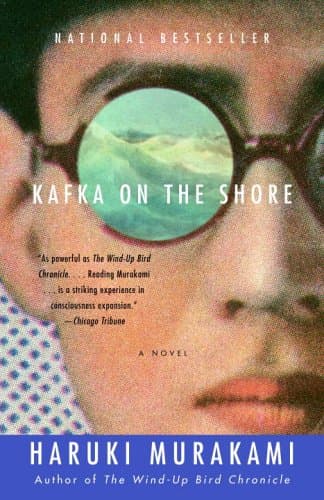
I’m surprised that it took me so long to get myself to read a Murakami book. It was rather common for every young person I knew to have read one of his quirky narratives. Often, they would cite Murakami’s ability to transport the reader to a surreal reality, one that is neither absolute fantasy nor our lived experience, yet uniquely stuck in between. Kafka on the Shore was my first approach with a Murakami story, really to take a break from the heavy non-fiction I was reading, and I’ll admit that I was very pleasantly surprised at the finish of the book.
“Sometimes fate is like a small sandstorm that keeps changing directions. You change direction but the sandstorm chases you. You turn again, but the storm adjusts. Over and over you play this out, like some ominous dance with death just before dawn. Why? Because this storm isn’t something that blew in from far away, something that has nothing to do with you. This storm is you. Something inside of you. So all you can do is give in to it, step right inside the storm, closing your eyes and plugging up your ears so the sand doesn’t get in, and walk through it, step by step. There’s no sun there, no moon, no direction, no sense of time. Just fine white sand swirling up into the sky like pulverized bones. That’s the kind of sandstorm you need to imagine.
Fair warning given to me about Kafka on the Shore was that each individual element of the story would not make sense by itself, but when put together, tells a beautiful story. Such a narrative skill is difficult to fathom, but in Murakami’s story of Kafka, a young boy who runs away from his cruel father and his curse, and Nakata, an old man who is driven by an instinct without knowledge of where it will lead him, weirdness is just a background feature to a deeper message. Both characters are subject to the harshness of fate, the thread of life that seems so out of our control yet so invasive. Kafka and Nakata both have different approaches, Kafka trying to fight his curse at all cost while Nakata fully succumbing his every being to it. This tension between fate and agency is well played out, with even the reader lost for what could happen next.
“What I think is this: You should give up looking for lost cats and start searching for the other half of your shadow.”
Elements such as the curse, Nakata’s ability to talk to cats, lucid dreams and spirit projections demonstrate Murakami’s vivid imagination and his embodiment of the inevitable force that is fate. What drives these characters to still seek agency is their search for meaning and fulfillment, what Murakami alludes to as their “other half of their shadow”, a part of themselves that they must find and confront. This sometimes is found in the sandstorm, the brutalistic core of fate.
“Things outside you are projections of what’s inside you, and what’s inside you is a projection of what’s outside. So when you step into the labyrinth outside you, at the same time you’re stepping into the labyrinth inside.”
Such engagements take on peculiar forms themselves. I don’t want to spoil the book, but there are beautifully painted backdrops against which Kafka and Nakata make wild choices and move forward in their discovery of themselves. Murakami balances setting, characters, poignancy and ludicrousness in a delicate mixture such that the reader completes the book as if having tasted a unique omakase menu at a restaurant. Be prepared though, when things go crazy, they really do.
Readability: 5/5
Intellectual Stimulation: 3/5
Perspective Shifting Capability: 2/5
Would I Recommend? – It’s a good light read – if you have the craving for something different!