rovik. reads: how will you measure your life
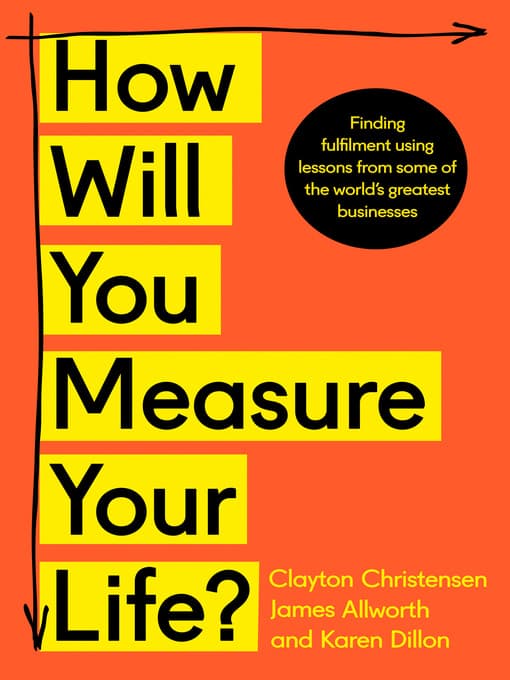
In general, I tend to be skeptical of self-help books. Most of them tend to be common sense repackaged with new lexicon and slang. So when Hui Wen passed me this book to commemorate our time working together, I convinced myself that this book must have had some unique value for a trusted colleague to be able to boast so much about. Clayton Christensen was also not an unfamiliar name – a lot of Singaporean public servants like to point to him as a fresh modern day thinker so I coincidentally saw it as an opportunity to see myself what all the fuss was about. The book did not disappoint. Providing original perspectives across career, family and the self, How Will You Measure Your Life is a reminder that we all need to evaluate where we are in our lives in relation to who we want to be. Here are some of my favorite sections.
“In our lives and in our careers, whether we are aware of it or not, we are constantly navigating a path by deciding between our deliberate strategies and the unanticipated alternatives that emerge.”
“As you go through your career, you will begin to find the areas of work you love and in which you will shine; you will, hopefully, find a field where you can maximize the motivators and satisfy the hygiene factors. But it’s rarely a case of sitting in an ivory tower and thinking through the problem until the answer pops into your head. Strategy almost always emerges from a combination of deliberate and unanticipated opportunities. What’s important is to get out there and try stuff until you learn where your talents, interests, and priorities begin to pay off. When you find out what really works for you, then it’s time to flip from an emergent strategy to a deliberate one.”
Christensen spends a good amount of time talking about the need to be responsive while having a goal and vision. We can easily get occupied with a definitive view of our lives in relation to the world, including aiming to achieve a certain set of outcomes (e.g. being able to buy a car), that we miss out on opportunities that emerge or hazards to avoid.
I could definitely relate to that as I’m a year into my career at my current organization and I have put on a laser focus on a goal I know will take much dedication to achieve. Yet as I move towards that goal, formulating steps and strategies to reach there, I have to catch myself on whether I’m blindsiding myself from interesting opportunities to learn and broaden my horizon. Projects that may not necessarily build my skillset for my career goal may still be good projects to help me learn about newer domains that could one day be useful to know about. It’s a recognition that there’s much more to learn than what we think we should learn about, and that the only way to learn those things is to put yourself out there.
The beauty of life is not in the formulaic determinism of plans but in the interplay between logic and chance. We become better at life when we learn to both have a plan and respond to randomness.
“I genuinely believe that relationships with family and close friends are one of the greatest sources of happiness in life. It sounds simple, but like any important investment, these relationships need consistent attention and care. But there are two forces that will be constantly working against this happening. First, you’ll be routinely tempted to invest your resources elsewhere—in things that will provide you with a more immediate payoff. And second, your family and friends rarely shout the loudest to demand your attention. They love you and they want to support your career, too. That can add up to neglecting the people you care about most in the world. The theory of good money, bad money explains that the clock of building a fulfilling relationship is ticking from the start. If you don’t nurture and develop those relationships, they won’t be there to support you if you find yourself traversing some of the more challenging stretches of life, or as one of the most important sources of happiness in your life.”
“Intimate, loving, and enduring relationships with our family and close friends will be among the sources of the deepest joy in our lives.”
Christensen spends a good amount of time talking about family and relationships. It is here where he introduces concepts of “Jobs to be Done”, resourcing, and outsourcing – common analogies that I hear in the public service nowadays. It’s interesting because Christensen introduces them as business topics but applies them to interpersonal phenomena. For example, he highlights that a husband may need to recognize their “Job to be Done” is to provide support and a listening ear to the wife rather than to simply help alleviate their household chores, similar to how a hypothetical policy team may need to realize their “Job to be Done” is to create a safe working environment rather than to perpetually create policies.
If you’re intrigued by such analogies, you’ll find much value in these chapters of his book, but I personally appreciated the focus and attention Christensen placed on investing into families at early stages and then consistently after. Relationships can never be taken for granted and must always be treated with as much intentionality as can be afforded. Spend time and effort on the people that matter in your life because you will ultimately recognize that they brought you the greatest joy.
“It’s easier to hold your principles 100 percent of the time than it is to hold them 98 percent of the time.”
“Resources are what he uses to do it, processes are how he does it, and priorities are why he does it.”
The last section is on integrity and values, and ultimately focuses back on the title of the book – How will you Measure your Life? Christensen firmly believes that we will define our own metrics by our values, but it is there that we must have absolute fortitude. Personally, I was moved by his own experiences defending his values in the face of life’s many scenarios. I have definitely given myself chances and excuses to concede my values for temporary comfort and joy but Christensen is right to point out then that we do not live according to the purpose we have identified for ourselves.
My theme for 2019 was Purpose and Priorities – living with a north star that would keep me from danger and sloth. As a human, I’ve erred plenty this year. But I can’t always depend on that excuse. Christensen is on point to call out that we need to measure our lives regularly and to ask ourselves if we are resourcing, doing and aligning according to what we value. Much to think about and much to ponder.
If you’ve read the book, I’d love to hear your thoughts. How did it provoke you and what did you try to change about your life?
Here are my ratings:
Readability: 5/5
Intellectual Stimulation: 4/5
Perspective Shifting Capability: 4/5
Would I Recommend? – Yes!