rovik. reads: hillbilly elegy
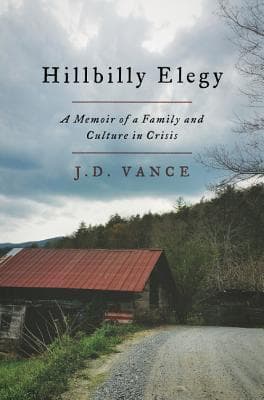
I was looking for something different to read from the philosophy-heavy material I had been consuming recently and I chanced upon J.D. Vance’s Hillbilly Elegy on a couple of recommended reading lists. The memoir of someone who had grown up in ‘working class White America’ appealed to me as a different narrative from what I was bombarded by in college. After all, I was told to be able to hear someone’s narrative and respect that their experience plays a big role in how they interact with the world. I hadn’t heard too many stories from this part of the US and was curious to what I was potentially going to learn.
Vance starts by qualifying his life a bit, stating that while he truly did grow up in the Appalachian Region (a region I never knew was socio-politically significant as a non-American), he at times has to claim the exception rather than the rule. He did manage to get into Yale Law School and he did sign up to go into the military and those are not things everyone in working class White America does. He also claims that while his story will ultimately deal with class more than anything else, the effects of race are more nuanced than explicit. “There is an ethnic component lurking in the background…sometimes these broad categories are useful, but to understand my story, you have to delve into the details…I do not identify with the WASPs of the Northwest. Instead, I identify with the millions of working-class white Americans of Scots-Irish descent” he states, distinguishing that even within whiteness we cannot claim a monolith. These are interesting qualifications because they suggest that the story about to be told has to be read more critically than originally intended. This isn’t just a story of someone’s life – this is an opportunity to piece together some vital clues on why a region has developed to where it is and how one can find his way out of it.
Another useful note about the book is that while it wasn’t written to explain Trump’s election (it was published June last year), it quickly became a tool to understand why the nation voted the way it did. Why did so many states where significant populations of white blue-collar workers exist, vote red instead of blue like some used to? Why did Michigan and Wisconsin turn its back on the Democratic party? It’s difficult to claim some of Vance’s points as foundational reasons because he doesn’t directly draw those connections. He may now act as a pundit on blue-collar white America, but his story has become more of a tool to explain away the 2016 election than anything else. “Here lies the reason!” I can imagine someone claim as they insist the book join the reading list of hundreds of school in the nation. These drive even wider implications into how we read this book. This isn’t supposed to be the bible on the Appalachian region, but it suddenly has become exactly that. There are few if any narratives on life in the area. Off the top of my head, I immediately think about To Kill a Mockingbird and tales of Tom Sawyer, and I’m not even sure if they’re based on the same region. Those are outdated and not immediately relevant to understanding the current profiles of people. One could argue that White people have enough coverage as it is – that minorities require more focus than anything else – but I can only speak to the fact that learning about this part of the US was something I was never given the opportunity to do while in college and in the US.
There are two main things I want to talk about in this review. One in favor of the book and one not so.
Vance makes a number of important claims in his book. He summarizes them well in the beginning, draws example as he goes through his life semi-chronologically (sometimes bouncing into the future and then quickly back), and then drives his point back home. One of his biggest points is the importance of loved ones in your life. This is something I definitely take for granted. I have a family who loves me and is there to show me they love me. I have the privilege of being miles away from home but have parents who will top up my mobile data for me if I’m stuck in the rural mountains just so that they can call me. This is something that I can never appreciate enough but also something that is difficult for people in broken families to empathize with. Vance draws a comparison to black families that are frequently shown to suffer from absent father figures because of crime and drugs. White hillbilly families have similar situations, he claims. Drugs, domestic abuse, and dissatisfaction are frequent themes that appear in multiple forms. These are issues that are innately tied to class. As the main institutions of support – large corporations that required labor and provided good insurance and family support – left these areas, government was expected to fill in the gap and as it regularly has done with the poor, it performed poorly. Vance shows that at the end of the day, the only reason why he was able to escape it all was because of the love and consistent presence of his grandmother (who he affectionately calls Mamaw) and some of his other family members. It was only because there was someone who chose Vance’s future over their own ‘present’, that Vance survived the multiple traumatic experiences he had as a child growing up. These experiences are not just his own, he continues to claim. Multiple other ‘hillbillies’ have reported to him strong feelings of empathy with his experience and learnings. It becomes even more painful then to learn that the foster care system doesn’t easily permit extended family members from taking over the role of foster parents when actual parents fail. It seems like children raised in the region are set up for failure if they’re not born into the right family.
Which brings me to my major contention. Vance sets all of this up but then displays his own ability to overcome, once again claiming that it was his Mamaw and his aunt and his one dad who brought him to church amongst others who gave him the support he needed to believe in himself. He makes important points on mental health amongst the Appalachian community, talking about how anger is not handled well amongst them. He even talks about how he overcame the rhetoric back home that he couldn’t achieve more with himself. He shows us how he succeeded but then goes back and makes a disturbing claim. This isn’t everyone else. Regular people in blue-collar white America don’t want to work for their pay, they feel entitled to a basic pay. The Appalachian folk hate the Democrats because they give help to those who don’t work, so they feel like they shouldn’t work hard too. Vance quickly paints a picture of the present that dissonates with the picture of himself, one that rubs a lot of readers the wrong way. I personally can understand what he’s trying to do. He’s trying to explain a phenomenon. He’s trying to speak from what he’s seen or heard to justify what is actually happening in his community. But that’s where the book ultimately fails. Hillbilly Elegy is not written by a sociologist or a someone aiming to provide a theorized understanding of what’s happening in America. It’s written by someone trying to tell his story, and I’m glad that he did. But when you use that story as an authoritative piece on what the region looks like, you see a failure that has repeated itself through the history of identity politics. Your experience, while frequently can connect you to others’ experiences, can rarely be sufficient to justify policy or thought change. It’s the dialoguing through the experience and the ability to elucidate clear themes that can be patterned out systemically from other experiences that make identity stories actually useful in addressing real human lives.
We need to hear more stories from people like Vance, and in fact, people not like Vance. What’s the story of Vance’s mom’s nurse colleague, or his beloved uncle? Politics is like popular culture now and while we all want to seem educated, few want to pick up an academic paper. Stories like Vance’s act as proxies to this convoluted and messy world. In its novelty, the book has become both a powerful tool but also a dangerous force. The ability to be critical is important in this regard.
I took 3 weeks to read it, but I was reading very leisurely (one chapter a couple of days) as I was reading while traveling. Here are my ratings for it:
Readability: 5/5
Intellectual Stimulation: 3/5
Perspective Shifting Capability: 4/5
Would I Recommend? – Yes