rovik. reads: heidegger and a hippo walk through those pearly gates
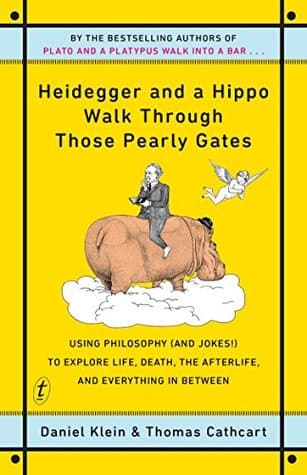
Heidegger was quite controversially a Nazi “sympathizer” but he and his overall positions on existence have been understood to be crucial to the wider philosophy genre. So when I was given this book as a Secret Santa gift from a good friend and colleague, I was curious to see what I could stand to learn from a book that dove head-on into the messy and cloudy realm of death and existence. Rather than act as a single thesis, this book from Cathcart and Klein is a light-hearted sprint through the various perspectives on the heavy topics, interlaced with comics and jokes. Curiosity begets more curiosity, and if that was the point of the book, I’d declare it successful in driving me toward wanting to know more.
“It’s only when we dare to experience the full anxiety of knowing that life doesn’t go on forever that we can experience transcendence and get in touch with the infinite. To use an analogy from gestalt psychology, Non-Being is the necessary ground for the figure of Being to make itself known to us. It’s only when we’re willing to let go of all of our illusions and admit that we are lost and helpless and terrified that we will be free of ourselves and our false securities and ready for what Kierkegaard calls “the leap of faith.”
Heidegger and a Hippo walks us through the various themes surrounding death and existence including Immortality, Heaven, Eternity and even Biotechnology. It draws from the likes of Socrates, Kierkegaard, Nietzche, and the authors’ personal favorite – Woody Allen, to provide a range of contrasting and evolutionary views on the lenses we can adapt to approach life. I personally took away a bunch of new ideas, including recontextualizing time as both an eternal and momentous phenomenon. It also provides advice on how we can encounter life knowing that death is inevitable – whether it be by committing to actionable faith as recommended by Kierkegaard or to avoid the mundane as advised by Heidegger.
Such books are good for providing a quick and easy entry point to admittedly difficult topics. However, Cathcart and Klein do get a bit tiring with their forced segues into jokes and ad-libs. Some chapters are mostly jokes and not enough philosophy. I’ll readily admit that this wouldn’t be a book I usually pick up but because it was a gift, I gave it a shot. If you don’t want anything too serious on your reading list, however, then this book is definitely for you. If not, this book could be a good roadmap to the philosophers you’d want to read more from. I’m personally curious to hear more of Heidegger and Kierkegaard’s material, albeit modern adaptations perhaps to avoid the convoluted language.
Here are my ratings:
Readability: 3/5
Intellectual Stimulation: 3/5
Perspective Shifting Capability: 4/5
Would I Recommend? – Only if you want a brief intro to Existentialist Philosophy