rovik. reads: ficciones
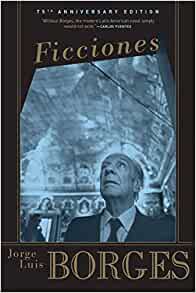
Whenever I tell people I’m reading Ficciones, I’m either met with confusion on who Borges is or utter excitement for what I was about to encounter. Before being gifted Ficciones by a friend through my book club, I’ll admit my ignorance in not knowing who Borges was. Yet, as I learned more about how he was a major figure in Spanish literature and the role he’s played in influencing many storytellers, I read this book with a lot more appreciation of the worlds Borges was creating. Each story is dense with imagery and philosophical ideas to an extent that I’ve never seen before, and I’m still brooding on a lot of them.
“It is a laborious madness and an impoverishing one, the madness of composing vast books – setting out in five hundred pages an idea that can be perfectly related orally in five minutes. The better way to go about it is to pretend that those books already exist, and offer a summary, a commentary on them.”
Jorge Luis Borges
Ficciones is a collection of short stories, each one distinct but also vaguely similar. Borges employs some unique styles, taking almost a magical realism approach where the content starts off dry and procedural (e.g. a review of an author’s writings) but starts to include nuggets of surprise and wonder. He has a fascination with infinity and structure, paradoxes and histories.
“When it was proclaimed that the Library contained all books, the first impression was one of extravagant happiness. All men felt themselves to be the masters of an intact and secret treasure. There was no personal or world problem whose eloquent solution did not exist in some hexagon. The universe was justified, the universe suddenly usurped the unlimited dimensions of hope.
At that time a great deal was said about the Vindications: books of apology and prophecy which vindicated for all time the acts of every man in the universe and retained prodigious arcana for his future. Thousands of the greedy abandoned their sweet native hexagons and rushed up the stairways, urged on by the vain intention of finding their Vindication. These pilgrims disputed in the narrow corridors, proffered dark curses, strangled each other on the divine stairways, flung the deceptive books into the air shafts, met their death cast down in a similar fashion by the inhabitants of remote regions. Others went mad …
The Vindications exist (I have seen two which refer to persons of the future, to persons who are perhaps not imaginary) but the searchers did not remember that the possibility of a man’s finding his Vindication, or some treacherous variation thereof, can be computed as zero.”
Jorge Luis Borges
Perhaps most cheeky of all is that Borges incorporates twists and inversions in many of his stories. I still remember the short story, Death and the Compass, that traces a detective and his hunt for his nemesis, the Red Scharlach. Yet, through the detective’s own obsession with logic, he falls prey to a product of randomness. Or the story of the Library of Babel where every permutation of characters is contained within books, and therefore there stands to reason that each person’s complete story (and “Vindication” as in the quote above) is already written. Yet, in the pursuit of one’s Vindication, some die a cruel death, ending their story before they can see it. These are ironies and challenges that Borges conveys in prose but tap onto deeper intuitions about the worlds we actually live in.
“I imagined a labyrinth of labyrinths, a maze of mazes, a twisting, turning, ever-widening labyrinth that contained both past and future and somehow implied the stars. Absorbed in those illusory imaginings, I forgot that I was a pursued man; I felt myself, for an indefinite while, the abstract perceiver of the world. The vague, living countryside, the moon, the remains of the day did their work in me; so did the gently downward road, which forestalled all possibility of weariness. The evening was near, yet infinite.”
Jorge Luis Borges
I cannot possibly start to imagine what goes through Borges’ mind. I actually followed up each short story with some research on what others have taken away from the story, and I’ve always missed something out. Each story can be re-read a couple of times and you’ll always pick up something new and interesting. I guess in some ways, those are the best kinds of stories. I’m just glad I got introduced to the worlds of Borges.
Here are my ratings:
Readability: 3/5
Intellectual Stimulation: 4/5
Perspective Shifting Capability: 4/5