rovik. reads: art of cruelty
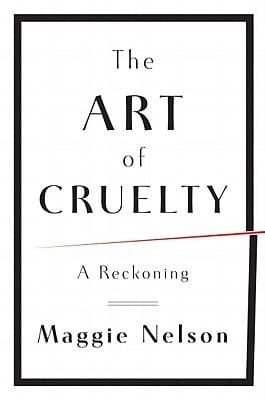
The book club reconvened for a conversation on a book not many of us would have picked if not for our resident art history enthusiast. Regular readers would recognize the similar sense of struggle I had dealing with John Berger’s Ways of Seeing but I’ve learned to appreciate the perspectives endowed in such critiques. Maggie Nelson, celebrated for her interdisciplinary take on a number of topics, brings her mind to the arena of cruelty in this collection of essays. Our culture, from the mainstream to the avant-garde, has a fascination with the gore and vicious, sometimes even forcing it onto the viewer in a self-justified pursuit of truth . This book explores the vast landscape in the treatment of cruelty in our lives and highlights some major controversies and issues.
It’s really difficult for me to review Art of Cruelty’s actual theoretical contributions mainly because I myself struggled to understand some of Nelson’s subtler points. She encompasses a wide range of applications for mainstream media to the news to feminist critique to even literary cruelty. Each chapter is an essay probing into a particular domain of cruelty but all ultimately guided by Artaud’s main prompt in his Theater of Cruelty, the creation of a work which “wakes us up. Nerves and heart,” and through which we experience, “immediate violent action,” that “inspires us with the fiery magnetism of its images and acts upon us like a spiritual therapeutics whose touch can never be forgotten.” For a more comprehensive critique of Nelson’s actual contributions in the art critique space, I’d recommend this useful Slate article I found. To my readers however, I contribute my own perspectives on cruelty, inspired by Nelson’s challenges and open questions.
One of Nelson’s key questions is whether the confrontation of cruelty is truly as Aristotle puts it – cathartic.
“Katharsis arrives in English virtually untranslated, as “catharsis,” which derives from katharos—“pure.” But the word has stretched to signify or entail a wide variety of processes, including clarification, enlightenment, purgation, elimination, transubstantiation, sublimation, release, satisfaction, homeopathic cure, or some combination thereof. Second, the phrasing of Aristotle’s original sentence leaves it unclear whether “catharsis” applies to incidents or to emotions—that is, whether the action takes place inside an individual, outside of her, or somewhere in between.”
It is an interesting challenge because my own experience with cruelty has tended to either be indulgent (like Game of Thrones) or provocative (like McDonagh’s Pillowman). Nelson begins by recognizing that simply because the artist wills the work to be thought-provoking it may not be so. There are not so obvious lines that we and society have to choose not to cross but often they only become obvious once we cross them. How do we entertain the use of pointed, deliberate cruelty in our mediums and yet shudder when we see the photos of sadistic torture in Abu Ghraib. Is there really catharsis in cruel pieces? More importantly, Nelson asks is there ANY use in manifesting cruelty?
“While the two words often arrive sutured together, I think it worthwhile to breathe some space between them, so that one might see “brutal honesty” not as a more forceful version of honesty itself, but as one possible use of honesty. One that doesn’t necessarily lay truth barer by dint of force, but that actually overlays something on top of it—something that can get in its way. That something is cruelty.”
The ways we have adapted our lives to possess different sensitivities in different domains may encourage some use of shock, horror and revolt to confront the meaning of it all. Nelson doesn’t believe it’s all encompassing, there are ways to do it wrong but those ways are just as obscure as the ways to do it right. It is in this void of understanding that art has some use.
“Whereas an art that affects you in the moment, but which you then find hard to remember, is straining to bring you to another level. It offers images or ideas from that other level, that other way of being, which is why you find them hard to remember. But it has opened you to the possibility of growing into what you are not yet, which is exactly what art should do.”
Another key point of Nelson is on the agency of the spectator. Frequently, such pieces are designed with an audience in mind, either engaging with the actual content or more traditionally just watching. Of course, today’s art is easier to implicate the audience, both in physical spaces such as Ana Mendieta’s rape piece as well as in virtual spaces through affordances such as likes and retweets. Nelson is most obviously against the use of surprise in putting the audience through a cruel moment, but recognizes simultaneously that sometimes the power of cruelty occurs in its shock. It is here where she provides a proposal that is worth adopting: the exercise and recognition of consent.
“The problem is, of course, that art typically requires an audience, which loops us right back to the problem of observing actions and losing ourselves in consideration of their imagined form.”
The audience can usually comfort themselves in the lie that such cruelty is only temporary – it is but a means to an artistic end, but does that reduce the actual impact of cruelty on the audience? Are we less brave if we choose not to participate, and are we naive if we convince ourselves that we can live our lives without such cruelty? Nelson alludes to the fact that such absolutes do not exist in art – the audience is equally at stake in shaping how the piece implicates and the provision of consent in the treatment of cruelty is critical in allowing the audience to make the transformation journey themselves. Yes, that means the audience member can simply walk away, but that empowers them all the more to find meaning in the choices that they do make.
Art of Cruelty is a really tough read but it’s an important one. In an age where desensitization to topics such as cruelty is a possibility, it is important to consider how we treat darkness and violence in a world where moral relativity is in fashion. I still have a lot of thoughts but they are wiser and more confused – signs of a more realistic position on this sticky issue. Hopefully if you do read this book, you’ll end up at a similar place.
Here are my ratings for the book:
Readability: 2/5
Intellectual Stimulation: 5/5
Perspective Shifting Capability: 4/5
Would I Recommend? – For your next challenging read.