rovik. at the theatre: the birthday party
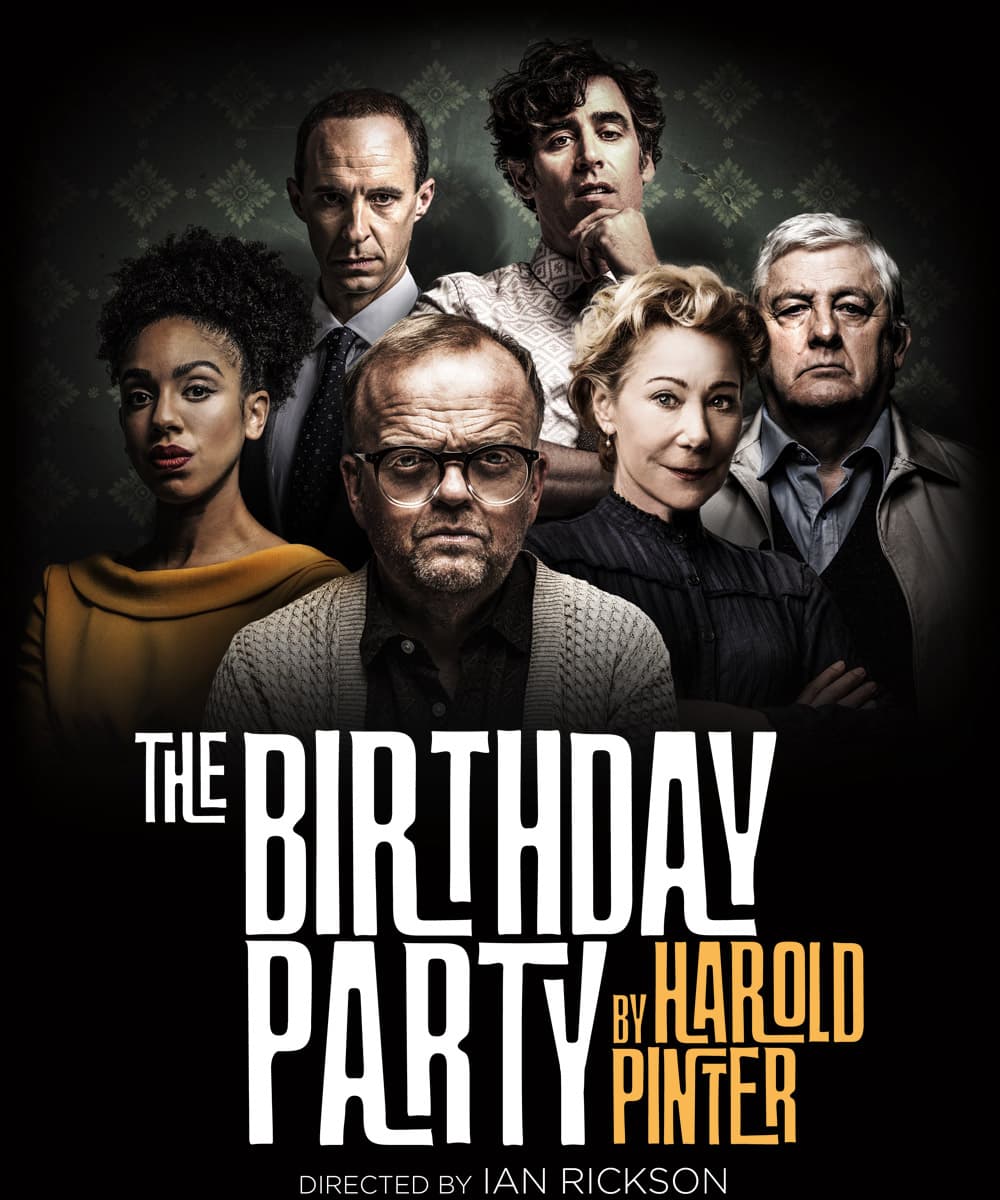
The absurd has become something of a familiar place recently. I had heard about Pinter’s association with the likes of other famous absurdist thinkers such as Camus and Kafka and was very excited to see The Birthday Party being put on in London. Seeing Toby Jones and Pearl Mackie, two of my favorite English actors, as part of the cast convinced me to buy a ticket for what ended up being a true delight for the intellect. I won’t spoil the play because I highly encourage anyone in London to try to catch it during its limited showing, but I will discuss alongside my review of the actual play, some of the key themes addressed in this ‘comedy of menace’.
For those who are unfamiliar with absurdism, the way of thinking evolved out of post World War 2 Europe when the world seemed like a bleak place. It essentially is an observation and reflection of humanity’s quest to seek meaning and purpose in a world that doesn’t seem to provide any. It is not nihilism in the denial of meaning in life, but rather an acceptance than meaning seems elusive and may not be the object of pursuit. If you want to explore absurdism in a digestible way, Franz Kafka’s stories are a deliciously addictive way to do so.
The Birthday Party takes place in a ‘boarding house’ in an English seaside town. The time and exact location are not immediately known, and hints are given throughout the play with a care to not give enough to be precise. The cast is a small ensemble – we have Petey and Meg who own the boarding house, Stanley who is the only actual boarder, Lulu who is a young attractive woman in her 20s that is a friend of the owners, and finally Goldberg and McCann who are suited men that are interested in staying for a couple of nights.
The status quo, one that is established as a routine without change is set up to be challenged. The meaning of actions, in the beginning, is worth less than the actions themselves. Meg is an almost stereotypical illustration of the domesticated housewife, focussing on preparing meals and ensuring that the men in the house are satisfied. Petey, her husband, is more than happy to not only entertain this but support it as well. Stanely, on the other hand, is a symbol of rebellion, only to the level where it excites the mind but does not actually engage in action. He berates Meg and then compliments her, calls her ‘succulent’ but then insults her ability as a wife. It is teasing, flirtation and everything that a Kierkegaardian would despise.
Introduce Goldberg and McCann, symbols of disruption, who ironically enter suited up as businessmen, stiff and proper. They hint at a possible ‘assignment’, again another misdirection by Pinter that things may become clearer. What is initially a slightly comical reenactment of monotonic countryside life is turned on its head by the dark intentions of these characters. They convince Meg to throw a birthday party for Stanley upon hearing that it’s his birthday (we never find out if it actually is), and that’s where the story becomes really exciting. I won’t spoil the rest of it, but I’ll just say that Meg’s delusions of routine and Stanley’s desire to be a rebel get challenged. We see in different ways how humanity fails to truly embrace the absurdity of the world and instead double back into areas of safety or comfort.
The play as a whole is a treat because the audience must decide if they want to pause and process the event that just passed or indulge in the visual spectacle continuously being presented in front of them. There’s no time to think, but think you must. Pinter artfully places silences and pauses that suggest relief but instead convey intense tension. The setting is perfect and the characters more layered than what first meets the eye.
I was personally a big fan of the performances of all the characters. Toby Jones did not disappoint as a convincing Stanley that conveys the madness of his character but Zoë Wanamaker (Meg) and Stephen Mangan (Goldberg) were the actors that truly carried the moral weight of the play. The set was beautifully bland (in the spirit of the scene) but dynamic and versatile in conveying the areas in and out of our sights. There are themes of sexuality, truth, and deception that are well complemented by intentional lighting, prop use (they use a lighter/match flame frequently in the play), and staging. Visually, you will not be disappointed, especially in the Harold Pinter theatre where space is appropriately tight to convey an almost portal-like sensation. The play does not do much for women, and perhaps it is a function of its period of conception, but it’s disappointing that such strong actresses don’t have much depth beyond being means to convey the cruel ends of the male characters.
Watching theatre in London, not just West End shows but independent and art shows as well, is a privilege that I’m glad I was able to afford. The Birthday Party is one of those decisions that I’ll look back at my time in London and be grateful I had the opportunity to take advantage of. Here are my ratings:
Script: 4.5/5
Performance: 5/5
Production: 5/5
Overall: 4.83/5