rovik. and friends discuss: secularism in politics
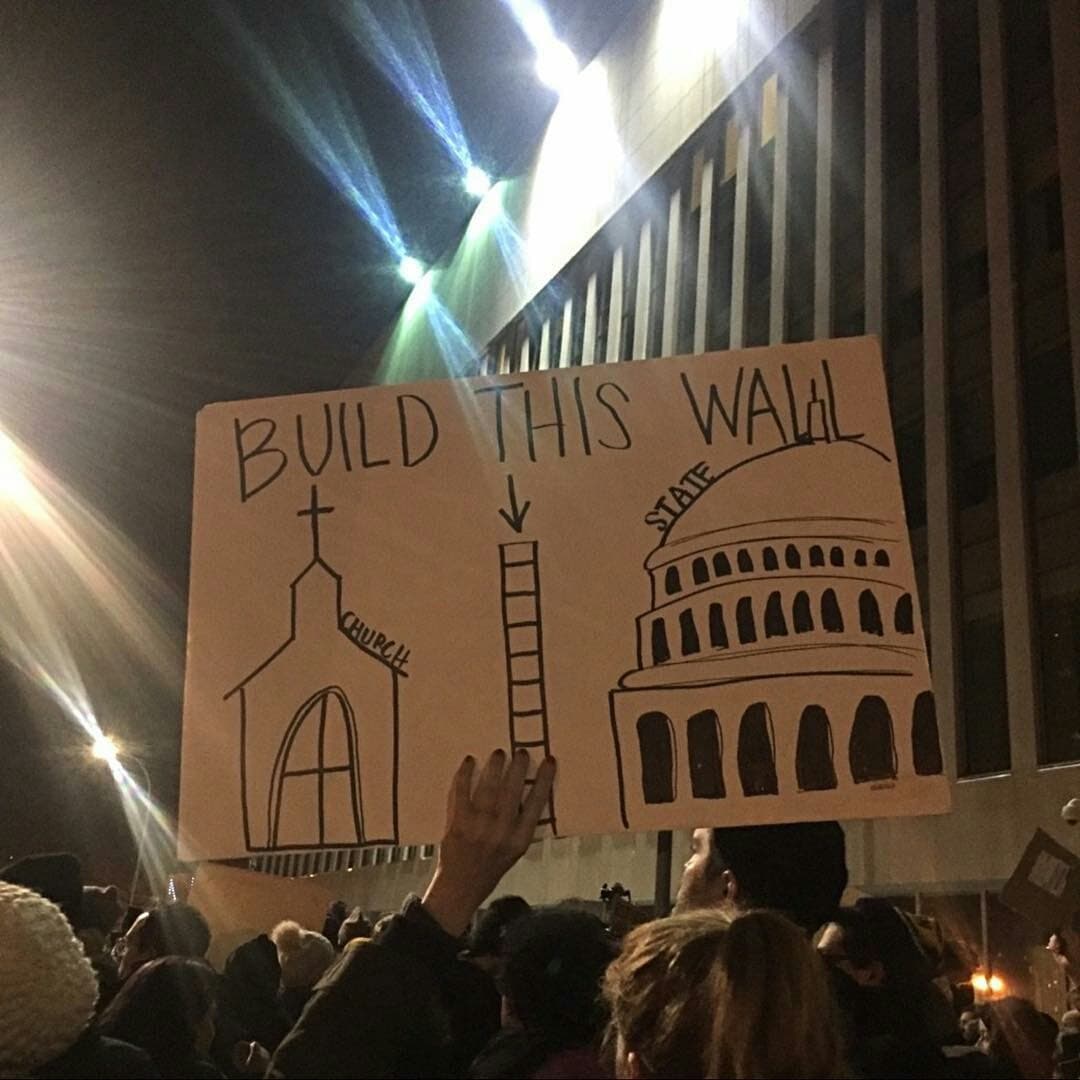
The discussion group met up again for a new topic and this time we chose to dialogue about our first sticky theme: religion and politics. If you read the post linked above, you’ll remember that we formed this group to form a safe space for difficult conversations between people of different opinions, and trust was a big part of this conversation – trust that no one in this group was out to invalidate the beliefs or experiences of others. In the same way, this post is going to explore a couple of positions on the topic, and just as our group could not come to a final conclusion, so too will this post lack any form of finality. Additionally, I had the incidental advantage of a long delay between our conversation and this post, allowing the points to sink in a bit more and for me to bring new thoughts to conversations I have with others and refine them. I will reflect that too here. Finally, I will talk about ‘church’ and state, as it is used in popular terminology, but I refer to any religious body by this and not just the church of the Christian faith.
Before we proceed, I will, as previously done, drop the resources we used as preliminary readings here:
- Internet Encyclopedia of Philosophy Explanation
- Political Secularism: Why It Is Needed and Why We
Need to Learn from Its Distinctive Indian Version – Bhargava - An Atheist in the White House – HBR
The first discussion point that was explored was the history of the philosophy of secularism. According to Bhargava’s paper (linked above), there are multiple types of dynamics that can exist between religion and state, from a religion-led state (similar to Iran’s) all the way to a state that completely devows religion as a function of government and vice versa (similar to France’s Laïcité philosophy). Naturally, a lot of countries lie somewhere on the spectrum, choosing to support religions and their place in society without giving them a significant role in influencing politics.
The role of religion in politics is easily reconciled in cases of appointments and finances – the state can live without the church and the church can live without the state in these regards. The President and Pope can afford to be different people. But reconciliation is almost always impossible in topics of policy. Religion intuitively prescribes a way of life. Policy is supposed to uphold a manner of living. These two forces are so intertwined that the attempted separation of them causes tension. Yet, by the influence of religion on the way of lives of the general population, you inevitably prescribe onto the portion of the population with no religions as well. Anecdotally, I’ve heard many religious folks complain about how politics needs to be aligned with God’s will and policies that seem to oppose the religious laws are sacrilegious. But the contrapositive is seldom acknowledged amongst them – laws that are created solely for religious purposes only favor one group. Yes, it is prescriptive, one could argue. The law is the best for the morality of humanity. But no one group should have a say in that matter. In fact, in the Encyclopedia article (linked above), we see how Rawls argues that no policy should be accepted purely on its religious merit – it needs to stand the test of public debate.
Of course, we also have to consider the inevitability of religion in politics. Religion, with its well-known benefits of charitable service and social cohesion, ultimately becomes the moral compass of those who subscribe to it. Asking someone to keep their faith private and as Richard Rorty states, at ‘an ironic distance’, is nearly impossible. One’s morals are built on their religious beliefs and so asking for input on social policy with moralistic elements will draw out religious foundations easily. How can the secular person ask the religious person to be ‘objective’ or ‘neutral’ – such things are fallacious in moral arguments. A ‘secular’ person believes in his or her own framework and while not worshipping a supernatural being, is still also prescribing a way of life for the general population. The religious person ought to have their right to practice their faith and to see the world as they want it. Repression of their voices only causes more isolation and can build into radicalism. The state must partner with the church to show that it recognizes their place in society.
These opposing forces explain how and why current states exist in the manner that they do. Some states give in to one side more than the other, ultimately for the reasons above, and some states do a better job of balancing the sides. What does an ideal state look like though? What would it take to achieve proper secularism that respects both religious and non-religious folk as well as provides confidence in ‘neutral decisions’.
The Encyclopedia goes on to explain how neutrality can be presented as achieved:
In one sense, neutrality can be understood in terms of a procedure that is justified without appeal to any conception of the human good. In this sense, it is wrong for the state to intend to disadvantage one group of citizens, at least for its own sake and with respect to practices that are not otherwise unjust or politically undesirable. Thus it would be a violation of neutrality in this sense (and therefore wrong) for the state simply to outlaw the worship of Allah. Alternatively, neutrality can be understood in terms of effect. The state abides by this sense of neutrality by not taking actions whose consequences are such that some individuals or groups in society are disadvantaged in their pursuit of the good. For a state committed to neutrality thus understood, even if it were not explicitly intending to disadvantage a particular group, any such disadvantage that may result is a prima facie reason to revoke the policy that causes it.
Additionally, there needs to be more acknowledgment in inter-faith dialogues and religious conversations, that non-religious ideas are also part of the cooperative framework.
Simply put, there needs to be sufficient debate on various grounds before a morally weighted policy can be passed. No policy should have a unilateral religious foundation, both for the purposes of having a robustly thought through policy and also to ensure that multiple parties are satisfied with the provision of effort. Policies such as legal rights for LGBTQ persons or abortion rights cannot and should not be held hostage by religious beliefs. Conversely, the government should limit its influence in religious practices (see: France’s Burqa law).
It’s interesting to note that a lot of religious organizations have realized this and have taken more public-friendly personas to push their causes (see: Family First-esque organizations). These provide the impression of robust ‘neutral’ debate that the public can stomach better. In my view, that’s acceptable, because the religious organization has taken a more ‘neutral’ stance on the issue and is coming to the debate on everyone’s terms rather than purely their own. However, it also can come off as sneaky or duplicitous, especially if the public prioritizes the appearance of an unbiased decision. The complexity just increases.
So there we have it, an incredibly complex phenomenon slightly simplified. There’s a lot more philosophy and theory that we covered and you can see the references from the links I posted. If you have even more interesting thoughts or ideas, I’d love to hear them. As mentioned, religion and politics to me are in flux, both at a personal and institutional level and we definitely don’t have a comprehensive scope on things. All we can do is try to crystallize the essence of the tension.
Look out for more posts soon!