rovik. and friends discuss: gun culture
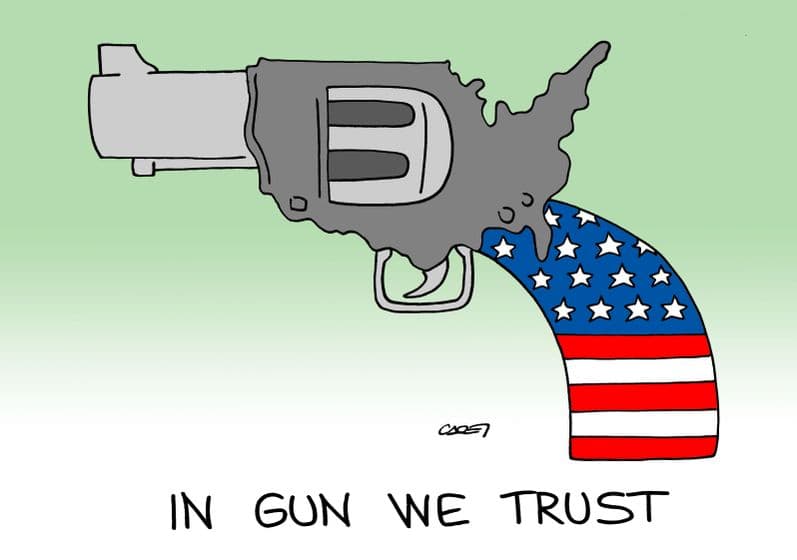
I know what you’re thinking – “Oh boy, here we go again. The Gun Debate”. Here’s a fair topic warning: we talk about gun violence, mass shootings, and gun culture, in a much wider sense than usual, and with the aim of unveiling how we got to the current state. While the US is the inevitable focus of these discussions, we wanted to understand how gun culture looks like around the world, in countries such as Switzerland and Israel, and compare that to the issues occurring in the US. It was also an interesting conversation because two of the members of the group were actually pro-gun ownership (and also pro-gun regulation). Coming from Singapore where my firing a rifle was pretty much a sacred moment in my military career, it took a massive opening of the mind to be able to understand some of the arguments being presented here.
Here are some of the resources I used to build this post:
- Kialo Debate on Gun Control
- BBC Article on Gun Culture (2017)
- CNN Article on US Gun Culture in Charts (2017)
- Switzerland and Gun Laws
- Small Arms Survey
- Global Gun Cultures – Wikipedia
There were two main focus areas: the evaluation of gun culture and the case for/against further gun control.
Gun Culture
Gun culture “encompasses the behaviors, attitudes, and beliefs about firearms and their usage by civilians.” (Wikipedia). Right off the bat in the conversation, one of my more liberal friends declared that he supports the Second Amendment to the United States Constitution, standing on the side of the only openly conservative member in our group. My immediate question was to ask why.
Gun culture, like many other social phenomena, cannot be thought of deterministically. Most people have an idea of rationality as cause-effect oriented. If something is good, use it, and if it’s bad, don’t. This makes sense in some regards but we know that there are social conditions that make things ‘sticky’. The concept of social embeddedness reappears many times in these conversations – sometimes history, culture, and habits play a role in ingraining norms into our life and rationality is less to do with cause-effect and more to do with unveiling sociological forces.
The first thing recommended in our group was to decouple our normative judgment on firearms from the actual artifact i.e. think of guns as just an object that can achieve varying objectives. Firearms are used for multiple functions from security to hunting to warfare. The US isn’t the only country that allows civilians to bear arms. Switzerland is a frequently cited counterexample where civilians (actually only males who have completed their National Service) are allowed to purchase firearms to keep in their homes. However, unlike the US, which declares the right to bear arms as a fundamental right, the Swiss have a dedicated purpose for the distributed ownership of arms – quick mobilization. In a country such as Switzerland which is very spread out and has many remote regions, having every trained citizen be able to quickly pick up their arms, mobilize into militias and protect their country is a strategy that enables reflexive strength. Singapore, for example, only allows trained civilians to draw arms under extremely controlled circumstances from central arsenals because the country is small and mobilization is theoretically quick. The use of arms, even for hunting, is extremely controlled in these countries. The UK and Canada allow firearm use for the purposes of hunting in remote areas, again under extremely controlled conditions.
The ability to hold a weapon for hunting makes enough sense to me. I was in Delton, Michigan two Thanksgivings ago and came face to face with a hunting rifle (and a crossbow). My friend, who I’m very grateful for the experience, told me that they were taught to fire a rifle from a very young age and go hunting as a pastime. Just like skiing is a hobby afforded to those with mountains in access, and skis merely the tool so was hunting to them simply a hobby and the rifle simply the tool. As someone who’s always lived in urban environments, the perspective shift was possible once I was stuck in rural Michigan and understood how things worked here.
But why does the US see security as a justifiable enough reason for firearms? It has a lot to do with its history. The US has always had a natural distrust of authority, and for good reason. Their governing and enforcing bodies, from the British to early governments to current (sometimes) abusive police forces, have time and again proven that citizens need to be vigilant and watch out for themselves. This too is valid enough for my friends to justify bearing arms in both suburban and urban environments. You can only trust yourself. To them, gun culture is less about being ‘gun-crazy’ and more about the ‘responsible use of guns’. Again, this is a massive perspective shift for me.
Why not just ban guns altogether? Won’t you be able to solve inevitably cut gun violence as a whole? That, unfortunately, is the wrong question to be asking. History has already brought us here, where the proliferation of firearms in society is high. Yes, you can provide a normative justification to the ceasure of gun sales, but the implementation of such a concept is not only impossible but possibly problematic. How would you take away guns from a population that has already built their lives on it? How would you ensure that existing guns in society don’t get shifted around to the wrong players? How would you make sure a black market doesn’t develop? These questions provide enough uncertainty that most Americans rather continue to enforce gun culture (in the responsible sense) and focus on gun control rather than gun ceasure.
Gun Control
Most Americans, as seen in the articles listed above, support tighter gun control. The problem has always been in what that means. From restricting gun sales to people with mental health issues and criminal history to banning sales of assault rifles, the types of controls recommended actually number. If you remember my ode to science, you’ll be familiar with another contributor to this problem – the selectivity and bias of scientific research in supporting agendas. For every measure proposed for legislation, the National Rifle Association (NRA) which is funded by the gun industry, is able to provide ‘scientific’ counter-justifications, normally citing operational ineffectiveness or discriminatory behavior. Funnily enough, the NRA has even used racism as a card to vilify gun control proponents. If you want to tackle something enshrined in the constitution, you’re going to need irrefutable evidence and the NRA only has to poke holes in any major legislation for it to fail.
Objectively, one must ask if what the NRA is doing is actually good. Could it be that the NRA actually has our best interests at heart? Can the gun industry actually be providing guns to support the constitutional provision instead of primarily their own pockets? The history of capitalism should provide clear enough answers to these questions. The social embeddedness of guns, gun legislation and capitalism has swarmed the US into a sticky mess that is difficult to climb out of. The rest of the world continues to watch ineffective legislative process continue and wonder how every other country is suffering less than the Americans. Of course, one must also ask if existing laws, many of which already exist, are even enforced. The complexity of technology (with 3-D printed firearms) and state rule cause legislation to play a catch-up game with trends while enforcement continues to suffer.
Another consideration is the whole ‘gun vs person’ blame game. Many times people cite that the shooter is the problem rather than the access to guns, especially when a mental health scenario is introduced. It does sicken me a bit that this same focus on mental health isn’t seen in legislative coverage for mental health benefits in the US (and more, unfortunately, globally as well). Rather than see it as an either-or scenario, I personally cannot fathom why legislators aren’t able to see it as multi-causal and therefore requiring action on both mental health as well as gun access.
What could possibly be a solution to this all? The US looks like the only country stuck in this situation, but countries such as Canada are seeing an emerging call for more open gun access following US industry performance. There is enough of a reason, in addition to the extremely unfortunate shootings that occur on almost a regular basis, to focus on policy tackling of gun culture. Working within the Second Amendment and still curbing gun use for nefarious purposes seems like feasible enough of a bipartisan goal, but money first has to be taken out of the equation. Lobbying has to take on new non-monetary forms within the US government, that enable reasonable advocacy without pork-barrel politics. Can gun culture take on a more responsible form? Can we limit gun sales to only those that are licensed and are non-discriminatorily certified? Can we monitor and improve enforcement of gun trade and use? These are questions that can be answered and should be answered comprehensively.
___
There are many reasons I’m thankful I call Singapore home – one of which is the fact that I rarely have to think of gun violence affecting either me or my loved ones. I’ve lived in Chicago and London, and while I haven’t personally seen gun activity, I’ve heard of shootings not too far away. The fear that one day I too could be caught in the line of fear is real and tangible. Would having my own gun help me feel safe? Sometimes I think so and this is how many Americans feel. But many times I just wish no one else had guns, and that’s a future difficult for Americans to envision. Rather, knowing that the law is robust and well enforced is the second-best solution that we should be investing resources on. Operationally, this is what is worth betting on.