münster – germany’s bike-crazy city
Münster! Another small city in Germany that offers more than meets the eye. I chose to visit this city on my grand journey towards Amsterdam and was very pleasantly surprised by how many cool things can be found around this area. There are many things to note about the city – it’s mostly a student city, it’s Germany’s most bike-active city and it also holds one of the world’s most interesting collection of sculptures. Intrigued? So was I.

Münster is a very walkable city. You can see the main sights within a day, but as with most cities, you’ll want to start in the city center. Here, that’s Prinzipalmarkt. This was the main marketplace of Münster and is accentuated by all the picturesque historic buildings lined in a row. An interesting fact is that this area was bombed during World War 2 and was heavily restored after, so you’ll see a lot of that.

On the main street, you’ll come across the Historisches Rathaus (or Historic City Hall), one of the most important buildings in European history and also a very architecturally ornate building. This too was restored after World War 2.

What’s especially important about this building is that it was one of the negotiation centers for the ‘Peace of Westphalia’ and the end of both the Thirty Years War and the Eighty Years War. I’ll be honest – I knew nothing of these wars before coming to this site, and so I was having a history lesson on the spot as I learned about some of the major drama that influenced European powers. Knowing I was walking in the same space as some of these influential people made me giddy with how time has a way of layering significance.

On the note of cool looking buildings, definitely stop by the Erbdrostenhof, a magnificent baroque mansion that now houses many cultural institutes. The estate is normally accessible (not sure about the building itself) and it definitely stands out amongst Münster.

As with every city, you’re going to need to find the big church. Münster has a couple of interesting churches and you’ll chance upon them as you explore the city, but the St. Lamberti stands out with its strikingly gothic facade. The combination of its grandiose, gothic spires and post-WW2 restoration create an intimidating first encounter.

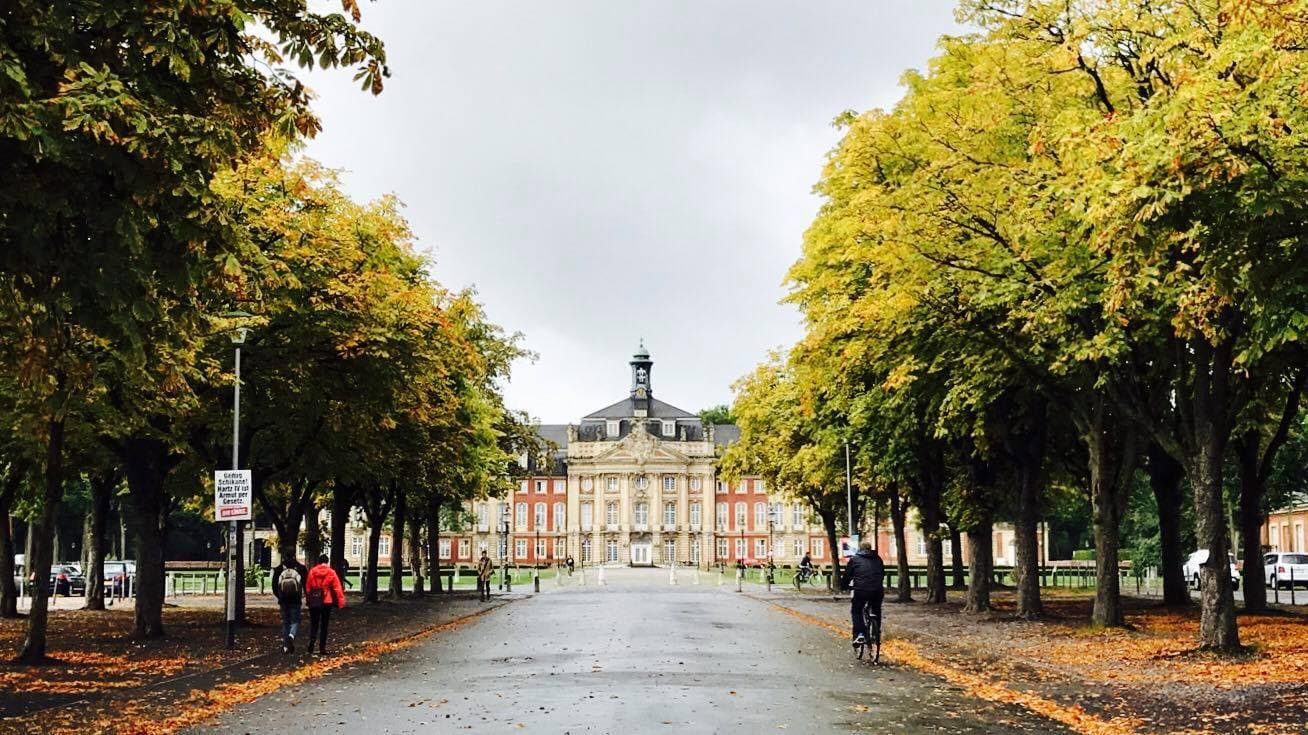
The last building requires a bit (just five minutes) of a walk out of the city center. This is the Schloss Münster, the former mansion of a Münsterian duke-bishop. Now it’s a university building but you can walk around its promenade and estate. It’s a reminder that even in these smaller cities, lifestyles of the rich and famous continued to exist and dominate the sights.

Here we take a break to talk about bikes. Europe has a lot of bike-friendly cities, with countries such as The Netherlands being a bike-friendly country altogether. Münster is that one spot in Germany where bikes are the main mode of the transportation, more than anything else. You’re going to have to continuously keep an eye out for them because they definitely don’t have time for you. What’s cool is that the city has tried to create infrastructure to support this lifestyle – implementing the Promenade, a green belt around the old city. You can also jog/walk on the Promenade, and I recommend that you do so because it’s a relaxing time.

Another thing that’s important about Münster is that it’s home to the Skulptur Projekte (or Sculpture Project). This is a ‘festival’ held every 10 years and allows the city to become an installation platform for a range of sculptures and exhibits. These ‘Giant Pool Balls’ from Claes Oldenburg sit on the Aasee bank and provide some interesting historical context. The balls were targets of vandalism frequently, especially to protest political events and have become embedded in Münster’s past.

There’s an app you can download to see where some of these sculptures are because a number of them are well hidden from the public eye and require some exploring. This one was one of my favorites, in a normally closed off underground passage. The lights use heat from actual fires in the lamp to provide LED lighting. It’s a bit of a mind whirl.

This is my last German stop on this specific Eurotrip and I thought I’d point out one of the most interesting things I saw in all the Germany cities I visited. These are called Tripping Stones and are memorial stones built by Gunter Demnig. They are placed outside the former residences of Jewish and other minority people if they were taken away to be killed or tortured by the Nazi. Many German cities have allowed these stones to be placed, encouraging citizens and visitors to remember that the past can’t and shouldn’t be easily forgotten. It’s also known as the largest decentralized memorial ever.

Münster is also home to a pretty good market, open on Wednesdays and Saturdays. They have fresh seafood, meats, and vegetables as well as a lot of great coffee vans.

One of the things I’d encourage you to try at the market is the Reibekuchen. It’s a regional specialty and is essentially a potato pancake (or latke). They’re normally eaten with sugar or applesauce and are really good here.

If you’re still craving local food, the Altes Gasthaus Leve, has a Münster Platter, with knipps, blood sausage, Münster-style wursts on a bed of delicious sauerkraut and a side of fried potatoes. I’ve gotten used to all these sausages in Germany so you can start tasting the distinct differences between each style fo sausage/wurst. These have more grains in them but are ultimately still a deliciously fatty dish. The service here is also really good.
General Tips:
You can essentially walk to all the sights but if you so need, there is good public transportation as well. You could also be like a local and rent a bike.
Safety is good here, especially because it’s a student town and they prioritize it.
For accommodation, I stayed at Sleep Station, which is really close to the old city. It’s a good place with free breakfast and affordable prices. The only downside is that their reception is closed sometime in the afternoon which makes it tough to check-in or leave your bags. Also it’s right next to the train tracks, so be prepared for some noise.
Overall Münster is a very underrated city that will occupy your stay well. Definitely, don’t miss out on it if you’re nearby.