meandering through myanmar: yangon & bagan
It had been nearly 8 months since my last solo trip and I was feeling the itch. Being back in Southeast Asia meant I had no shortage of rich and exciting options around me. Myanmar was admittedly not the first country to pop up when you think of Southeast Asia, but I had seen the likes of Bangkok and Ho Chi Minh and wanted something off the beaten path. The sights of Bagan’s pagoda and Yangon’s tea shops attracted me towards the land of enchantment where I found nothing short of an adventure.
Before I proceed to provide a travelogue of my trip, it’s important to talk about the relevant topic of the Rohingya Crisis. I’ve been trying to practice responsible tourism and so had to do my research on the multiple sides of the issue. After talking to both people in Myanmar as well as those working in the human rights organizations in the region, I learned that the government’s treatment of the Rohingya, while brutal and excessive, was merely one of many ethnic clashes happening in the country. To boycott a whole country for one government’s actions seemed hypocritical to me if we simultaneously accepted traveling to the US after Guantanamo Bay and to China after their issues with protesters. To me, if I was able to ensure my money went to local operators and I minimized my spend towards government functions, I felt like I could direct my travel dollars towards Myanmar locals who were genuinely trying to make a living. Having said all of that, let’s dive into what I actually did in Yangon and Bagan!
Yangon


Yangon’s downtown area is built around the Sule Pagoda. Said to be built from the time of the Buddha, this stupa is a central figure not just physically but also historically, drawing crowds during protests and uprisings. It is said to enshrine the “hair of the Buddha” and actually functions as a pseudo-museum of sorts, displaying various statues and paintings. They have a section with various “Asian Buddhas” which I thought was interesting. The pagoda can be entered from all directions but it is ticketed.


South of the Sule Pagoda is the Maha Bandula Park, an iconic public park where locals gather and participate in a variety of recreational activities including exercise and picnics. The Independence Monument celebrates independence from the British, quite interestingly replacing a statue of Queen Victoria that used to be in the same place. Around the park, one can find many remnants of Myanmar’s colonial past in the buildings standing including the City Hall and Region Court. While now repurposed for local governmental functions, they are an interesting variation in the city landscape.


Probably the most iconic of all of Yangon’s sights is the Shwedagon Pagoda. This 99-m pagoda is one of the most sacred and beloved sites in all of Myanmar and stands tall as a beautifully gold-gilded destination for Buddhists around the world. Slightly northwest of the main Sule area, Shwedagon is also known for holding many important objects from the past Buddhas. It is a large campus. with one entrance needing an escalator to bring you up, and full of many mini-temples and areas to explore. One could probably benefit from hiring a tour guide although there are sufficient English descriptors around. There is also huge crowds of people at any given time so be ready to navigate yourself. I’d recommend spending a good hour or so here, there’s a lot to explore and it’s not uncommon for people to sit under the shade of some of the pagodas and simply rest. It is ticketed entry for foreigners but you get a place to leave to shoes, bottled water, and wet wipes for your feet after walking around.

You could be wondering if Yangon is all pagodas. There are mosques and synagogues actually, as well as churches like St Mary’s Cathedral. The red brick church is the largest in Myanmar and was built more than a century ago with funding from British India. It’s a very unique addition to the skyline in Yangon and worth a slight detour from the main markets to go check out.


Speaking about markets, it would be criminal to miss out on Yangon’s many craftsmen and traders. The Bogyoke Aung San Market in central Yangon is the most iconic with a large campus of stalls selling everything from local art to produce to perhaps the most illustrious – gold and jewelry. In fact, Myanmar is so well known for its gold and jade trade that the main hall of the market is packed with such traders. The market here is a lot more put together than the street markets nearby, so if you want more order while you shop, this is a place to consider.


If you love the hustle and bustle though, wander the streets of Yangon. Almost every side street is numbered for convenience and packed with food and produce stalls. It’s really a colorful expedition through flavors and sounds as you wander amongst other locals and interact with traders. Make sure to look out for Burmese tea shops – street stalls that have snacks ready for you on the table and that will provide you a powerful tea for you to carry on your traveling. I cannot emphasize enough how fun it is to just get lost in the streets of Yangon.

Of course, it’s not just all about food in Yangon. Near the Pansodan area, vendors set up secondhand book stores to trade off their collections. This outdoor Book Market is a nice spot to get lost in the world of books, mostly old, from all over the world. I saw some pretty dusty collections and could easily expect to get a copy of one of the classics at a cheap price. This was definitely a good variation on my food-filled trip.


Finally, in Yangon, don’t miss out on a recreational afternoon at Kandawgyi Lake. This large park is a comfortable distance from the main city and is littered with cafes and restaurants in relaxing layouts. You could just wander around the boardwalk and sidewalks, or you could try to grab a snack or meal at one of the spots there. You wouldn’t miss The Palm, a built island-boat that is built in a regal style and draws curious eyes from all around the country. My favorite time is to come here in the evening and catch the sunset over the lake from the Esperado Hotel. It has one of the best views i’ve been blessed to witness in my life.


Alright, it’s time to dive into food! I cannot even begin to describe how much I fell in love with noodles in Myanmar. While Yangon itself may not have many “native” dishes, it is a base for many Myanmar cuisines to flourish. We’ll start with the unofficial national dish Mohinga, a rice noodle and fish soup dish that is served as breakfast. The best versions of these are laden with crispy bits like fried dough and fish cakes. In fact, the dish is not too fishy and is a delicious meal. My favorite dish in Myanmar was the Nan Gyi Thoke, where Thoke means salad. This is a noodle salad dish made with round rice noodles coated in a chickpea-based chicken curry. The chickpea base is really what made it for me because the slightly starchy texture on the rice noodles made for a delicious and unique flavor profile. Both of these dishes can be found at many roadside stalls and cafes but I loved the ones I got from Feel Restaurant.
You may be interested to try Kyay-Oh, a Chinese influenced dish that is made with vermicelli, pork (meat, intestines, meatballs etc.) and egg. It is a deceivingly heavy dish and I found myself well nourished at the end of it. I’d definitely consider it a good hangover dish if it was open early but most locals seem to have it for lunch or dinner. The original version is the soup version, but people also can find the dry version which comes as a noodle salad style dish. The iconic spot to get it is at YKKO, a chain restaurant.
Of course, you’ve probably heard of Shan Noodles, a classic dish from the easternmost Shan state in Myanmar. It’s a simple dish with rice noodles, minced meat, fermented tomato and bean paste, and some other garnishes. It is, however, extremely delicious. Taken with some lahpet, this dish is a classic way to spend your time in Myanmar. Many places will sell this but 999 Shan Noodle Shop is a reliable spot for travelers to check it out in Yangon.

If you’re looking for more Shan style food, I’d recommend finding your way to some Shan Rice. This is a very unique dish, where rice is mixed with a white meaty fish to produce this slightly glutinous form. It’s normally eaten with fried tofu and chili oil, making it a delicious mix. I couldn’t find many restaurants that sold this except Shan Yoe Yar, although I’d recommend bringing cash since this restaurant doesn’t treat credit customers well.


Breakfast in Yangon is a past time. You could go slightly more Chinese style at Lucky 7 Tea House, where they offer dim-sum style small plates. I personally tried the Rice and Peas with a Beef Curry – great start to the day. I also went to a more Indian style Yatha Tea Shop for their Samosas and Parathas. Both of these spots are fast service and no frills, but all at great prices. Even they are inspired by their respective regions, Myanmar food tends to have a more succinct mix of heat and sweetness that distinguishes it from its influences.

One of my favorite dishes in Yangon was the Tea Leaf Salad. Pickled tea leaves are served on top of an assortment of nuts and tomatoes and spiced for a kick. This dish is extremely simple and has a levity to it that makes it addictive. It looks funky initially but on first bite I found myself knowing I was going to get addicted. I washed it all down with a sweet Lahpet and found myself emotionally satisfied. You can find basic versions of this dish all over the city but if you want a refined version, do as I did and check out Rangoon Tea House for a good afternoon session.


My final meal recommendation is a touristy one but an experience nonetheless. Yangon has a region in the main city called Chinatown that while not too different from the rest of the city in the day, comes alive in a unique way at night. On 19th Street, after 8pm, the stretch becomes an al fresco BBQ area that serves skewers, grilled fish and salads. It is noisy, messy and full of mosquitoes, but you will have delicious food at cheap rates. Shwe Mingalar is a reliable spot that has great salads and decent meats. I’d definitely recommend at least grabbing a beer here.

While you’re in Yangon, make sure to treat yourself to some Burmese desserts. Underrated but very delicious, these desserts rely on ingredients such as taro, coconut, black rice and banana to make pancakes, confectionaries, and cakes. Most stalls will have these on a platter for you to try.

Finally, while Myanmar has a good staple of macro beers, go to Burbrit Taproom for Yangon’s only microbrewery. The folks here take established styles from the world and use local Myanmar ingredients to make these tasty beers. I personally loved their Nevada Pale Ale but found myself enjoying almost all of the beers on the tasting platter. Again, all for an extremely cheap rate.
Bagan

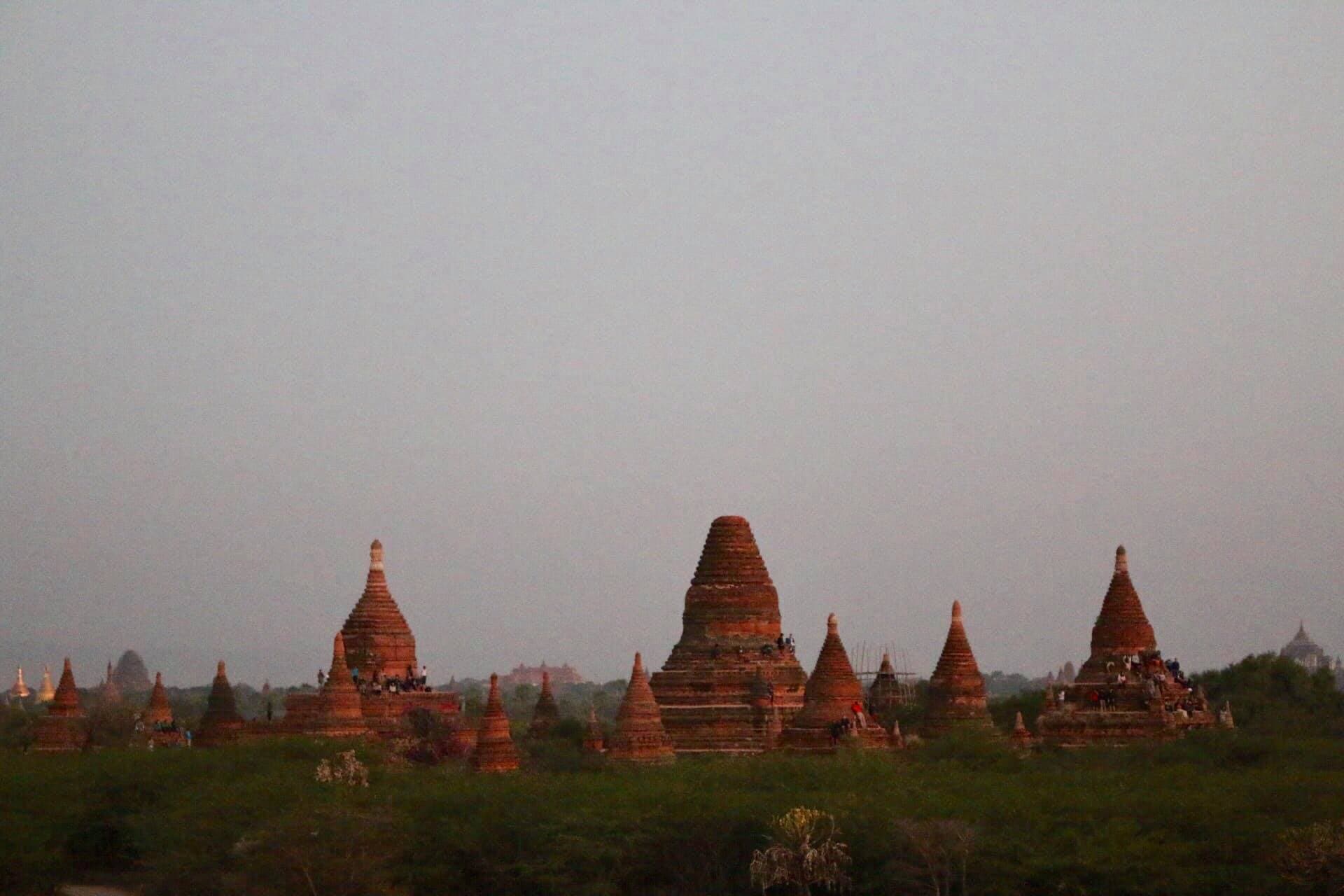
Myanmar is just starting to get discovered for its gems but Bagan is well established as a must-visit destination. It’s only an overnight bus ride from Yangon and you can rent an e-scooter for 5 USD to explore the whole region from sunrise to sunset. Most commonly compared to the Angkor Wat area in Cambodia, Bagan is contrastingly a collection of living monuments that still function as temples for Buddhist visitors. They are remnants from early Myanmar civilization where the ruling king built more than 10,000 temples out of which only around 2000 are remaining in the area.
The two most important moments in Bagan are sunrise and sunset and some stay multiple days to get different views of each. For sunrise, the priority is to find a spot where you can see the hot air balloons emerge over the pagodas. Hot air balloons themselves cost ~300 USD per person and are a common big-ticket purchase by visitors but I chose to stay for only a day and decided to find a structure to climb. The government has banned most structures for climbing so you normally need to chat with the friendly locals to find a reliable location. I was directed to the Brick Monastery to discover a breathtaking sunrise view and if it’s still permissible when you visit, I’d recommend making your way there too.

The rest of the day is normally temple exploring so I shall quickly share some of my favorite temples to check out. Thatbyinyyu is a double-storeyed temple with towers and terraces, making it one of the tallest structures in Bagan. It is quite an imposing figure and very cool to explore.


Next to Thatbyinyyu is the Ananda Temple, a more regal campus with unique paintings and an extremely tall Buddha status. Built in 1105, this temple is ancient and extremely ornate, speaking to the conservation effort that went into the structure. One can also notice the heavy Indian influence on the design of the temple.


Another interesting temple is the Htilominlo temple. This 3-story red brick temple is surrounded by markets and stalls so you could kill your souvenir shopping and temple hopping in the same visit. It’s said to be named after the king who built the temple on the grounds of where he was chosen to be king so that’s quite interesting.


Similar to the Shwedagon Pagoda in Yangon, Bagan has a Shwezigon Pagoda with a stunning gold-gilded stupa and multiple ornate embellishments. It is an interesting walk to the Pagoda under a long white brick walkway.


Adding some diversity to the itinerary is the Bupaya Temple, a riverside temple that has a smaller stupa and a sheltered area for worshippers and meditators. I liked this spot because of its waterfront location and the more casual nature of the temple.


If you’re looking for something close to the Tomb Raider style structures in movies, Dhammayangyi Temple off the road is your destination. The temple is said to be built as compensation for the King’s murder of his own father and brother. The temple is quite unique because it is the only one with the double Buddha statue at one of its altars. It also has a Myanmar puppet shop where you can see the local renditions of the puppet craft.


My last favorite temple is the Sulamani Temple, not too far from the one above. I liked this temple a lot because of its intricate wall paintings inside the temple itself, depicting various forms of the Buddha.

For sunsets, again you are constrained by the prohibitions of climbing around the area. I was brought to Pagoda 2100 by a local for a small tip to be able to climb to the top and witness this magnificent sight. There are many of these smaller ruinous temples that one could climb but that are risky since there is no way to know if the structure is stable. I’d always err on the side of asking a local to guide instead.

If you’re looking for food in Bagan, you can avoid the touristy spots and just find a roadside stall with only locals around. Alternatively, you can go to San Thi Dar, a family run restaurant that serves affordable home cuisine such as the above Pumpkin Beef dish (so darn good) and fresh smoothies. You shouldn’t have to sacrifice good food when you’re traveling. If you’re looking for something different, Sharky’s is a Western-targeted restaurant that has good cheeses and cold cuts made from local ingredients. Protip: they accept credit and have a nice bathroom.
____
Here are some other tips:
- Yangon and Bagan are very safe cities from the onset. I didn’t feel vulnerable at all and could easily walk around even later in the evening. Of course, because it is a developing economy, I would practice general safety principles and avoid dark streets (which are common).
- Yangon has Grab all around the city so you can use it to get to and from the airport for around 7 USD. Otherwise, the downtown area of Yangon is very walkable. Bagan doesn’t have Grab so you may have to take a cab from the bus station to the main city – this tends to be quite expensive since the market is captive so either share with others for around 12 USD or take your own for 20 USD.
- Both cities are extremely cash dependant although some places do accept credit or e-payments. All of my locally based friends warned me to NOT exchange cash outside of Myanmar since the local currency (Kyat) is a controlled currency and most foreign versions are fake. Changing cash at the airport changer is your best bet since ATMs charge 5 USD per withdrawal.
- You can book ahead for your buses between cities. JJ Express is a reliable operator trusted by foreign travelers although there are others your hostel or hotel could recommend. I paid 20 USD per ride for JJ Express for a 10-hour bus ride and got water, blankets and comfortable seats.
- For my e-scooters in Bagan, you could either ask your hotel or go to Green Apple Rental. The owner is friendly and quite reasonable so I was taken care off.
- Finally, for accommodation, you can actually get pampered for the cheap in Bagan. I still went budget and stayed in Backpacker Bed & Breakfast for around 10USD per night and had a very nice bed and decent breakfast. The one downside of the spot is that they have an ensuite bathroom per shared room which makes it awkward and noisy at odd hours.
My overall trip to Myanmar was a blast. For really good prices, you could experience a strong culture, history, and cuisine while watching development happen in front of your eyes. Because the tourism industry is not as developed, you also have the opportunity to mingle directly with locals without the excessive touting that is endemic to tourist hotspots. Myanmar, by virtue of its foundational Buddhist culture, is also a spiritual place where you get the sense that everyone is concerned about purpose and meaning. For a traveler, that is empowering because I chose to participate actively in that ideal. I must extend my special thanks to Xiu Jing, Chris, Sheriel, and Aaron for making my time in Myanmar so amazing. I definitely am looking forward to the overall growth and liberalization of Myanmar.