madrid: where the good times begin
Spanish culture is renowned for its proclivity for indulging in the better things in life. I already had a taste of it in Barcelona where I had some of the best food I’ve ever tasted and followed it up with a memorable night out. Madrid saw the more seasoned traveller in me approach Spanish culture with a more inquisitive lens. I wanted to have all of the festivities that I had in Barcelona, but I also wanted to understand the capital of the former Spanish Empire better and the constituents of Spanish culture. What resulted was an incredible stay in this lively city. I should also warn that this post has an exceptional amount of food coverage but that’s because Madrid was a paradise for food. Read with caution – your appetite may increase.


Every city has a heart and for Madrid, that is Puerta Del Sol. This is where you can have a good start point for any major spot in the city and therefore a great meeting point. You will see locals and tourists alike start their days and evenings here, and at night you can witness street performers and hustlers try to earn their wage in tips. There are two main statues, one of King Carlos III that stands ostentatiously over the crowds and the other of the bear and the strawberry tree, the feature of the Madrillian coat of arms.

Of course, the Puerta Del Sol does not have the feel of a proper Old World city square. That is found in Plaza Mayor, a more traditionally imposing square where Spanish kings used to hold events and activities such as those related to the Spanish Inquisition. The statue in the middle is that of King Phillip III, a controversial king in Spanish history, and another grand element in the city. Here you can find many small shops selling coffee, boccadillos (sandwiches) or souvenirs for the lazy tourist.

If you’ve been enjoying the old world charm of the city so far, make an exit out of the plaza into Calle del Toledo, where buildings look like they were built into the walls flanking the plaza and where some of Madrid’s ‘more traditional’ restaurants are meant to lie on. This was a nice walk and you can even find the oldest restaurant in the world here.


Continuing in the direction of travel, you will find Almudena Cathedral, a giant Baroque cathedral that looks like it could be medieval but actually was only completed in the 19th century. Both the interior and exterior of the Catholic church is visually stunning, but special recognition must go to the Romanesque Crypts that are free to access for a truly sombre experience.

If you are interested in the constitutional monarchy of Spain, then the Royal Palace is where you will be treated to the potential sight of the King and his royal family entering the campus. There are guard-changing ceremonies as the Royal Guard dressed in ceremonial garb swap places while on horses. It’s a particularly unique sight. Parts of the campus tend to be more restricted when the King is in, however, so it’s really up to your luck on how much you see.

Adjacent to the Palace is the Plaza de Oriente, one of my favourite parks in Madrid. This is a classic royal park with tall hedges and the statues of past Spanish monarchs. Locals and tourists alike occupy this area, and I saw people going through fitness regiments and leisurely walks all within a mile of each other.

Another plaza within walking distance is the Plaza de España, right next to the Gran Via and surrounded by skyscrapers. This is the meeting point of the quiet and bustling areas of Madrid and another city lung for casual activity. What is interesting is the giant statue of Miguel de Cervantes, the author of Don Quixote as one of the centrepieces of the plaza. Don Quixote appears right below him as well. The tallest buildings in Madrid including the Torre de Madrid and Edificio Espana are in eyeshot as well.

Before entering Gran Via, I recommend taking a detour to the Parque del Oeste where the Temple of Debod lies. These are ancient Egyptian ruins that came from Aswan. The park itself is very pleasant and has great views of the surrounding region, including the Sierra mountain ranges. Alternatively, this is a great spot for sunrise or sunset.

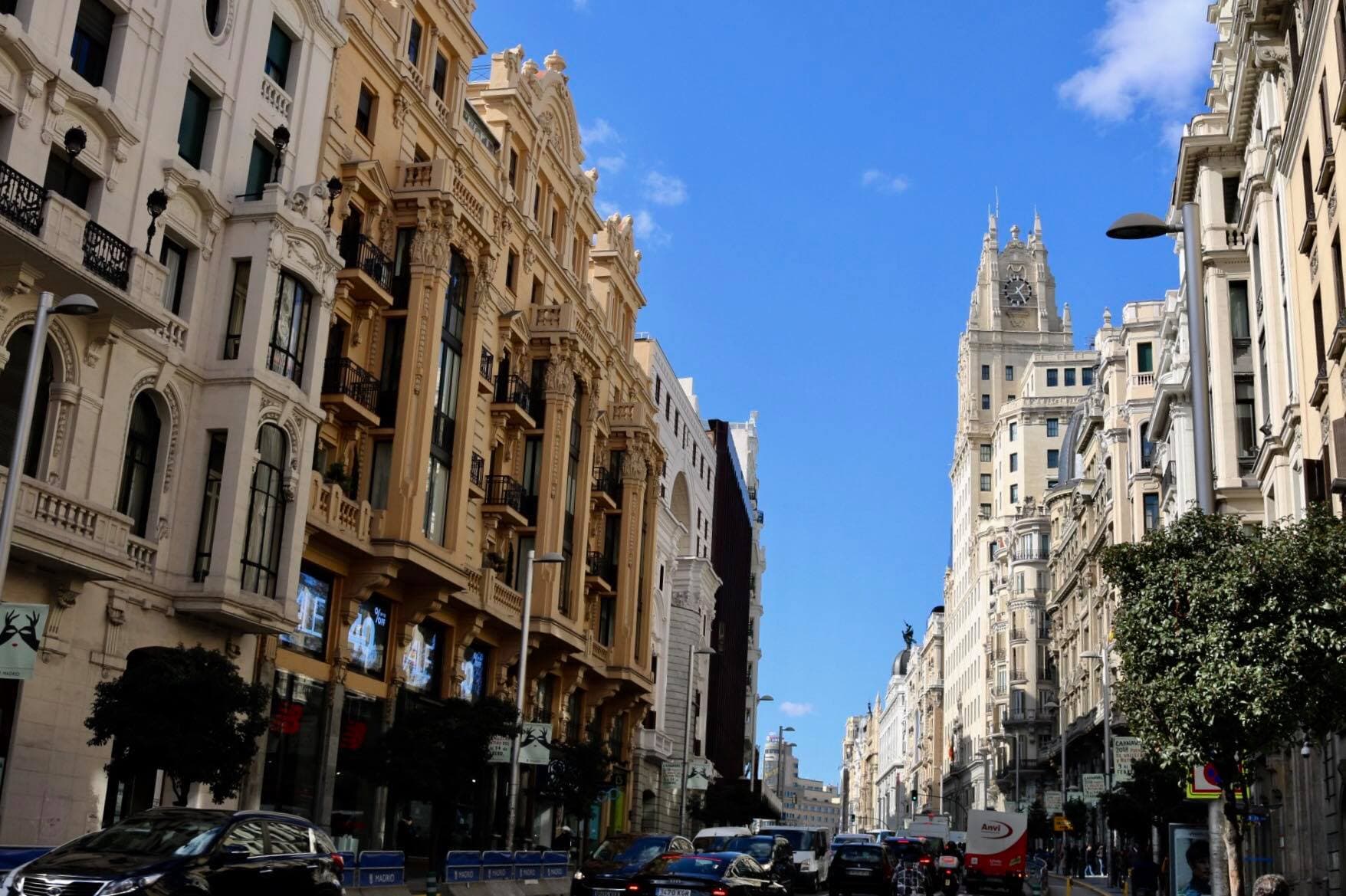
The main street of Madrid is the Gran Via, called informally the Spanish Broadway. This street always has stuff going on, even late at night, and is flanked by ornate and majestic buildings. Spanish architectural styles feature prominently here and you can shop till your heart’s desire at the many outlets around. From Primark to Ralph Lauren, all can be found here.


On the east side of the city is the expansive El Retiro Park. This is the main green lung of the city and a beautiful park year round for all kinds of leisurely activity. There are ponds that you can take a boat ride on, street performers and ice cream shops all for your enjoyment. Within the park exist a museum and the Crystal Palace, an architectural beauty and also an exhibition space for contemporary art pieces. Of course, it also becomes a popular Instashoot spot. Don’t miss out on this park.


Personally, I tend to be very selective of museums on my travels simply because they tend to be too many and most of the times are underwhelming, but Madrid’s collection of museums rank highly in my history of travelling. From the informative Museo Historia to the culturally significant Museo Prado to the thought-provoking Reina Sofia Museum, I was amazed by the collection of stimulating exhibits. You get to witness the likes of Velazquez’s Las Meninas in the Museo Prado and Picasso’s Guernica in the Reine Sofia and be amazed by how much more captivating these works are when encountering them first hand. Make time for museums in Madrid, and you will not be disappointed.


Beyond the attractions listed above, Madrid as a capital city is one that deserves exploring. Understanding the city comes from roaming through the side streets and alleys, and exposing one’s self to the diverse neighbourhoods that constitute Madrid’s narrative. From the streets of Centro, where tapas bars and taverns borrow from its Roman Empire past to the streets of Malasana which maintains a stronger Bohemian feel to Lavapies which is an immigrant melting pot that prominently displays its diversity, you will not be bored by Madrid’s streets. Look up and down, and enter cafes and bars for a break. You will be well rewarded with delicious food and great conversation.

On the topic of food, it is a good time to transition to the part of the post that will whet your appetite. There are many places to eat in Madrid but if you want to start with produce, the Mercado San Miguel will be your first stop. Mainly for tourists now, this market was built in the early 1900s for grocers to sell fresh produce. You can find a good amount of cooked food, wine and pastries now, but you will still find cured Spanish meats like Jamon Iberica and recently harvested fruits as well.

Spanish cheese is a unique area of exploration, being diverse due to the regions they come from. Some areas produce goat’s cheese and others do cow cheese, but regardless, cheese is well loved in Madrid. Manchego cheese especially is an amazing, slightly spicy cheese that I fell in love with. Rather than paying a premium at bars and restaurants, make your way to Queseria Cultivo in the Malasana area for both an extremely helpful (and tasty) tutorial on Spanish Cheese by the staff but also great rates. I was so impressed I bought myself a small wedge to bring back.

For breakfast, you will have many options but do not miss out on going to La Mallorquina for a beautiful selection of pastries and treats. The Napolitana con Chocolate is renowned and together with an espresso only sets you back 2.50 Euros. The pastry is fluffy with a creamy rich chocolate filling. It’s quite like heaven.

If you’re a coffee lover, try the Bombon, a Spanish rendition of coffee where instead of plain milk, a dollop of condensed milk is added to the cup. It reminds me a lot of coffee the way we do it in Singapore but here the coffee is made from an espresso machine. Cafelito in Lavapies is a cosy and welcoming cafe where you can enjoy this treat.

Still have a sweet tooth? Then make sure you head to the 24-hours Chocolateria San Gines where you can eat freshly deep fried churros with a cup of dense Spanish-style chocolate. This is a very heavy meal and you will walk out very full, but satisfaction will glow from your face.


What would a conversation about Spain be without talking about tapas? Madrid has a wide selection of tapas, much of which is regionally focussed. If you don’t know how it works, many times you simply order a drink and you get some food with it. These normally are olives, croquettes or in the case of El Tigre, a whole plate of pinchos. These are pieces of Spanish bread topped with all kinds of stuff including cured meats, Spanish omelettes and cheese. Here they come on a plate of patatas bravas or fried potatoes topped with a spicy sauce. For 5 euros, you will be well stuffed. Other tapas to try in Madrid is the Callos Madrillenos or stewed tripe at Casa Toni and the Bachalau (Salt Cod) Fritters at Casa Revuelta. These are exceptionally made and are cuisines you cannot forget.

For main courses, you have a number of options. The Spanish love their bocadillos but in Madrid, the Bocadillo de Calamares is the superstar. These calamari rings are fried in a fragrant oil and stuffed in a sandwich. Don’t expect any sauce on the bread, the traces of oil make the sandwich delicious by itself and the fresh calamari will leave you more than satisfied. Bar La Campana near Plaza Mayor is supposedly the best place to get these.

Want something interesting? Try the Huevos Rancheros, especially at Casa Lucio where the best are served. Broken eggs, freshly fried fries and topped with the topping of your choice (in my case, spicy sausages), this is an understated dish that will fill you up. Washed down with some beer or red wine, this is as classically rustic as Madrid can get.

Madrid used to be known for bullfighting. As someone who wanted to balance an appreciation for history and culture with an ethical mindset, I personally chose not to seek out any notion of active bullfighting. There are museums about that one can visit to understand the culture while still maintaining a distance from the practice. I understand that it is outlawed in most of Spain. Another place to get a glimpse to its culture is at Malacatin, where bullfighters used to come after a day at the arena and have a heavy meal of Cocido and drink alongside pretty women. The restaurant is adorned with bullfighting memorabilia as a result. Cocido is a uniquely Madrillian dish that features mainly chickpeas and cabbage with meats such as blood sausage, pork and sausage. Normally served as multiple courses and meant to be shared, Malacatin has an individual portion that can fit the solo traveller’s budget.


Of course, home-cooked Spanish food tends to be a lot more rustic and homely and there are Spanish restaurants that dish out amazing menus for around 10 Euros, including three courses and a glass of wine or beer. La Sanabresa stood out to me for this, with great service at affordable rates. Definitely, order their grilled asparagus.
Nightlife in Madrid was an absolute treat. If you prefer bar hopping, head to La Venecia for curated and strong sherry, Salmon Guru for a more modern cocktail venue or Malaspina for a good collection of regional Spanish wines. If not, you will find bars on every corner anyway and you can just follow the crowds. Clubbing starts late in the city, at around 12am and normally goes strong until around 6 am. There are many places to go, some better than the others, but I had a great time at Star Coyote. Check out the video above.
Here are some general tips for Madrid:
- Madrid is very walkable but the metro is also a smooth machine so there’s nothing stopping you from exploring the whole city. Getting from the airport to the main city does cost slightly more and you will have to pay for the card, the base fare and the airport surcharge but it’s still affordable compared to other modes of transport.
- Madrid seemed mostly safe to me although there were many streets that seemed shady. I would try to stay in the main party areas after hours and stay with friends or around other people.
- ATMs are scattered around the city pretty well. You can also use a credit card at most places so no need to hold on to too much cash.
- Costs tend to be in the low to mid-range here so you can enjoy yourself a bit in Madrid.
- For accommodation, I stayed at Cat’s Hostel and was very satisfied with the vibe and facilities. It is a party hostel so don’t expect to sleep a lot, but how else would you want to spend your time in Madrid.
I had a great time in Madrid, and the best part about the city is that there’s more to come back to. It’s also an easy entry point to the rest of Spain that by itself is so diverse and complex. I hope this guide gives you a foundation for a fun trip – let me know if there are any places I should add for my next visit!