krazy guide to krakow
My last trip before my final exams took me to Krakow, Poland’s second city and my easternmost destination within Europe. I had been told the cheap prices, great food and rich culture would get me hooked and while all of that was true, what kept me interested was the obvious tension of a city that is making efforts to modernize itself yet is cloaked by its heavy past. The story of a Krakow is honestly a ‘crazy’ one, with all sorts of twists and turns and that makes it all the more interesting to explore.

Exploring Krakow normally starts at the Old City, a fortified vicinity within Greater Krakow that remains as one of Europe’s few remaining fortified areas. The iconic place to start is the Barbican, a fortified medieval outpost that was Krakow’s main entry point back in the day. It’s quite an architectural feat given the era when it was built and can be admired from the outside, although you can also buy a ticket and explore the interior.

Before you actually enter the city, it is worth noting that the outer ring is actually surrounded by an incredibly well-maintained and beautiful park. There are many places to sit and have a picnic, or you could just find a bench to people-watch from, but this is one of Krakow’s best offerings. There are a number of monuments to culturally and historically important figures along the way as well.

One can enter the fortified city from multiple entrances but the best is the St Florian’s Gate, adjacent to the Barbican. This gate was the main ingress into the city and its tower is well decorated with a chapel inside. You will find performers playing folk-ish music within the gate during the day which is probably as good as it gets for the start of an adventure.

As with most European cities, one can just wander around and admire the mix of medieval buildings, local shops and quiet alleys. Krakow is one of those cities that will surprise you as you follow the twists and turns, especially as you find parks and squares to take a break in.


Heading towards the centre of the city will bring you to the Main Market Square, one of Europe’s biggest with what looks like two squares separated by the Cloth Hall. Built in the 13th century in a Renaissance style, this arcade still holds many small touristy shops that sell souvenirs and local products. It is quite a colourful exploration but also be sure to look up as you enter the Hall to admire the various murals.

Also in the Main Square is the St Mary’s Basilica, an exemplar of Polish Gothic Architecture. It has an extremely ornate wooden altarpiece inside but the church is better known as a common meeting point for locals and tourists alike. Every hour a trumpet-like noise is sounded which supposedly commemorates a trumpet sounding to warn of a Mongol attack back in the 13th century.


Probably the most iconic part of Krakow’s city and a UNESCO World Heritage site is the Wawel Castle, a hilltop castle that has a mix of medieval, Baroque and Renaissance structures that make it a curious exploratory promise. While the grounds itself are free to access (except for Monday when it’s closed), there are a number of museum exhibits housed within the castle rooms that do require a ticket purchase.

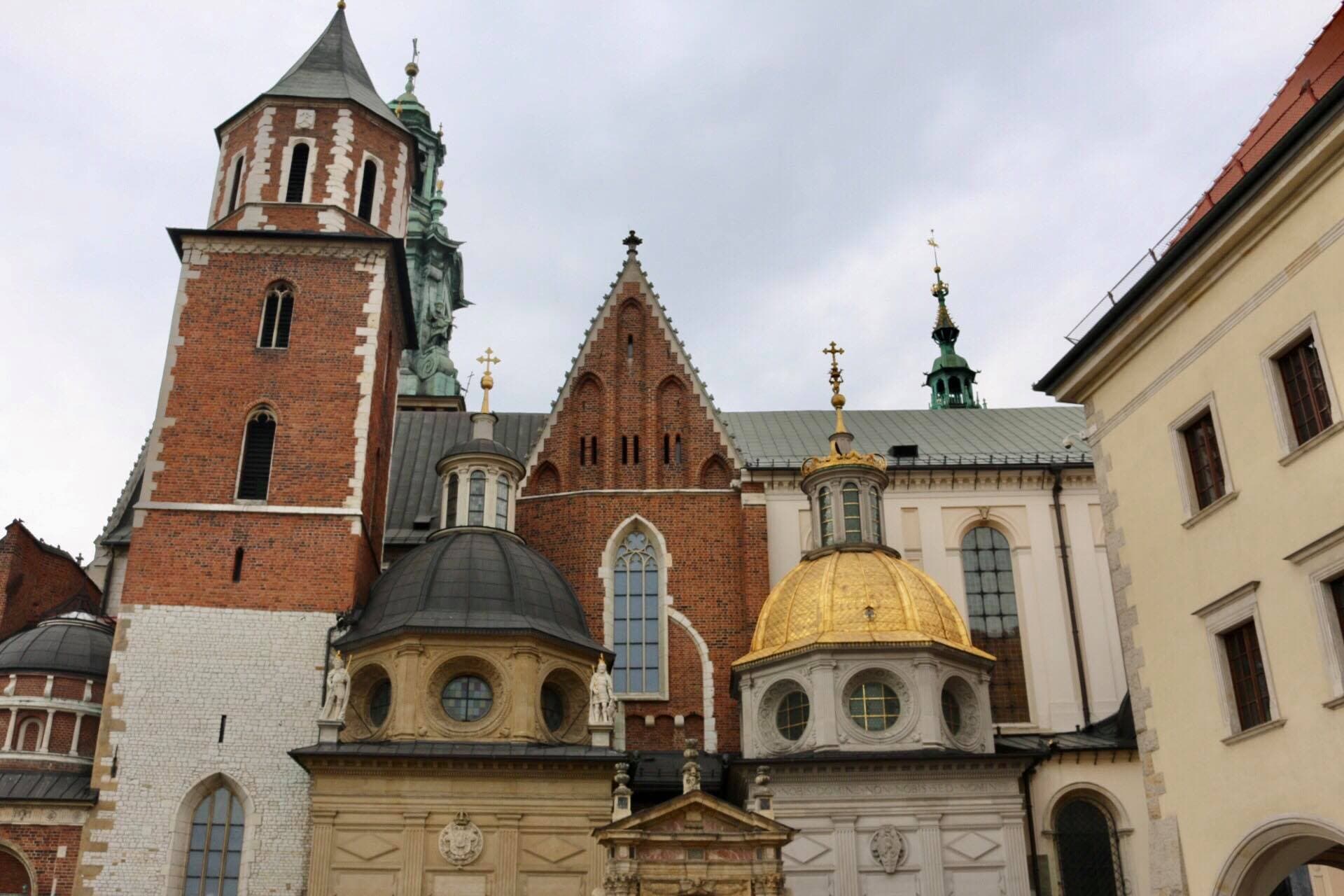
Within the Wawel Castle grounds, it will be hard to miss the central Wawel Cathedral, the most important cathedral in Poland where monarchs were coronated and important people are buried. The interior of the cathedral speaks to the history and beauty of Krakow, with some really striking murals and art pieces. The gold dome is also a big reason why people love the cathedral, the chapel underneath housing the tomb of King Sigismund, the founder.


From the castle, it’s worth making your way down to the Vistula River. On a beautiful day, this is where the locals go to laze on the grass and enjoy the weather. Boats on the river offer drinks and food or you could purchase a cruise. The Wawel Dragon is also adjacent to the river, actually breathing fire every five minutes or so. It makes for a great Instagram shot.


Besides the Old City, a must-visit in Krakow is the Jewish Quarter. Historically this district is important for its role in World War Two where all the Jews were imprisoned and taken to the concentration or labour camps. As you walk around the quarter, you will notice the number of synagogues and memorials commemorating the Jews who lost their lives. It is a very sobering reminder within the city itself and is part of a larger narrative within Poland’s history. However, the Jewish Quarter is also increasingly being repurposed as Krakow’s ‘hipster’ district, coexisting with its important past.

One such place for this ‘hipster’ evolution is Plac Nowy, a square within Krakow that is a market for vintage goods as well as hipster foods that I’ll point to below. The evenings are when this place becomes a bustling area for youth but the day is when you’ll have the best chance of finding some rare vintage artefacts.


Further away from the city is the Schindler’s Factory. If you haven’t watched the movie, Oskar Schindler was a factory owner who convinced the Nazis to let him hire Jews as labour in order to protect them from the concentration camps. Here he worked to provide them asylum from persecution and abuse and was an important symbol of hope in a horrid period of history. The museum inside the factory is a very powerful reminder of the ability for people to be good amongst all that was bad.


Most tourists don’t really venture beyond this area but I recommend for the adventurous to make their way to the Jewish Ghetto, where amongst other memorials to the Jews is the Krakus Mound. No one knows how the mound was formed but it is known amongst locals for having some of the best views of the city. Adjacent to it is also a quarry that is closed off but often broken into for some adventuring. One can easily find walk up to the mound following the roads.

Perhaps one of the most important things to do in Krakow, and Poland in general, is to make your way to Auschwitz Memorial Camp. I’ve written a bit more extensively about both the logistics and experience of visiting the camp but let me just reaffirm how life-changing of an experience it is and remind you, my reader, of the need to remember that travellers have an obligation to fully confront the realities of countries we visit.


Another day trip to make is to the Wieliczka Salt Mines. Taking a bus from the city centre, you will reach the mines in 40 minutes. It’s around 15 Pounds to get in for a student but the museum itself is UNESCO World Heritage site and has many unique features that make it worth the price. You are brought by a tour guide below the surface where Polish miners extracted rock salt. What’s more interesting is the subculture that developed here, where chapels and art pieces were built. Now, dinners and events are hosted here, and medicinal treatments are administered under the saline conditions of the mine. It’s really quite the portal into a new world and will leave you with a whole new domain of knowledge.


When it comes to food in Krakow, you will be spoilt. Not only are the options incredibly cheap, you will also find a range of traditional and innovative cuisines, sometimes not too far away from each other. Keep an eye out for Milkbars, traditional Polish canteens that dish out food fast and simple but with flavours that will impress. Also look out for food truck parks, all around Krakow’s outer ring especially in the Jewish Quarter and bosting some of Krakow’s more forward-looking cuisine.


One of the best things to eat in Krakow is the Zapiekanka, a Polish flatbread pizza. The traditional version is simply topped with grilled mushrooms and lots of cheese and can be found from any Polish bakery on the corner, but you must head to Plac Nowy where there are up to 8 different hipster spots innovating this dish to make some delicious options. I had the option from Corleone and was very pleasantly surprised by both the aesthetic and the range of flavours for such a cheap price.


Polish soups are also starred in local cuisine here and operate as great appetizers. Make sure to try the White Borscht, a starchy bread soup, or the Beetroot Soup, a savoury concoction that tastes unlike anything else. Gospoda Koko is a milk bar that does affordable set meals with great soups.

For some reason, the Polish love their bread bowls, and a traditional dish that is often served in it is Bigos, also known as Hunter’s Stew. This is a sauerkraut heavy dish that is mixed with a number of meats such as pork. It’s much lighter than you expect and Pod Wawalem, a traditional spot near the Castle, does a really good rendition of this.

One of my all-time favourite dishes in Krakow was the Placki Ziemniaczane, or the potato pancakes. These deep-fried pancakes are similar to latkes but are topped with a beautiful sour cream and are a sinful way to gain your calories. Kuchnia U Babci Maliny is a traditional milk bar that makes amazing pancakes.

If you’ve come from the US, you may be wondering where all the Polish sausages are. While you can order them at most restaurants, the locals know the best are served every evening from a blue truck near the east of the city. These sausages are flame grilled and for a small price, you are treated with an extremely flavorful snack.

How can we talk about Poland without talking about pierogis, the local dumplings that are stuffed with anything from pork to cherries? These bad boys are found everywhere, with some places dedicated wholeheartedly to them. The best are reputably from Przystanek Pierogarnia, an easy to miss whole in the wall that definitely meets the hype and for a really low price. Their pork pierogies are my favourite although they have a decently diverse menu. I also loved the fried pierogis from Milkbar Tomasza.

If you’re wondering which food truck to spend your meal one, I also recommend the Andrus Food Truck which serves a variation of a traditional stewed pork meat that is served in a well-dressed sandwich. It’s similar to pulled pork but the rich meal will leave you stuffed and happy.

The predecessor to the quality Jewish bagel is said to come from Poland in the form of the Obwarzanek krakowski, a boiled bread sprinkled with salt and topped with anything from sesame seeds to poppy seeds. You’ll find them at any bakery or at these blue stalls all across the city. They are extremely chewy so fair warning, but they make for a good snack.

For desserts, Krakow will not disappoint. The Polish love their ice creams, and you can try some of their best produce (including cherries) in local flavours. Good Lood serves some of the best ice cream in the city near the Jewish Quarter

Make sure to grab a bunch of Paczkis as well, stuffed Polish doughnuts that are dense with cream and are sugary sins. The best is thought to be the hole-in-the-wall Gorące Pączki, that definitely gave me the best Paczkis I ever had, and I remember trying a good number in the Polish Village in Chicago.

Finally, nightlife in Krakow is a bit varied, with a larger focus on bars than anything else. Polish Vodka is known for being more experimental with a range of flavours so you can drink to your heart’s delight without getting bored. Wodka Cafe Bar serves a tray of vodka shots for a good price and you can try anything from cherry to chocolate vodka.
Here are some general tips for Krakow:
- Krakow is well connected by public transportation including a regular bus (for 13 Zlotys) from the Airport. There is Uber in the city but I found myself mostly walking around except for the day trips out.
- While you will want a decent amount of Polish Zlotys (local currency) for streetside stalls, a lot of restaurants and attractions do accept credit cards so you can balance out how you want to have your finances. ATMs are not hard to find.
- For accommodation, it is a good idea to stay near the Central Bus Station. Submarine Hostel, where I stayed, was very convenient and a good value for money.
- Krakow is incredibly cheap and I spent less than 150 GBP, not inclusive of flights, over four days. It was really the ideal destination for a student.
- While I found myself mostly safe in Krakow, I did experience my first overt racism incident in a long time, in the town of Wieliczka, near the Salt Mines. Here a Polish local came up to my face and started shouting a racist slur (that I corroborated by Googling and asking my Polish friends). I had to simply walk away to the train station but it did make me feel quite scared being the only dark-skinned guy for miles. Just be aware of your surroundings and don’t go to places without other people.
Aside from the one racist incident, I did really enjoy Krakow and took back a lot of appreciation for both the history and culture of Poland. It really is a unique place that stands the test of time and is committed to continuing doing so.