brunch-chat in singapore: session one
I remember reading over a couple of articles that claimed a good portion of prominent CEOs were philosophy majors at college. As a Computer Science student, I biasedly dismissed the claim as pop-journalism and marched on in my exploration of technology and engineering as the superior discipline. However, over the past 18 months, I had discussed a passion for conversations around ethics, existentialism and moral philosophy. It is important for leaders to approach complex problems with an attitude that discerns between logical biases and real implications. Issues such as inequality, environmental degradation, and bioengineering have so much to unpack. Having moved back to Singapore recently though, I was challenged by the lack of discourse around the philosophy of some of these issues here.
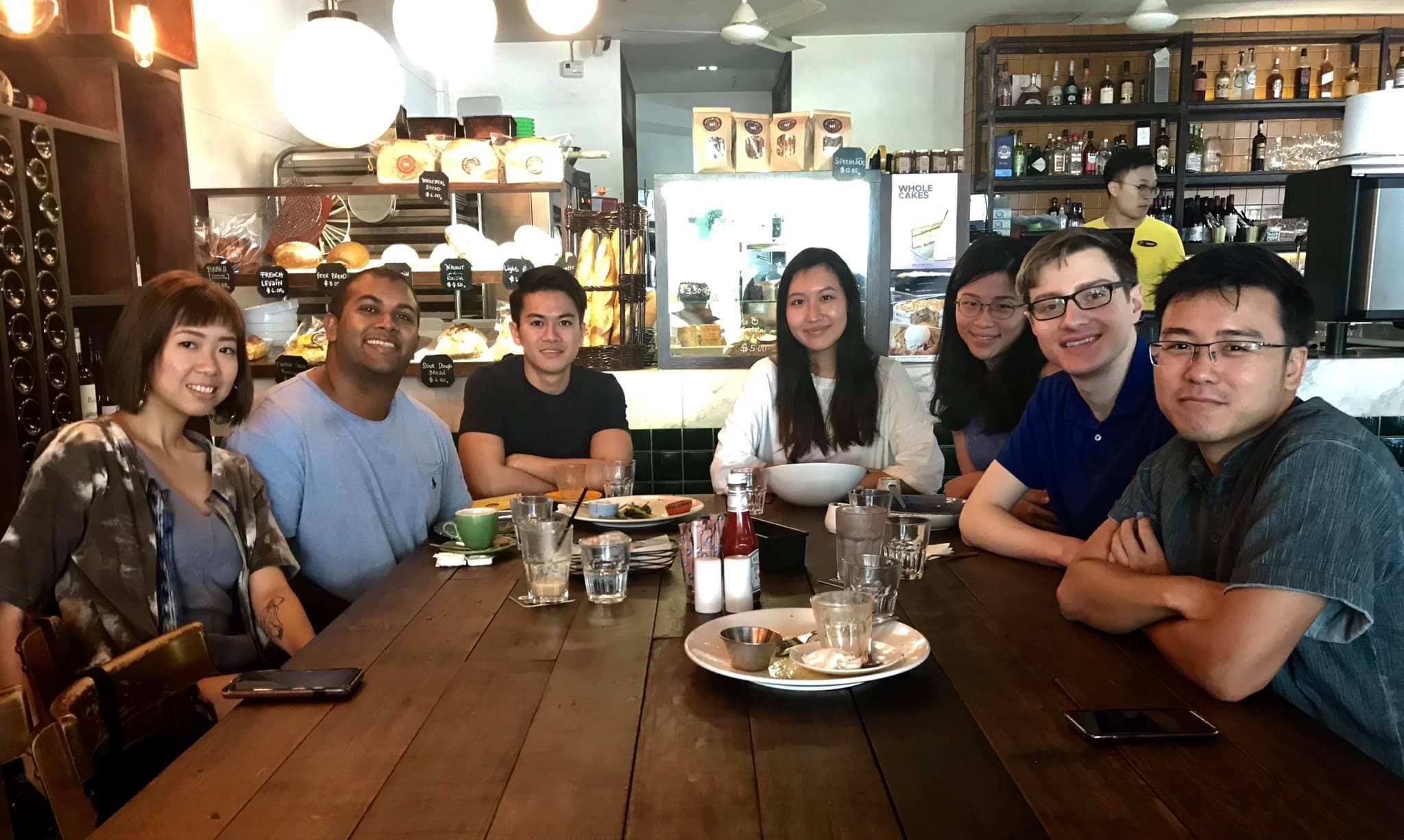
Many that I spoke to seemed reserved to the determinism of Singapore-brand pragmatism and security. I wanted to figure out what a model for conversations in Singapore could look like so I decided to host monthly brunches where I bring together six friends from different circles to dialogue, debate and discuss difficult topics. I hosted my first one yesterday and I was thrilled by the level of conversation and openness brought to the table. There were dynamics operating at multiple levels. At the simplest interface, people were sharing their views and listening to others. At a level that I was most interested in, people were engaging in the mechanics of conversation, identifying logical assumptions and calling out necessary corollaries. At a more sentimental level, my friends were connecting with each other and benefitting from the diversity of community I had always aspired to build. As with most endeavors, I wanted to document and track some of my key reflections. This blog series is my attempt to do that.
For the record, these are the topic summaries I recalled from brunch:
- Carnism and its relation to veganism, bioethics and alternative proteins
- Religious congregation and practice at work, and the extent to which we endorse power concentration
- The ethics of reproduction, especially if agency is a moral prerogative
I won’t dive into these topics here mainly because they’re all incredibly dense but if you want to hear what I learned, hit me up over a coffee or a beer. What I do want to talk about are some Singapore-specific interim conclusions I came to that are purely a result of these chats.
Disclaimer: While the below ideas were derived from conversations with my peers and friends, these ideas can only be represented as my own. Even there, these are my ideas at this point in time, as I continue to audibly process them.
Power and Morality
I’ve always had an issue with the concentration of power. Humanity has demonstrated time and time again that absolute power corrupts absolutely – that those who feel the need to “protect power” from the immoral are themselves willing to forgive certain wrongs for their own claim to what is right. It is also why I have increasingly become a fan of productive tensions – checks and balances that are set up to provide a limit to the power that can be concentrated.
For checks and balances to work, however, the group to be checked must firstly be observable and impact-able and must secondly, be willing to participate in good faith terms with the overall system. Singapore prides itself on the rule of law and the prevention of abuses as it has defined them. So, for the most part, we do see checks and balances do a lot of the work here that other countries could not realistically employ – financial regulation, racial justice, explicit political corruption prevention. These are baseline domains that we have recognized the pragmatic need for checks and balances – that the law must reflect the protection of certain standards and rights such that no one can harm or abuse one another.
However, there is a section of moral policy in Singapore in which I am skeptical of the employment of checks and balances. In areas such as family issues, religious practice, sexuality, and gender, we frequently see the sensitization and even submission of power to those with religious authority or influence. It is one thing to recognize the stakeholders of such moral policies and the need to involve them in discussions but it is another thing to allow such policies to be shaped heavily by them. In this brunch chat, I was able to interrogate my skepticism and recognize that it wasn’t the religious influence itself that interested me (because one cannot blame a Christian religion, for example, for following its teachings of spreading its gospel) but the interplay of such influence with the concentration of power.
I can only speak anecdotally but I have been privy to the employment of professional networks and public platforms by those in morally conscious circles to advance their messages and multiply their reach. This is an experience supported by other peers. What troubles me is the deceptive strategics of such measures that cannot be checked and balanced. In a country like Singapore, where networks are so dense and inequalities are stark, can the proliferation of such power strategics create a moral policing that is inescapable?
Some of the underlying issues here are not massively unique to Singapore. One only need to look at our neighbor, Malaysia, to see how Islam plays a directive role in moral policing. However, in some ways, I admire how the power mechanics in Malaysia is observable and tractable (at least more than here). In Singapore, it seems the game of power may be one of shadows and swords and that is not something we want. There is, of course, a high degree of sensitivity in this topic so if you want to talk more about this, private chats are in order.
Principles and Consequences
A slightly more palatable conversation perhaps is the implicit bias in Singaporean moral frameworks towards consequentialist theories. Maybe Simon Sinek has rubbed off on me too well but I start every exploration with the Why? Why is something a good idea? Why is it right or wrong for something to be? These are much more aligned with deontological thinking, popularized by the likes of Kant.
Consequentialists measure the moral value of a decision by its outcome while deontologists measure it by its imperative. There are intuitively some areas in which deontological thinking is frustratingly unhelpful and others in which consequentialist thinking is tyrannical. What I realized over the course of brunch was that the position a lot of Singaporeans have taken is to purely focus on consequentialist evaluations of policies and phenomenon and have taken satisfaction in their defensibility. Most of these fall under the umbrella of utilitarian defenses normally employed (e.g. social stability).
I realized this had been a big source of my frustration. I was arguing on the terms of rights and imperatives while my discussion partners were arguing on the terms of utility and pragmatism. I became aware that we had not even identified if either of the moral views were appropriate for the discussion and had just jumped into discussing past each other.
This birthed a new area of inquiry for me – how do we carve our spaces in Singaporean policy that depend upon imperatives (e.g. the Woman’s Charter maybe) and others that depend upon utilitarian pragmatism (national defense perhaps). I am curious to see what ideas people have – again, reach out if this interests you
___
Group sessions like these are vibrantly helpful for discussions because the dynamics extended beyond the 1-1 create space for new insights. How people form consensus and camps, in the presence of a given plurality of ideas, is a very strong spark for understanding how Singapore has come this way. I’m looking forward to future sessions of these brunches. Let me know if you would want to join!