being irish in dublin
It’s been a dream of mine to being on the Irish island during the St Patrick’s season, and so when Ryanair drastically cut its prices during a promotion I put myself on a plane to the Emerald Isle and landed in Dublin. It made me a happy man to realize that a lot of Dublin’s attractions lie inside the domains of pubs and taverns, justifying my continuous exploration of ales and whiskeys. I did my best to take in this truly unique culture where joy and pain are both celebrated in singing, dancing and community living.

The city of Dublin is a smaller city than you’d expect, easily explorable within a day. That being said, every part of the city is embedded in this tapestry of lore, politics and contemporary use. Possibly the best example of that is right in the city center at Ha’penny Bridge. Also known as the Liffey Bridge for running over the Liffey River, Dublin’s main river, the bridge gets its other name from the fact that folks used to be charged half a penny (ha’penny) for crossing the bridge. There’s a story involving a ferryman, legal oversight and a lot of pennies somewhere that is worth reading, but the bridge is just one of many key story heavy artefacts in the city. Language is also a fun thing in Dublin, where you’ll see a variation between Gaelic, English and my favorite, Irish English, full of abbreviations and derivations that bewilder you for a second before you get the meaning.


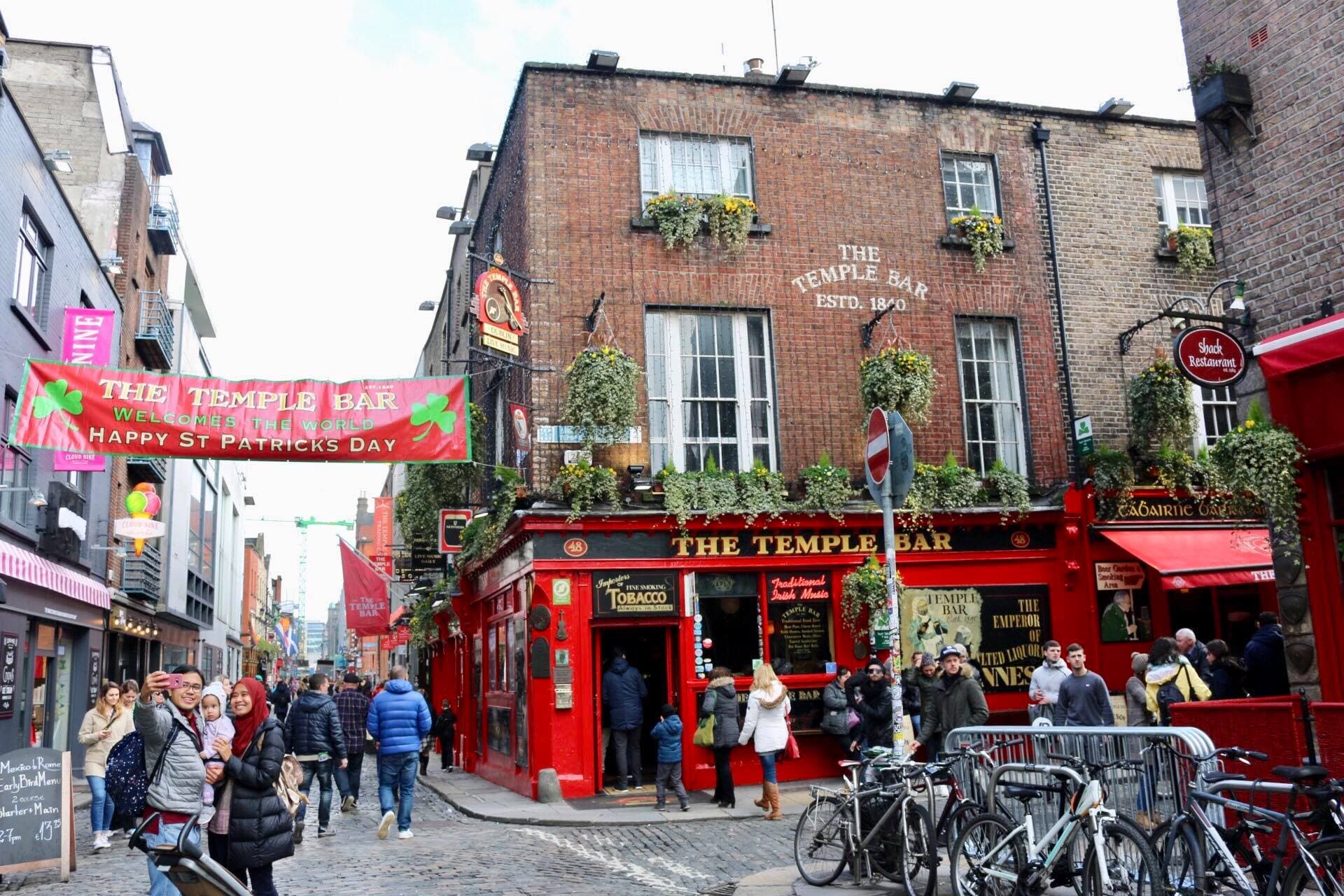
In the city center, you’ll eventually find your way to Temple Bar. This isn’t a specific bar exactly, but rather a watering hole full of Irish pubs and a mix of international restaurants. It is a colourful place though, with cobblestone streets and brick buildings, and at night becomes a boisterous and rowdy venue for locals and tourists alike. Most people end up spending a lot of time at The Temple Bar, in itself historically significant and where there there are multiple rooms, courtyards, patios and memoribilia to famous Irish folk and patrons. This is one of the many historically significant pubs in Dublin and one my absolute favorites.

There are museums in Dublin that speak to the separation of the Republic of Ireland from the UK and walking tours that point to some of the main events and areas surrounding them. The Dublin Spire on O’Connell street is one of those areas, having being built as a replacement centerpiece to the Nelson’s Pillar that was destroyed by irish republicans back in the day. It continues to polarize the locals and I personally found it a continuation of phallic monuments plaguing modern cities, but the history behind the Spire did interest me a lot. If you’re interested in more modern history of Ireland, I’d also look out for museums/tours talking about the great Irish emigration to America. That and the separation from the UK are significant events that continue to shape Ireland’s place in the world.

I don’t normally explore universities as part of my city explorations but Trinity College is definitely both historically (oldest university in Ireland) and aesthetically very desirable as a sightseeing spot. It’s quite remarkable that despite it’s location in the city center and its constant occupancy by both students and tourists, it has a very peaceful calm that strikes you the moment you enter. The college library is probably the most popular attraction for its style and possession of the Book of Kells, but I was put off by the heavy entrance fee.


As a European city, you’ll have to expect churches being a part of the itinerary. Dublin has a good number of cathedrals spread across the city, most of which are expansive and imposing. The Christ Church Catherdral is one of the city’s most important ones, serving as the seat of the Church of Ireland. Apparently its crypt has a mummified rat and cat. St Patrick’s Cathedral is the namesake of Ireland’s saint and is where a lot of Dublin’s events occur. St Patrick’s Cathedral has a pretty nice park in front of it. Both cathedrals age back to medieval times and possess many medieval elements in its architecture.

Speaking of the medieval, there’s nothing more medieval than a castle. Dublin Castle was initially built as a fortification for the Norman kingdom back when Dublin was a part of it but has since evolved to become a place for State dinners and other government functions. It’s also a ticketed tourist attraction. It also sits adjacent to a garden area where the Dubhh Linn (pictured above), or black pool, used to be – the namesake of the city. If you have the time, check out the Chester Beatty Library near be for some interesting exhibits.


The Irish love their drinks, and visitng Dublin wouldn’t be right without checking out the home of Guinness. The Guinness Storehouse is Guinness’s museum and customer loyalty experience, having a mix of exhibits on how Guinness is made and stories of the brand’s evolution. They offer a drink with the ticket which can be redeemed either at their rooftop panorama bar, their Academy (where they teach you how to do a Guinness pour, not that simple) or at their tasting room where you can get a platter of different Guinness varieties. Since I was there around St Patrick’s season, I got to see a lot of performances and was treated to some extra treats so my ticket was very good value. I really enjoyed my time at the Storehouse.

Irish Whiskey stands as a strong category for the country, especially since Ireland is supposedly where whiskey even originated. Triple-distilled and having a mixed of unmalted and malted barley in the pot still phase, Irish whiskey is distinct from all other whiskies and worth trying even for the uninitiated. There are a number of places to check this out – I went to Jameson’s because that’s what I’m used to and wanted a continuation of the brand loyalty I was experiencing after Guinness. Unfortunately this venue is neither a functioning distillerry nor an interesting experience – I was told Teeling’s may be a better alternative that I’ll have to check out when I come back.

If you’re like me and here for St Patrick’s season, aside from the rowdy drinking at Temple Bar, you can expect a bunch of cool events around the city including cultural exhibitions and people starting to dress up. My favorite was the lighting up of the city in emerald green, reminding me that Ireland really has it’s own thing going.

While you’re in Ireland, don’t miss out on catching some live Irish music. Frequently these are middle-aged Irish folk who pull out their instruments and start telling stories of both tragedy and celebration through song. If you’re in the right place, dancing is sure to happen as well. Almost any proper Irish pub is sure to have live music, especially after 9PM so plan ahead to catch some. Time to move onto food!

The Irish do have their own style of cuisine, that often do centre around meat and potatoes. For breakfast, you could have an Irish Fryup which consists of black and white pudding in addition to the English fry-up, but I chose to opt for the healthier Irish porridge. These are made from the coarser steel-cut oats than what most people are used to and are served with fruits, nuts and jams. I really enjoyed my serving at Queen of Tarts, also famous for its cakes and pastries.

Of course, you’ll need to get your hands on some Irish stew (apologies for the fuzzy photo), consisting of freshly sourced local lamb/ mutton and vegetables, stewed over an open fire. The ingredients are Ireland are definitely superior to other places and the stew brings that distinction out strongly. The mashed potatoes are a good touch and the bartenders encouraged me to try the stew with a sweet brown sauce. I was stuffed at the end of the meal but I get why this dish is always recommended. The Brazen Head, Dublin’s oldest pub, serves a really good version of the dish that I’d go back to

Been enjoying Irish potatoes? Try the boxty, an Irish potato pancake served with a beef filet and covered in a peppered cream sauce. While more regional than necessarily Dubliner, the boxty is delicious and one of the lesser known Irish cuisines. The Gallagher Boxty House at Temple Bar specializes in the dish and even does half-portions for those who can’t handle the larger portion sizes.

The last local dish within Dublin I’d recommend is the coddle. Affiliated with the city, this is a soupy dish normally with leftovers. The broth is made from boiling bacon and sausages and comes with potatoes and soda bread on the side. It took some getting used to but the broth is dense and flavorful and it makes for a very filling meal. I had mine at The Woollen Mills which provides great Irish food.
Here are some general tips for the city:
- Ireland uses Euros so don’t get surprised that your sterling pounds don’t get accepted. You can go cashless everywhere here.
- Safety is assured for the most part of the city, the streets are well lit and I didn’t notice any dodgy characters.
- I stayed at the Four Courts Hostel which met only my basic expectations. It was one of the cheaper places I could find so if you’re on a budget, it’ll work for you.
- The Irish are very friendly folk and were a pleasure to interact with, especially in the bars and restaurants.
Of course, seeing Dublin isn’t representative of Ireland as a whole. I didn’t get to spend a lot of time within the Republic but I’d be interested to come back to see the magnificent countryside. Fortunately, I’d be making my way up to Belfast where I had more time to explore the nature, more of which will be shared in my next post. Till then, keep traveling!