a very swiss winter
I had a week to kill before the next semester began and of course, that prompted the question of where to visit next. I had a whole list of countries yet to be discovered and frankly, Switzerland wasn’t high on that list. However, Eddie, my travel buddy, insisted that the country had much to offer and that we wouldn’t be disappointed. I’ll admit the feeling I experienced the most instead was awe – at the mountains, lakes, and landscapes that make up most of Switzerland. From Zurich to Luzern to Interlaken to Geneva, this cross-Switzerland trip gave us a pretty comprehensive view of the magic (and cost) of this country.
There is something to be said about Switzerland before we dive into the cities, which is that a lot of the attractions around here are natural ones. Most of the cities themselves are small and can be seen in one to two days, with a lot more time favored to taking day trips and adventuring. In addition to that, we were on the lookout for what makes the Swiss … Swiss. There’s so much German and French influence on the country, and to a smaller extent, Italian, that it was quite the journey to parse out the uniquely Swiss elements. Some aspects of these will make their way into the post below.
Zurich

Zurich is the capital of Switzerland and frequently associated with banks, expensive lifestyles and the quintessentially German part of Switzerland. I will not lie – it is all of that. But it’s also a quaint pretty city that describes the Swiss concept of living aptly. It embeds itself in the beautiful surroundings and carves a space for itself without imposing too much. The Quaibrücke is the main meeting point of the city, where you can observe Zurich’s intersection of civilization and nature. This waterfront has a jetty that you can walk onto to see the Lake Zurich, where canoeing and boating happen alongside the swans in the area.

Adjacent to the waterfront is one of Zurich’s oldest buildings, the Opera House. In front of it is a giant square where you’ll see all sorts of activities and where chilling is a completely acceptable option. If you want to participate in Swiss high culture, try to catch a show here perhaps.


As a city, Zurich doesn’t really have too much to do, but that doesn’t reduce how beautiful it is. You’ll see spires from various churches, especially the Fraumünsterand the Grossmünster which are also some of the oldest parts of the city and architecturally significant, frame the Swiss mountain regions and compose perfect settings with the bridges and the Limmat river. It’s a good idea here to just enjoy the views and breathe truly fresh air.

Switzerland’s military neutrality has meant that most of the city is kept pristine from any wars or bombings, so you’ll see the old city as it was especially along Münstergasse. Here you’ll walk alongside medieval buildings and under festive banners. It is very possible to imagine yourself transported to old Switzerland here with shophouses that maintain a lot of the old world charm.

While you’re in Zurich and being fancy, it’s perhaps a good idea to check out some of Switzerland’s famous confectionaries, especially those that focus on Swiss chocolate, one of the country’s best exports. The popular ones are Sprüngliand Teuscher. Sprüngli is the same brand as Lindt, which is known better internationally, but both confectionaries go beyond chocolates to have all sorts of pastries and delights. If you do stick to chocolate as I did, remember that Swiss chocolate is famous for its milkiness since it uses dairy from Swiss cows.

Another strong recommendation I have for the fancy time in Zurich is Cafe Schoberwhere you get all sorts of pastries and cakes for your tea or coffee break. The strudle here is to die for and very sinful. I’ve heard other patrons describe the cooked food as just as delightful although getting a seat inside the elaborately Baroque decorated cafe will entail quite the wait during peak hours. You can do as we did and grab a seat on their terrace.
Luzern

An hour away from Zurich is Luzern, a city more medieval and in my humble opinion much more emblematic of the Swiss landscape seen in tourist brochures. Sitting on Lake Luzern, this was one of my favorite locations on the trip just because of the sheer beauty you’re exposed to as you roam the city.


The old city is extremely well preserved and full of hidden turns and squares. You need to spend a lot of time looking up as some of the old buildings have been preserved for a long time and maintain their painted fronts. Most of these buildings are made partially from timber and you can see it as you go through.

The main attraction within the city itself is the Chapel Bridge, which is supposed to be Europe’s oldest covered bridge. Connecting a water tower to the banks, this bridge is maintained even after a fire partially destroyed it, and has murals within it pointing to both religious and historical moments. This is one of the more unique medieval attractions I’ve come across and a very special part of Luzern.

Northeast of the city center is theLion Monument, which commemorates the Swiss soldiers who were massacred during the French Revolution. It’s a very powerful sculptural take on lions in the way they embody warriors, in that it’s a much more mournful and poetic view of them compared to the normally regal and imposing stance they’re made to embody. The whole monument park is very reflective and worth visiting.


Luzern is a launchpad for many mountain trips. The best one according to the various travel blogs and communities is Rigi Kulm. Part of the Schwyzer Alps and known as Queen of the Mountains, this is a culturally significant mountain having been visited by royalty and literary heroes such as the Queen and Mark Twain. You can get a bundled ticket from the Luzern Ferry terminal that covers a ferry ride (this is a really cool ride on the lake with beautiful views) and a cog train ride up. I strongly recommend checking the weather forecasts and planning for bad weather, especially in the winter as we got stuck in heavy winds up on the peak and saw chaos ensue as the whole mountain was shut down. The views were astounding until the moment we were trapped indoors but I can imagine coming on a good day will do one much better.

While you’re in Luzern, find your way to have a traditional German-Swiss meal of Rosti. These are potatoes made as they were by farmers in German Switzerland and is one of the more uniquely Swiss cuisines present. Des Alpes Restauranton the riverfront is a great location for these at comparatively affordable rates. Their fig mustard is amazing also.
Interlaken, Unterseen, Lauterbrunnen

My other favorite part of Switzerland is Interlaken, sitting as the name puts it, between two lakes. These are the Lakes Thun and Brienz. Interlaken is the gateway to the Swiss Alps as we know it and a very beautiful city by itself. Elevated higher above sea level than most other cities, Interlaken has all of the features of a mountain town that people crave: fresh air, cool temperatures and access to higher land.

It’s important to note that Interlaken itself has very few buildings or sights that are unique. What is spectacular is the access to adventures. You can go hiking, paragliding, trekking amongst other activities all from within the town, and access the slopes for skiing or snowboarding. If you just want to catch the paragliders, Höhematteis the place to do some viewing.

Built in 1133, the monastery turned church of Schlosskirche is one of the city’s few buildings that are worth taking a walk to. Not only for its stunning positioning against a backdrop of mountains, the church bleeds history.

Interlaken and the surrounding region is also where you will find the most ‘Swiss’ parts of the country. As written previously, the east is strikingly German and as you’ll see later on, the west is obviously French. Finding what is truly Swiss became more and more of a mystery till we reached Interlaken. In the summer, you will be able to find people performing on the Alphorn. In the winter, you’ll have to make due with these picturesque Swiss-style alpine cabins.

From Interlaken, you can make a number of trips out on the lakes. Canoeing, sailing and water skiing are all viable options, especially on the Lake Brienz, but the Lake Thun has more concrete sights such as the Oberhofen Castle. You can take a public bus out here to visit the smaller cities and on a nice day, have a coffee or tea outdoors. All in all, there’s more to see than just Interlaken itself.


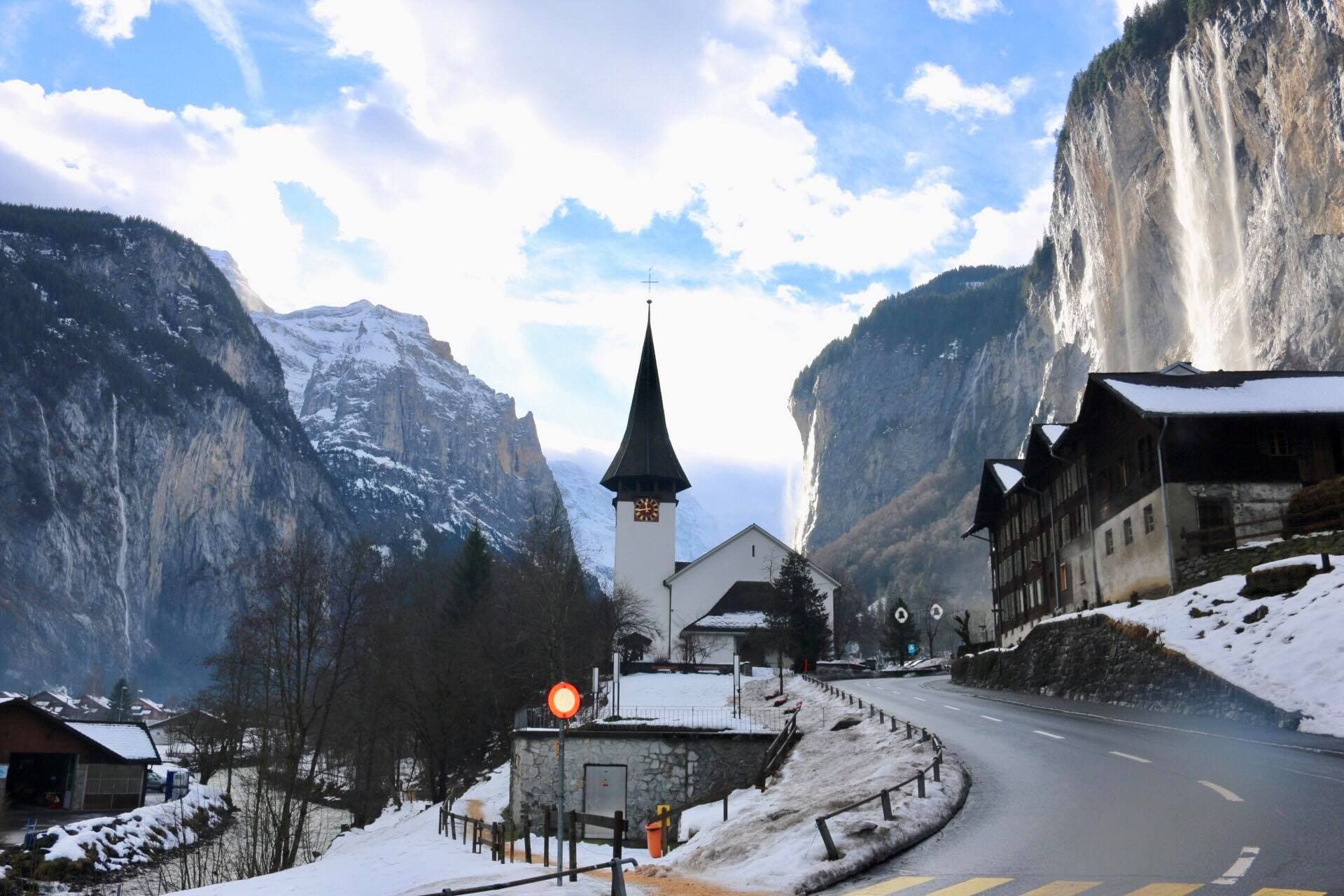
The trip that I highly recommend everyone to take is the one to Lauterbrunnen, even further up in altitude and where ski lifts up to the famous viewing points for Jungfrau, Monch and Eiger start. What’s unique about the town is how it’s flanked by cliffs that have waterfalls on them as well as an enjoyable river to walk along. This is the location for some of the most picturesque parts of Switzerland and another reminder of what makes this country so unique.

When it comes to food, you can’t go wrong with some Swiss raclette. This is a semi-hard cheese that is melted and served over food such as potatoes, gherkins or untraditionally in my case, burgers. You can get them at any Swiss style tavern or restaurant. Up in the mountains, the raclette does well for the soul.

Speaking of doing good for the soul, getting a chocolate fondue with Swiss milk chocolate is a delight. Note that this isn’t traditional Swiss cuisine and some locals scoff at the ‘abomination’, but as long as good ingredients go with good techniques I’m a happy man and this fondue does me well.

Another Swiss food item that doesn’t strike one as extremely Swiss is muesli. Raw rolled oats mixed with dried fruit and nuts, this is a popular breakfast item and was developed by a Swiss physician for his patients. You’ll see it everywhere on breakfast menus around the country so know everytime you eat it that this is a Swiss invention.

When it comes to dessert, a unique dish is the Swiss Vermicelli, made out of chestnut and normally served on whipped cream or meringues. You don’t have to go too far to find these tasty treats though. Migros, a national grocery chain sells this at approximately 3 Swiss Francs.
Geneva

Heading even further west and all the way to the edge of Switzerland, one will find their way to Geneva. It is quite a striking difference on the trains as the language switches from German to French without any notice. The city is also distinctly different from both Interlaken and Zurich/ Luzern, possessing a strong French charm. The Genevan Jet d’Eauis the centerpiece of the city (although Zurich has a less famous one as well), and a popular waterfront sight.


The Old City itself is classically French in its twists and turns, with entrance columns and open squares. The St Pierre Cathedral is a popular destination within the city, where Protestant Reformation leader John Calvin went.

My favorite spot in the city is the Promenade des Bastions, a giant park where the University of Geneva and the Reformation Wall are. Amongst all of it are these giant chess boards where locals and travelers alike are found challenging each other to a game of intellect. It’s worth spending a good time here.

The Plainpalaisis a giant open area near the center of the city, where flea markets and all kinds of fairs and carnivals occur. It is worth checking online what’s going on that day and to get a glimpse of local life.

Another cool icon of Geneva is the flower clock, near the waterfront. This is a functioning clock where the clock face is made up of hedges and flowers. It’s actually pretty cool, and interesting especially when you’re taking a stroll around the park.
Due to our limited time and the fact that we were there in the first week of January, there are a number of other iconic Genevan attractions that we couldn’t visit. Geneva is home to many important international organizations such as the UN and the Red Cross, both of which you should make the time to visit if you can. If you’re an engineering geek like me, you’d want to see if you can book a slot on the CERN tour that happens regularly to see where contemporary science is making breakthroughs. Finally, if you came to Switzerland for watches, Geneva is home to the big brand sellers and also a cool Patek Phillipe watch museum where you can learn how Swiss watches are made.

For food, indulge in a beautiful cheese fondue here in Geneva. It’s reputed that aside from the cheese towns themselves, Geneva is the best place to get a good cheese fondue. The Moitié-moitié Fondue is especially famous, being made half with gruyere and half with vacherin. It’s exactly what you’d want from good cheese – creamy, punchy and rich. The place I’d recommend for this is Les Amures, which Bill Clinton himself patronized.
____
Here are some general tips for Switzerland:
- As you’d have noticed, I didn’t eat out as much as I normally do. Costs in Switzerland are high and everyone’s aware of it, including the Swiss. Find your local Aldi, Denner or Lidl for extremely cheap groceries that you can stretch over a couple of meals.
- Transportation in Switzerland is also expensive, especially intercity. Book ahead for intercity trains to take advantage of Supersaver tickets. If you’re doing really long distance trips, Swiss citizens have the ability to buy for you a special ticket that allows all day travel. This turns out to be on average cheaper than a long-distance train ticket and is much better. Public transportation is readily available in most cities, although they tend to be pretty walkable as well.
- Not much to worry about safety in this country. Not only do you not get the sense that crime abounds, there aren’t even homeless people in sight which either points to a strong welfare system or a really good coverup.
- I did not need to pay for much in cash here, so carrying a card is fine for the most part.
- Accommodation-wise, Switzerland actually has a really good Couchsurfing community that is worth exploring. Within Interlaken, Balmers Hostel is an institution that is good to check out.

I have to say, this trip would not have been the same without good friend Eddie who braved some of the strongest mountain winds with me and who made cooking meals to avoid expensive food much more enjoyable. Will I ever come back to Switzerland? Perhaps in the summer. Till then, I’ll hold on to the memories of these beautiful scenes.